Today
+0.06%
5 Days
+0.18%
1 Month
-0.52%
6 Months
-2.32%
Year to Date
-4.39%
1 Year
-6.47%
Opening Price
6.665Previous Closing Price
6.665
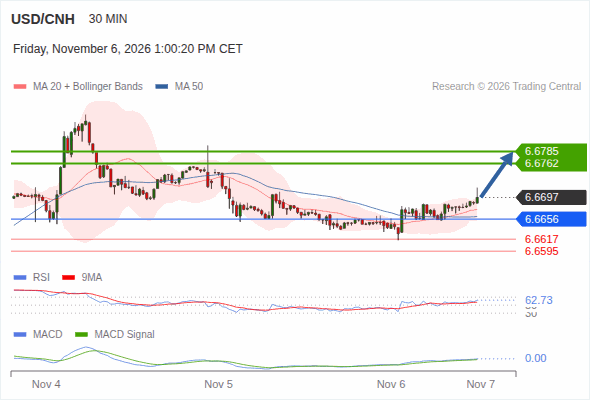
The upside prevails as long as 6.6656 is support, with 6.6762 and 6.6785 as targets
below 6.6656, expect 6.6617 and 6.6595.
The upside prevails as long as 6.6656 is support, with 6.6762 and 6.6785 as targets
On Friday, the People’s Bank of China (PBOC) sets the USD/CNY central rate for the trading session ahead at 6.7168 compared to the previous day's fix of 6.7156.
Societe Generale analysts Frank Benzimra, Michelle Lam and Kiyong Seong argue that the renminbi is nearing its peak as the PBoC pushes back against one-sided CNY strength. They expect USD/CNY to bottom at 6.60 in 1Q27, citing higher FX reserve requirements and potential fixing adjustments as key tools. Domestic liquidity and low inflation support slightly lower Chinese rates.
OCBC’ strategists Sim Moh Siong and Christopher Wong expect USD/CNH to consolidate as Chinese policymakers temper rapid Renminbi (RMB) gains.
The People’s Bank of China (PBOC) sets the USD/CNY central rate for the trading session ahead on Thursday at 6.7156 compared to the previous day's fix of 6.7180 and 6.6783 Reuters estimate.
MUFG notes that the People's Bank of China (PBoC) raised the FX reserve requirement ratio to 6% from 4% after USD/CNY moved toward 6.65, effective 15 November. The measure is seen as locking up about USD24 billion in FX liquidity and aiming to slow CNY appreciation rather than reverse it.
Commerzbank’s Charlie Lay and Dr. Henry Hao highlight that the People’s Bank of China raised the FX reserve requirement ratio to slow rapid CNY gains after a 13-session winning streak. They stress the move is counter-cyclical, aimed at preserving two-way flexibility rather than reversing the appreciation trend, and note USD/CNY and USD/CNH both bounced to 6.67 on the announcement.
The Indicators feature provides value and direction analysis for various instruments under a selection of technical indicators, together with a technical summary.
This feature includes nine of the commonly used technical indicators: MACD, RSI, KDJ, StochRSI, ATR, CCI, WR, TRIX and MA. You may also adjust the timeframe depending on your needs.
Please note that technical analysis is only part of investment reference, and there is no absolute standard for using numerical values to assess direction. The results are for reference only, and we are not responsible for the accuracy of the indicator calculations and summaries.