Indicators
Indicators
Value
Direction
MACD(12,26,9)
-0.176
Neutral
RSI(14)
51.408
Neutral
STOCH(KDJ)(9,3,3)
53.815
Buy
ATR(14)
0.835
Low Volatility
CCI(14)
-29.771
Neutral
Williams %R
37.722
Buy
TRIX(12,20)
0.013
Sell
StochRSI(14)
88.677
Buy


Today
+0.25%
5 Days
-0.37%
1 Month
+0.39%
6 Months
-0.91%
Year to Date
+0.74%
1 Year
+3.35%
Opening Price
157.445Previous Closing Price
157.478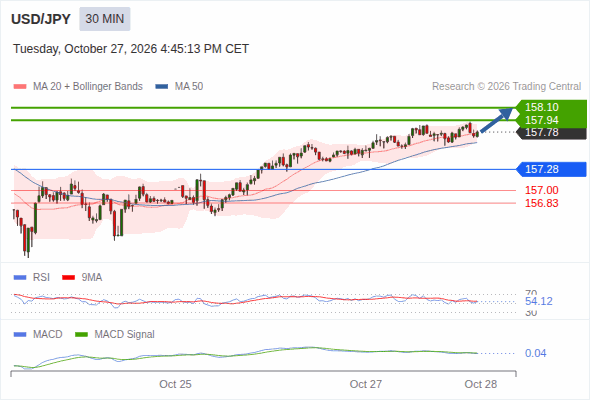
The upside prevails as long as 157.28 is support, with 157.94 and 158.10 as targets
below 157.28, expect 157.00 and 156.83.
The upside prevails as long as 157.28 is support, with 157.94 and 158.10 as targets
USD/JPY edges higher on Tuesday as last week’s AI-related worries subside, reducing the Japanese Yen’s (JPY) safe-haven appeal and helping the US Dollar (USD) resume its uptrend ahead of the Federal Reserve’s (Fed) monetary policy decision on Wednesday.
OCBC’s Sim Moh Siong and Christopher Wong highlight that the Japanese Yen (JPY) is regaining relevance as a portfolio hedge amid shifting AI-related market risks.
Halpenny at MUFG notes renewed Japanese Yen weakness, with USD/JPY seen vulnerable to further gains as markets await comments from BoJ Governor Ueda.
United Overseas Bank’s (UOB) Quek Ser Leang and Lee Sue Ann report that USD/JPY rebounded sharply to 157.64 instead of consolidating, with the move seen as overdone and likely to lead to intraday range-trading between 156.90 and 157.80. On a 1–3 week view, the earlier strong downside momentum is slowing, and a break above 157.80 would signal a shift into a range-trading phase rather than further declines, though the broader 1–3 month outlook still points to downside risks.
The Japanese Yen (JPY) continues to underperforms its peers amid caution ahead of the Bank of Japan’s (BoJ) monetary policy announcement on Friday. In the European trade on Tuesday, the US Dollar (USD) is up 0.22% at around 157.80 against the Japanese currency.
The USD/JPY pair trades with a positive bias for the third straight day on Tuesday, recovering further from an over one-month low, around the 156.00 neighborhood, touched last week.
The Indicators feature provides value and direction analysis for various instruments under a selection of technical indicators, together with a technical summary.
This feature includes nine of the commonly used technical indicators: MACD, RSI, KDJ, StochRSI, ATR, CCI, WR, TRIX and MA. You may also adjust the timeframe depending on your needs.
Please note that technical analysis is only part of investment reference, and there is no absolute standard for using numerical values to assess direction. The results are for reference only, and we are not responsible for the accuracy of the indicator calculations and summaries.