
Gold
3994.770
Today
-0.72%
5 Days
-4.10%
1 Month
-6.55%
6 Months
-15.18%
Year to Date
-7.38%
1 Year
-2.83%
TradingKey Timing Strategy - Gold
TK Alpha generates a daily timing score ranging from -100 to +100 and maps it to long, flat, short, or leveraged positions. The score reflects both the strategy’s directional view and the strength of its target exposure.
Alpha Gauge
The TK Alpha Gauge is a proprietary, comprehensive daily updated indicator developed by Tradingkey that reflects our outlook on specific financial instruments. Utilizing a long-proven AI framework, the index analyzes hundreds of proprietary price-volume, fundamental, and alternative data predictors. Values range from -100 to 100. Negative values signify a bearish (pessimistic) outlook, while positive values indicate a bullish (optimistic) stance. The further the value from zero, the stronger the quantitative signal. It provides quantitative insight into directional forecasts.
Strategy Data
Historical Return

Gold Trading Strategy
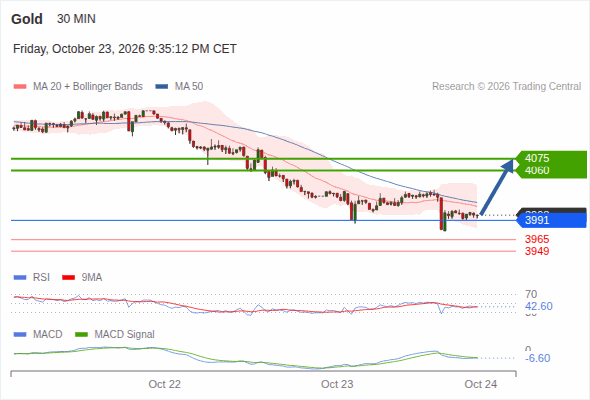
Trading Strategy
Rebound above 3,991 towards 4,075
Alternative scenario
below 3,991, expect 3,965 and 3,949.
Comment
Rebound above 3,991 towards 4,075
Gold (XAU/USD) price prolongs its agony, tumbling by nearly 0.60% on Friday and poised to finish the week with losses as higher energy prices increase the chances that major central banks could tighten monetary policy to control inflation.
OCBC strategists Christopher Wong and Sim Moh Siong highlight renewed weakness in Gold despite falling US Treasury yields and rising geopolitical risks. They note that surging Oil prices are reviving inflation concerns and expectations of prolonged restrictive Fed policy, weighing on Gold. They remains cautious, saying easing Oil prices, lower real yields and a better price response are needed for Gold to regain traction near term.
Gold (XAU/USD) attempts a recovery above the $4,000 mark on Friday after slipping to $3,986 during Asian trading hours, its lowest level since July. The rebound comes as dip buyers step in following Thursday’s sharp sell-off, when the metal lost 2.81%.
Gold (XAU/USD) is practically flat on the daily chart, just below $4,030 on Friday after bouncing up from 3-month lows in the $4,000 area.
ING analysts Warren Patterson and Ewa Manthey report Gold failed to benefit from the equity sell-off and falling US Treasury yields, with spot prices down 2.8% and nearing $4,000/oz. They argue the Gold market is focused on higher Oil prices and their inflation implications, which could reinforce tighter central bank policy while US inflation remains above the 2% target.
Gold (XAU/USD) rebounds slightly after dropping to a fresh three-month low, below the $4,000 psychological mark during the Asian session on Friday, though the upside seems limited. The Federal Reserve (Fed) recently signaled that there is no urgency to raise interest rates.
About Gold
How can I start investing in gold as a beginner?
For beginners, there are two main paths:
- Paper Gold: Investing inGold ETFs (Exchange-Traded Funds)or mutual funds. These track the price of gold and can be bought through a standard brokerage account without the need for physical storage.
- Physical Gold: Buyingbullion coinsorinvestment-grade bars(at least 99.5% purity). This offers direct ownership and no counterparty risk but requires secure storage.
Gold Bullion vs. Gold Mining Stocks: Which is better?
Whether gold bullion or gold mining stocks is the better investing option, it all boils down to your investing goals.
Gold bullion is best for wealth preservation and safety. It tracks the spot price of gold directly.
As for mining stocks, they offer leverage. When gold prices rise, mining company profits often grow at a faster rate, potentially leading to higher returns and dividends. However, they carry "management risk" and are more closely correlated with the broader stock market.
Method | Best For | Liquidity | Storage Needed? |
|---|---|---|---|
Physical Gold Bullion | Long-term security | Moderate | Yes |
Gold ETFs | Easy to trade | High | No |
Mining Stocks | Growth and income | High | No |
Digital Gold | Small budget investing | High | No |
What is the price of Gold today?
What is the trading range of Gold futures today?
What is the 52-week price range of Gold futures?
Why does Gold rise or fall?
What is the highest price of gold in history?
The gold price peaked at US$5,602.225 per ounce on January 29, 2026. This is the fresh all-time high price of gold.
What factors affect gold's price?
When investing in gold, it is important to understand the factors affecting gold price.
Central Bank Policies
Central Banksplay a pivotal role in determining gold price today. Their interest rate decisions and gold purchase programs significantly shape the market landscape.
When central bank lowers interest rates, causing negative real returns on cash and bonds, investors will move to gold as an alternative asset.
Geopolitical and Economic Events
Gold priceis also affected by geopolitical events. In times of uncertainty and crisis, such as wars or economic upheaval, gold becomes a safe haven for investors.
Market Dynamics
Variables like gold production, jewelry demand, and investment flows affects the demand and supply for gold.