tradingkey.logo

AUD/NZD

AUDNZD
View Detailed Chart

1.166USD

+0.002+0.13%
Time
1m
15m
30m
1h
4h
D
W
D

Today

+0.13%

5 Days

+0.84%

1 Month

+0.12%

6 Months

+6.39%

Year to Date

+0.66%

1 Year

+5.35%

View Detailed Chart

Key Data Points

Opening Price

1.165

Previous Closing Price

1.165
Price Range of the Day
1.1631.166
52-Week Price Range
1.0631.169

Indicators

The Indicators feature provides value and direction analysis for various instruments under a selection of technical indicators, together with a technical summary.

This feature includes nine of the commonly used technical indicators: MACD, RSI, KDJ, StochRSI, ATR, CCI, WR, TRIX and MA. You may also adjust the timeframe depending on your needs.

Please note that technical analysis is only part of investment reference, and there is no absolute standard for using numerical values to assess direction. The results are for reference only, and we are not responsible for the accuracy of the indicator calculations and summaries.


1m
5m
15m
30m
1h
2h
4h
D
W
M
1m
5m
15m
D
Buy
Sell(1)
Neutral(2)
Buy(8)
Indicators
Sell(1)
Neutral(2)
Buy(2)
Indicators
Value
Direction
MACD(12,26,9)
0.000
Buy
RSI(14)
58.992
Neutral
STOCH(KDJ)(9,3,3)
77.709
Neutral
ATR(14)
0.006
Low Volatility
CCI(14)
129.907
Buy
Williams %R
19.306
Overbought
TRIX(12,20)
0.017
Sell
StochRSI(14)
80.392
Overbought
Moving Average
Sell(0)
Neutral(0)
Buy(6)
Indicators
Value
Direction
MA5
1.162
Buy
MA10
1.161
Buy
MA20
1.160
Buy
MA50
1.154
Buy
MA100
1.147
Buy
MA200
1.119
Buy

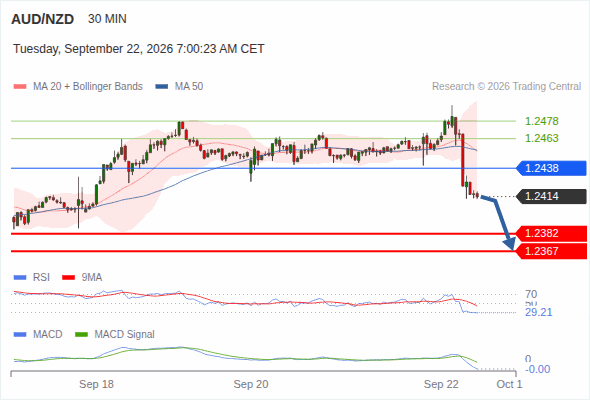
AUD/NZD Trading Strategy

Intraday
Short Term
The configuration is positive.

Trading Strategy

The configuration is positive.

Alternative scenario

below 1.1643, expect 1.1625 and 1.1614.

Comment

the upside prevails as long as 1.1643 is support

14 hours ago
Source: Trading Central(Reference Only)

AUD/NZD News

AUD/NZD climbs to near 1.1630 as RBA raises interest rates by 25 bps to 3.85%

The AUD/NZD pair jumps to near 1.1630 during the Asian trading session on Tuesday. The pair gains sharply as the Australian Dollar (AUD) strengthens after the Reserve Bank of Australia (RBA) raises interest rates by 25 basis points (bps) to 3.85%, as expected.

FxstreetTue, Feb 3
The AUD/NZD pair jumps to near 1.1630 during the Asian trading session on Tuesday. The pair gains sharply as the Australian Dollar (AUD) strengthens after the Reserve Bank of Australia (RBA) raises interest rates by 25 basis points (bps) to 3.85%, as expected.

AUD: Strength supported by rate hike expectations – HSBC

HSBC reports that the Australian Dollar (AUD) is being supported by domestic factors, including expectations of rate hikes from the Reserve Bank of Australia (RBA) in 2026. The RBA is anticipated to begin tightening on February 3, with markets pricing in a significant chance of this move.

FxstreetMon, Jan 26
HSBC reports that the Australian Dollar (AUD) is being supported by domestic factors, including expectations of rate hikes from the Reserve Bank of Australia (RBA) in 2026. The RBA is anticipated to begin tightening on February 3, with markets pricing in a significant chance of this move.

AUD and NZD eyed amid global growth and commodity ties – Rabobank

Since both the New Zealand Dollar (NZD) and the Australian Dollar (AUD) have links to commodities, historically they have been viewed as ‘risky’ currencies which tend to rally when growth prospects are strong and vice-versa, Rabobank's FX analyst Jane Foley reports.

FxstreetWed, Jan 21
Since both the New Zealand Dollar (NZD) and the Australian Dollar (AUD) have links to commodities, historically they have been viewed as ‘risky’ currencies which tend to rally when growth prospects are strong and vice-versa, Rabobank's FX analyst Jane Foley reports.

AUD/NZD slides to near 1.1440 as RBA holds OCR steady at 3.6%, as expected

The AUD/NZD pair falls sharply to near 1.1440 as the Reserve Bank of Australia (RBA) has kept its Official Cash Rate (OCR) steady at 3.6%. The RBA was expected to do so as inflation in Australia grew at a faster pace in the third quarter of the year.

FxstreetTue, Dec 9
The AUD/NZD pair falls sharply to near 1.1440 as the Reserve Bank of Australia (RBA) has kept its Official Cash Rate (OCR) steady at 3.6%. The RBA was expected to do so as inflation in Australia grew at a faster pace in the third quarter of the year.

AUD/NZD tumbles to near 1.1430 as RBNZ cuts OCR by 25 bps to 2.25%, as expected

The AUD/NZD pair slides vertically to near 1.1430 during the Asian trading session on Wednesday. The pair faces intense selling pressure as the Reserve Bank of New Zealand (RBNZ) has cut its Official Cash Rate (OCR) by 25 basis points (bps) to 2.25%.

FxstreetWed, Nov 26
The AUD/NZD pair slides vertically to near 1.1430 during the Asian trading session on Wednesday. The pair faces intense selling pressure as the Reserve Bank of New Zealand (RBNZ) has cut its Official Cash Rate (OCR) by 25 basis points (bps) to 2.25%.

AUD/NZD slips near 1.1500 as New Zealand’s Trade Deficit YoY narrows in October

AUD/NZD loses ground for the second successive session, trading around 1.1520 during the Asian hours on Friday.

FxstreetFri, Nov 21
AUD/NZD loses ground for the second successive session, trading around 1.1520 during the Asian hours on Friday.

More Details of AUD/NZD

The AUDNZD is a currency pair that consists of the Australian Dollar (AUD) and the New Zealand Dollar (NZD). It is one of the major currency pairs that are traded in the forex market. The AUDNZD pair is known for its volatility and is often influenced by economic indicators and events that affect both the Australian and New Zealand economies. Traders who are interested in the commodity sector often monitor this pair because both economies are heavily dependent on commodity exports. The AUDNZD is also used as a carry trade instrument, where traders borrow in a low-interest-rate currency to invest in a higher-interest-rate one.

How does the economic calendar impact AUDNZD trading?

The economic calendar is a schedule of economic events that can influence the financial markets. For AUDNZD trading, economic indicators such as GDP, employment data, inflation rates, and interest rate decisions from both Australia and New Zealand can cause significant volatility. Traders monitor the economic calendar to anticipate potential market movements and adjust their trading strategies accordingly.

What technical indicators are commonly used for AUDNZD trading?

Traders use a variety of technical indicators to analyze AUDNZD and make trading decisions. Common indicators include moving averages (simple, exponential), relative strength index (RSI), Fibonacci retracements, Bollinger Bands, and the stochastic oscillator. These tools help traders identify trends, reversals, and overbought/oversold conditions in the AUDNZD market.

How does the AUDNZD pair behave in relation to commodity prices?

The AUDNZD pair is sensitive to commodity prices since both Australia and New Zealand are significant exporters of commodities. An increase in commodity prices can strengthen the AUDNZD, while a decrease can weaken it.

Related Instruments

AUD/NZD

1.166
+0.002+0.13%
KeyAI