tradingkey.logo
tradingkey.logo
Search

Silver

XAGUSD
Add to Watchlist

66.936

+1.024+1.55%
TradingKey Chart
Time
1m
15m
30m
1h
4h
D
W
M
Please select

Today

+1.55%

5 Days

+5.91%

1 Month

-2.90%

6 Months

-1.36%

Year to Date

-5.76%

1 Year

+55.48%

TradingKey Timing Strategy - Silver

TK Alpha generates a daily timing score ranging from -100 to +100 and maps it to long, flat, short, or leveraged positions. The score reflects both the strategy’s directional view and the strength of its target exposure.

Alpha Gauge

The TK Alpha Gauge is a proprietary, comprehensive daily updated indicator developed by Tradingkey that reflects our outlook on specific financial instruments. Utilizing a long-proven AI framework, the index analyzes hundreds of proprietary price-volume, fundamental, and alternative data predictors. Values range from -100 to 100. Negative values signify a bearish (pessimistic) outlook, while positive values indicate a bullish (optimistic) stance. The further the value from zero, the stronger the quantitative signal. It provides quantitative insight into directional forecasts.

+11NeutralLast updated: Sep 22, 2026 2:05 AM

Strategy Data

Since Inception+764.13%
Today's Return+0.01%
Annualized+32.33%
Sharpe Ratio1.22

Historical Return

5Y
1M
3M
1Y
3Y
5Y
All History
0.00%Historical Return
No Data

Silver Trading Strategy

Intraday
Medium Term
Short Term
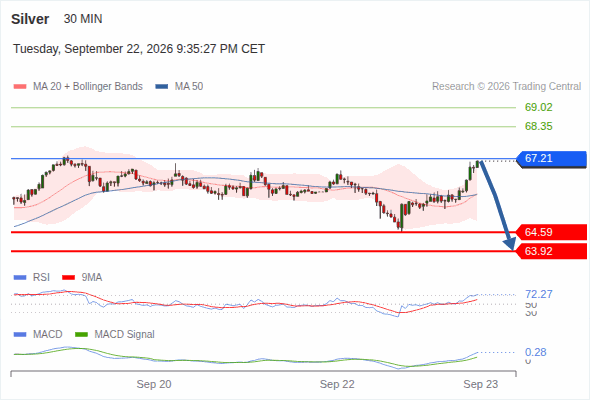
The downside prevails as long as 67.21 is resistance, with 64.59 and 63.92 as targets

Trading Strategy

The downside prevails as long as 67.21 is resistance, with 64.59 and 63.92 as targets

Alternative scenario

above 67.21, look for 68.35 and 69.02.

Comment

The downside prevails as long as 67.21 is resistance, with 64.59 and 63.92 as targets

2 hours ago
Source: Trading Central(Reference Only)
Silver edges lower as demand-led inflation keeps Fed tightening risks in focus

Silver (XAG/USD) declines 0.38% on Tuesday and trades around $65.85 at the time of writing.

Fxstreet7 hours ago
Silver Price Forecast: XAG/USD plummets below $65 on higher-for-longer Fed interest rates narrative

Silver price (XAG/USD) is down 1.75% to near $64.85 during the European trading session on Tuesday. The white metal is under severe selling pressure as Federal Reserve (Fed) officials warn that strong demand is also fuelling upside inflation risks alongwith higher oil prices.

Fxstreet13 hours ago
Silver Price Forecast: XAG/USD sticks to gains near mid-$66.00s; 23.6% Fibo. holds the key

Silver (XAG/USD) attracts fresh buyers following the previous day's two-way price moves and trades around the $66.40-$66.45 region during the Asian session on Tuesday, up nearly 0.50% for the day.

Fxstreet21 hours ago
Silver Price Forecast: 100-day SMA caps bulls as range tightens

Silver price advance stalled at the 100-day Simple Moving Average (SMA) of $66.39 and is set to end Monday’s session with losses of 0.39% as the Greenback rises following last week’s Fed decision. The XAG/USD trades at $66.03 after reaching a high of $67.05.

Fxstreet23 hours ago
Silver price edges up as lower Oil, guarded Fed stance temper upside

Silver (XAG/USD) starts the week on a positive note, gaining 0.37% on Monday to trade around $66.50 at the time of writing. The precious metal manages to advance despite a stable US Dollar (USD), with the US Dollar Index (DXY) trading virtually unchanged around 100.25.

FxstreetMon, Sep 21
Silver price today: Silver broadly unchanged, according to FXStreet data

Silver prices (XAG/USD) broadly unchanged on Monday, according to FXStreet data. Silver trades at $66.22 per troy ounce, broadly unchanged 0.05% from the $66.26 it cost on Friday.

FxstreetMon, Sep 21

About {index_name} Silver

Silver is a chemical element with the symbol Ag and the atomic number 47. It is a soft, white, lustrous metal that has the highest electrical and thermal conductivity of any metal. Silver is used for various purposes, such as making jewelry, coins, electronics, and photography. Silver can form compounds with different oxidation states. Silver also forms alloys with other metals, such as copper, gold, and zinc. Silver has many applications in various fields, such as medicine, industry, art, and science. Silver has antibacterial properties, and is used in wound dressings, dental fillings, and water purification. Silver is also used as a catalyst, a coating, a solder, and a superconductor. Silver has a long history and cultural significance and is associated with purity, elegance, and wealth. Silver is considered a commodity that can be traded in the global market, and a potential investment option for those who seek to diversify their portfolio and hedge against inflation and uncertainty. Some of the common ways to invest in silver are by buying physical silver, such as coins, bars, or bullion; buying shares of silver mining companies or silver streaming companies; buying silver futures or options contracts. Silver is a scarce and valuable metal, with a high demand and a limited supply in the global market. It has a low correlation with other assets, such as stocks and bonds, which can reduce the overall risk and volatility of the portfolio. Besides, It has a high potential for growth and innovation, as it is used in various emerging and expanding sectors, such as renewable energy, biotechnology, and nanotechnology. It also has a high sensitivity to inflation and economic downturns, which can increase its appeal and attractiveness as a safe-haven asset. However silver has high competition and substitution, which can reduce its demand and value in the long term. For example, silver can be replaced by cheaper or more efficient metals, such as copper, aluminum, or platinum.

What is the price of Silver today?

The current price of Silver is 66.94. Market data may be delayed, so please refer to the update time displayed on the page.

What is the trading range of Silver futures today?

The intraday low for Silver futures is 64.55, while the intraday high is 67.53. The trading range for today is 64.55 to 67.53.

What is the 52-week price range of Silver futures?

Over the past 52 weeks, the lowest price of Silver futures was 43.66, while the highest price was 121.59. Historical price ranges reflect past performance only and do not indicate future trends.

Why does Silver rise or fall?

The price of Silver may rise when market demand increases, supply tightens, or inventories decline. It may fall when demand weakens, supply increases, or inventories rise. Macroeconomic conditions, the U.S. dollar, interest rates, weather, policy changes, and unexpected events may also drive short-term price fluctuations.

What is silver all time high?

The silver all time high is $121.67/oz (Jan 29, 2026).

What is the 5 year forecast of silver?

The 5 year forecast of silver price is targeting $140–$200/oz by 2030.

What factors affect the price of silver?

Silver prices are mainly driven by:

  1. Industrial Demand: Silver is significantly used in industrial sectors like solar panels, electric vehicles, electronics and AI hardware.
  2. Investment Demand: Silver is regarded as safe haven against inflation and economic uncertainty.
  3. Monetary Policy and Macroeconomics: Interest rates and U.S. Dollar strength boost or decrease silver prices.
  4. Other Factors: Mining supply constraints, geopolitical tensions and market sentiment are play a role as well.

What is the rate of return for silver?

The rate of return for silver can vary significantly over different time periods. As of the most recent data available, the average annual return for silver over the past decade has been approximately 5% to 10%. However, it is essential to note that past performance is not indicative of future results, and the rate of return for silver can fluctuate based on factors such as supply and demand dynamics, geopolitical events, inflation rates, and overall market sentiment.

What are the top countries that produce silver?

The top countries that produce silver include Mexico, Peru, China, Russia, and Australia. These nations are among the leading global producers of silver, with significant reserves and extraction capabilities. Mexico and Peru are historically known for their high silver production, while China, Russia, and Australia also play key roles in the global silver market. These countries contribute significantly to the world's silver supply

What determines the price of Silver?

The price of Silver is primarily determined by supply and demand in the relevant market and may also be based on quotations from exchanges, market makers, or market data providers. The quoted currency, trading hours, product type, contract maturity, delivery terms, and market liquidity may also affect the price displayed on the page.

How can I analyze Silver price trends?

When analyzing the price of Silver, investors may consider charts across different timeframes, opening prices, highs and lows, support and resistance levels, as well as technical indicators such as moving averages, RSI, and MACD. Market supply and demand, inventories, production costs, macroeconomic conditions, policy developments, and changes in related industries should also be considered.

Are Silver price forecasts reliable?

Price forecasts are generally based on historical trends, technical indicators, market supply and demand, and macroeconomic data, but they cannot accurately predict future prices. Unexpected policy changes, geopolitical events, supply disruptions, and shifts in market sentiment may cause forecasts to become inaccurate. Therefore, forecasts should be used for reference only.

Can I invest directly in Silver?

No. Silver itself is an index and cannot be invested in directly. Investors typically gain price exposure through related spot products, futures, ETFs, CFDs, or shares of companies within the relevant industry chain. Costs, liquidity, leverage, and risks vary across these instruments, so investors should carefully consider market conditions and their own risk tolerance before making a decision.

What is TK Alpha Gauge?

The TK Alpha Gauge is a proprietary, daily updated indicator designed to provide a clear outlook on specific financial instruments. Developed by TradingKey, the gauge acts as a quantitative compass for market direction. Much like how sentiment indices track the "mood" of the market, the Alpha Gauge utilizes a long-proven AI framework to strip away emotional bias and provide a high-conviction forecast based on cold, hard data.

What exactly is an "Alpha"?

An Alpha is a proprietary mathematical formula designed to identify and exploit specific market inefficiencies. Think of it as a quantitative "rule" that has demonstrated a historical ability to forecast price movements. By translating complex market patterns into actionable signals, Alpha provides the statistical edge necessary to consistently outperform the market.

How is TK Alpha Gauge Calculated?

The Gauge is powered by a long-proven AI framework that analyzes hundreds of predictors across three categories: Price-Volume: Historical and real-time movement trends. Fundamentals: Underlying financial health and valuation metrics. Alternative Data: Unique datasets that capture non-traditional market signals. The final score represents the signal's strength; the further the value is from zero, the higher the quantitative conviction.

How often is TK Alpha Gauge calculated?

Every component and the Index are calculated as soon as new data becomes available daily.

How to use TK Alpha Gauge?

The Index serves as a systematic tool to remove emotional bias and determine position sizing. Depending on the asset and strategy, it can be applied in two primary ways: 1. Long-Only Strategy (e.g., GLD) Commonly used for ETFs like GLD, the gauge dictates exposure based only on positive momentum: Positive Reading: Scale long exposure proportionally to the gauge value. Negative Reading: Maintain a flat position (zero lots) to avoid downside risk. 2. Long/Short Strategy (e.g., Gold Futures) In highly liquid markets like gold futures, the gauge allows for active trading in both directions: Bullish (>0): Take a long position, scaling the size as the value moves toward 100. Bearish (<0): Take a short position, increasing the short exposure as the value moves toward -100. Neutral (0): Exit all positions to remain flat during periods of no clear signal.

How does AI improve the investment process?

Unlike static technical indicators, machine learning models recognize complex, non-linear patterns, allowing for more precise predictions of price movements in volatile markets. AI can facilitate the processing of massive dataset and synthesizes hundreds of high-performance predictors to generate meaningful trading signals. Adaptive models continuously learn from live market shifts, automatically tuning strategy parameters to maintain peak performance across different economic regimes.

How do you use Volume and Price together?

We analyze the relationship between price action and market participation (volume) to measure the conviction behind a move. Ideally, price and volume should trend in harmony. Our system is designed to monitor the synergy between these two variables. By identifying the periods of decoupling, our framework can proactively shift to a defensive posture, prioritizing capital preservation.

How does the "Super Alpha" ensemble help me?

Rather than relying on a single “rule”, the "Super Alpha" ensemble aggregates hundreds of diverse predictors across three distinct categories. This creates a robust system: If one predictor is skewed by temporary market noise, the remaining signals provide a stabilizing correction. This multi-predictor ensemble approach is designed to maintain portfolio resilience and steady performance, even during periods of high market volatility.

What are Deep Learning and Neural Networks?

Deep learning is a subset of machine learning that uses highly sophisticated artificial neural networks to model and replicate the way the human brain processes information. At its core, deep learning relies on multi-layered deep neural networks. These networks consist of interconnected nodes (called neurons) organized in multiple layers. Data flows through these layers in a highly connected manner, allowing the model to automatically learn complex patterns and representations from large amounts of data. This architecture makes deep learning particularly powerful for tasks such as prediction, classification, and pattern recognition.

Related Instruments

Silver

66.936
+1.024+1.55%
tradingkey.logo
Risk Warning: Our Website and Mobile App provides only general information on certain investment products. Finsights does not provide, and the provision of such information must not be construed as Finsights providing, financial advice or recommendation for any investment product.
Investment products are subject to significant investment risks, including the possible loss of the principal amount invested and may not be suitable for everyone. Past performance of investment products is not indicative of their future performance.
Finsights may allow third party advertisers or affiliates to place or deliver advertisements on our Website or Mobile App or any part thereof and may be compensated by them based on your interaction with the advertisements.
© Copyright: FINSIGHTS MEDIA PTE. LTD. All Rights Reserved.