1.175USD
Today
+0.51%
5 Days
+0.88%
1 Month
+0.33%
6 Months
+0.49%
Year to Date
+0.01%
1 Year
+12.67%
Opening Price
1.169Previous Closing Price
1.169The Indicators feature provides value and direction analysis for various instruments under a selection of technical indicators, together with a technical summary.
This feature includes nine of the commonly used technical indicators: MACD, RSI, KDJ, StochRSI, ATR, CCI, WR, TRIX and MA. You may also adjust the timeframe depending on your needs.
Please note that technical analysis is only part of investment reference, and there is no absolute standard for using numerical values to assess direction. The results are for reference only, and we are not responsible for the accuracy of the indicator calculations and summaries.


The configuration is positive.
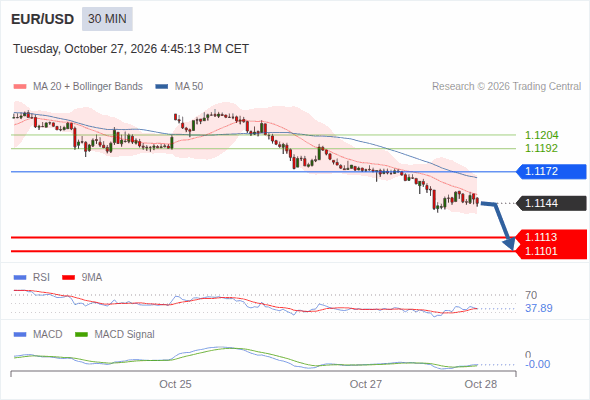
below 1.1709, expect 1.1677 and 1.1658.
the upside prevails as long as 1.1709 is support
The Euro (EUR) edges higher against the US Dollar (USD) on Thursday, supported by a broadly weaker Greenback as traders shrug off solid US economic data. At the time of writing, EUR/USD is trading around 1.1742, reversing the previous day’s losses.

The Euro (EUR) is consolidating within an incredibly tight range and entering Thursday’s NA session flat to the US Dollar (USD), a mid-performer among the G10 currencies in mixed overall trade, Scotiabank's Chief FX Strategists Shaun Osborne and Eric Theoret report.

The accounts of the European Central Bank's (ECB) December policy meeting showed on Thursday that some members of the Governing Council viewed inflation risks as tilted to the downside, per Reuters.

German Buba Monthly Report, released by Deutsche Bundesbank, showed on Friday that the economy will big spending boost in late 2026.

US Dollar (USD) recovered some of this week’s losses mostly versus Japanese Yen (JPY) and Euro (EUR). Cyclical-sensitive currencies are outperforming, led by Australian Dollar (AUD). Global equity markets are up, bond markets are steady, and gold is firm near record highs.

TradingKey - Conflicts between Europe and the U.S. may continue to intensify, potentially placing further downward pressure on the Euro's exchange rate. In the short term, geopolitical risks are likely to continue weighing on the Euro’s performance. Furthermore, given the lackluster economic growth outlook in the Eurozone, monetary policy is expected to continue shifting toward easing, which remains unfavorable for the EUR/USD pair.