


Oil vs. Gold: Which Is the Strongest ‘Safe Haven’ Amid Middle East Chaos?



AI Podcast


Middle East tensions have driven crude oil prices to surge over 20% since late February, with WTI breaking $80 per barrel due to supply disruption fears via the Strait of Hormuz. This contrasts with gold, which has pulled back to around $5,100 after briefly nearing historic highs. The inversion is attributed to oil's critical supply-demand fundamentals and the inflation fears potentially delaying Fed rate cuts, increasing gold's opportunity cost. Anticipating continued escalation, institutions have raised oil price targets, with some expecting WTI to reach $90-$100 per barrel.

TradingKey - Middle East tensions have driven a sustained surge in crude oil prices, while gold prices have pulled back after hitting highs, leading to a widening gap between the two.
During the early Asian session on Friday (March 6), tensions in the Middle East intensified, causing international oil prices to extend their rally. Among them, WTI crude oil ( USOIL) prices surged over 2% this morning, briefly breaking the $80 per barrel mark and peaking near $82, hitting its highest level since July 2024.
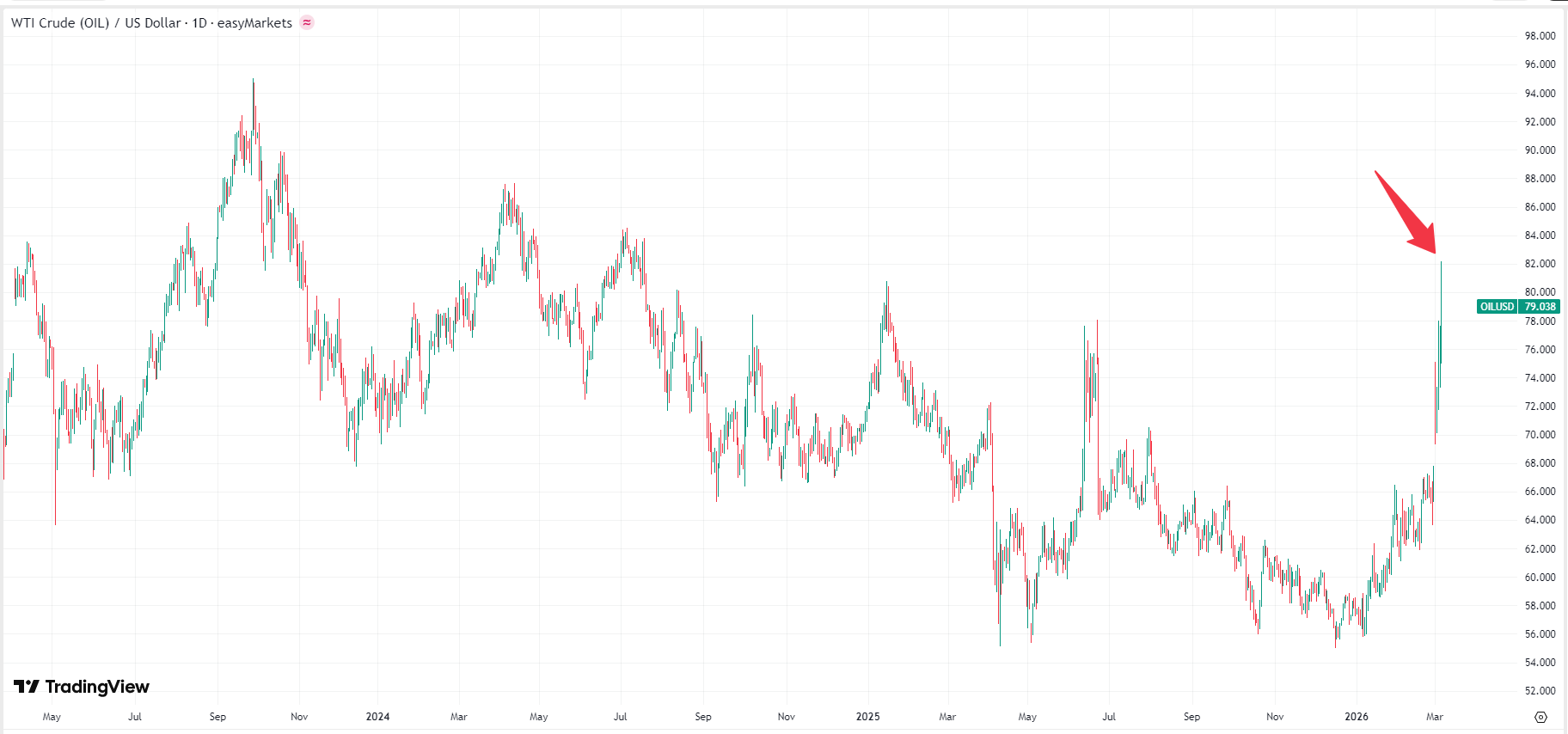 WTI crude oil price chart, source: TradingView
Since February 28, the conflict between the U.S., Israel, and Iran has continued to escalate, threatening crude oil supplies and driving international oil prices higher. WTI crude oil has surged from around $67, with a maximum gain of over 20% to date, far outperforming gold.
On March 2 (the first trading day after the U.S.-Iran conflict began), spot gold ( XAUUSD) prices spiked to $5,400 per ounce, nearing historic highs. However, instead of an upward breakout, gold prices faced aggressive profit-taking. Currently, gold is hovering around $5,100, with a cumulative decline of 1% over the last five trading days.
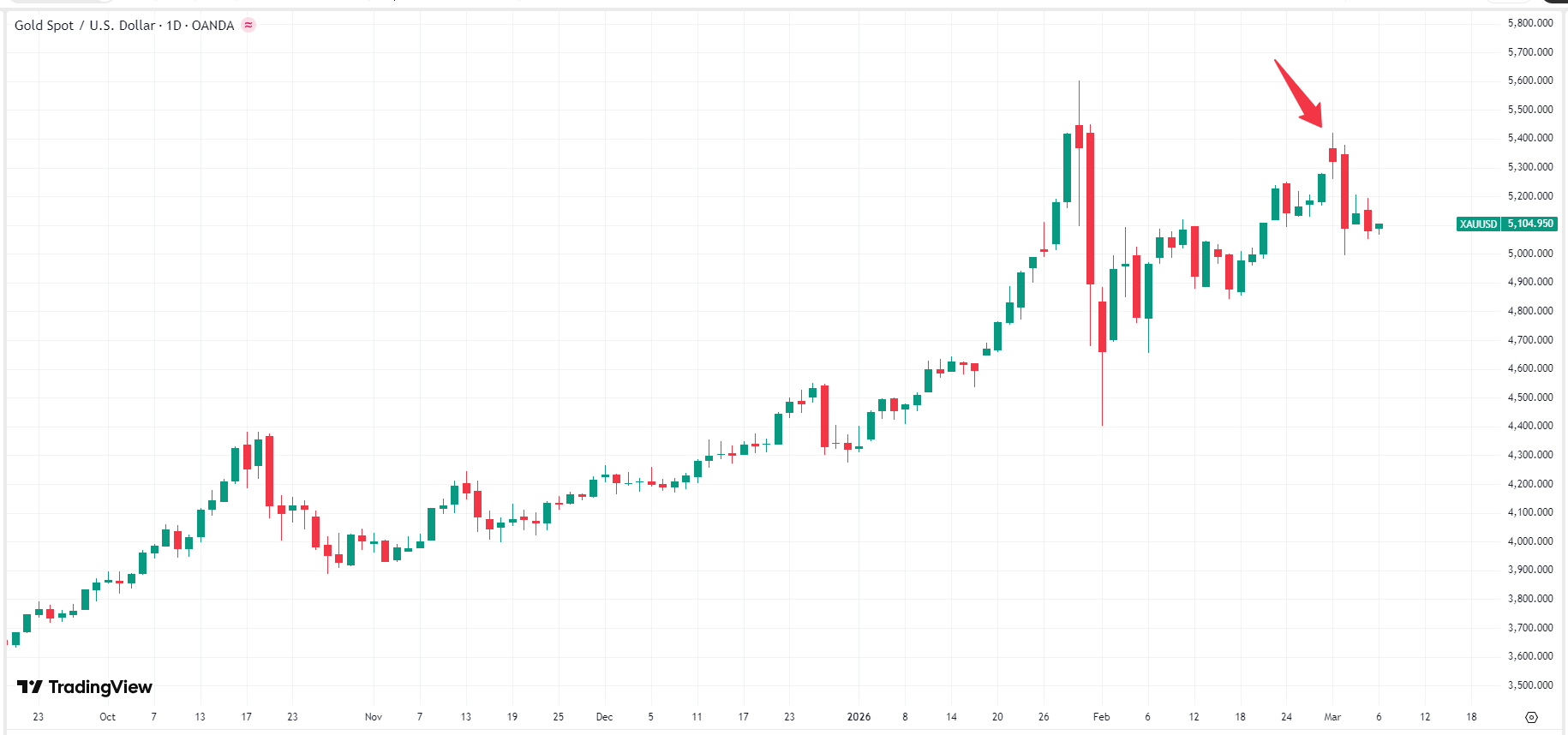 Gold price chart, source: TradingView
As seen above, crude oil has been the biggest beneficiary of the U.S.-Iran conflict, while gold's performance has been underwhelming. Why has this inversion occurred? There are three main reasons:
First, Iran controls the world's most critical energy chokepoint—the Strait of Hormuz—threatening 'supply disruptions' for oil transport. This hard support from supply-demand imbalance is far more powerful than safe-haven sentiment for gold, as gold lacks the industrial demand essential to crude oil.
Second, soaring oil prices have pushed up costs for transportation, manufacturing, and chemical products. Markets expect high inflation to force the Federal Reserve (Fed) to pause its rate-cutting cycle or even hike rates, which increases the opportunity cost of holding gold, especially since gold is a non-interest-bearing asset.
Third, gold had already accumulated significant gains before the U.S.-Iran conflict, leading to a 'fear of heights' in the market. When the conflict broke out, it not only ignited this sentiment but also forced some institutions to sell gold to meet margin calls for stocks or other risky assets.
Currently, tensions in the Middle East show no signs of easing. The Islamic Revolutionary Guard Corps (IRGC) has just launched the 21st round of counterattacks under 'True Promise 4,' and the United States has shown no sign of backing down. Defense Secretary Hegseth claimed the U.S. has sufficient ammunition for operations against Iran, while President Trump has taken a more hawkish stance, stating he will pivot to Cuba after neutralizing the threat from Iran.
War itself not only boosts crude oil demand but also hinders transport and targets production facilities, thereby weakening supply. This severe supply-demand imbalance will be the driver for further increases in international oil prices. Against this backdrop, institutions have raised their oil price targets. ANZ Bank is bullish on a move to $90 per barrel, while Goldman Sachs believes it could break the $100 mark.
This content was translated using AI and reviewed for clarity. It is for informational purposes only.
Recommended Articles









Comments (0)
Click the $ button, enter the symbol, and select to link a stock, ETF, or other ticker.