


Alibaba’s Cloud Grew 38% and AI Revenue Is Heading for 50% of the Segment - Is BABA a Buy at $146?



AI Podcast


Alibaba's stock surged despite missing Q4 revenue and EPS targets, driven by strong Cloud Intelligence Group growth (38% YoY) and AI momentum. AI-driven cloud offerings reached $1.3 billion, with projected over 50% segment revenue contribution within 12 months. The company is prioritizing AI infrastructure investment, committing $52-$56 billion over three years. Analysts like Goldman Sachs reiterated Buy ratings, focusing on AI's long-term potential over immediate profitability concerns. Technicals show constructive chart structure with support at $143-$144 and potential upside targets. Risks include geopolitical tensions and e-commerce margin pressures.
TradingKey - Alibaba (NYSE: BABA) surged between 7% and 8% on May 13 following its fiscal Q4 2026 earnings report, which showed a miss on reported revenue and EPS yet delivered the data points that truly matter for the long-term investment story.
The Cloud Intelligence Group reported 38% year-over-year revenue growth, totaling RMB 41.6 billion ($6.04 billion). AI-driven offerings saw triple-digit expansion and accounted for RMB 9 billion ($1.3 billion) of the cloud revenue total. Furthermore, CEO Eddie Wu projected that AI could comprise over 50% of the cloud segment’s revenue within the next 12 months.
Investors seemingly dismissed the EPS shortfall and purchased the stock on the strength of the AI momentum. BABA currently trades at $145.85, retracting back toward its ascending trendline support following the initial earnings-driven spike, with the RSI holding in neutral territory and a bullish hammer candle developing.
Market Indifference to EPS Miss, Alibaba Stock Buys Alibaba Anyway
Q4 headline results were underwhelming. Revenue amounted to RMB 243.38 billion ($35.28 billion), marking a 3% increase year-over-year that fell short of consensus estimates. Adjusted EPS reached $0.09, a significant decline from $0.22 the prior year. Meanwhile, operating income registered a loss of RMB 848 million ($125 million). Such figures did not explain the 7% to 8% single-day rally.
Instead, management made clear that profits are now "secondary" to ensuring that Alibaba remains competitive in the long-term AI space, which in turn shows the company’s investment working. It has pledged to spend more than it initially stated, RMB 380 billion ($52 to $56 billion), on AI infrastructure in the next three years. This is no hedge, it is a move to position itself as the key player in building China’s AI infrastructure. In the post-earnings call, Goldman Sachs reiterated its Buy rating.
Alibaba is the leading contender in the domestic AI race, cloud unit economics improving, Goldman said. The market is essentially trading based on the cloud and AI path forward instead of the immediate hit to earnings from outlay that hasn’t turned into income yet.
Cloud at 38% Growth and AI Heading to 50% of Segment, Which Is What This Means
The Cloud Intelligence Group’s 38% YoY revenue increase to $6.04 billion is the metric that shifts the overall Alibaba case for investors. For comparison, Alibaba’s total revenue only saw a 3% increase in Q4, as cloud growth isn’t an afterthought, cloud growth is what’s going to drive the business. AI-powered offerings experienced triple-digit gains and brought in RMB 9 billion ($1.3 billion) revenue for the quarter. Eddie Wu’s statement that AI revenue could make up a majority (more than 50%) of the business in the next 12 months signals that by this time next year, the segment’s fastest-growing component will be driven by AI.
The growth comes about thanks to Alibaba having a presence in the domestic AI space in China. Chinese tech giants and companies are turning to local cloud providers since there are US export controls for leading-edge Nvidia chips. Alibaba’s Qwen large language models and the infrastructure of its AI cloud are ready substitutes for American AI platforms for local businesses and the state. Michael Burry recently added BABA to his portfolio, indicating that China will go from a net buyer of AI to self-sufficiency in AI, thus creating a base level for demand for Alibaba’s cloud business that is immune to US competition because it is controlled by policy, not by how good their product is.
While traditional e-commerce sales continue to be eroded by Pinduoduo and JD.com, the quick commerce sector is growing at a faster pace and this is a drag on the short-term margin profile. Those are indeed challenges, but they are ones already factored into the market price, having been the case for a while now. A re-rating of Alibaba can be found in its cloud business and other AI services moving away from an e-commerce business’s valuation multiple to a cloud platform multiple, which appears to be what is happening, given that 38% YoY growth combined with triple-digit AI product growth is in play.
Alibaba (BABA) Technical Analysis, Trendline Support of $143 to $144 Comes After Post-Earnings Move
On a 2H timeframe, following the 7% to 8% post-earnings run, BABA is moving back into an upward sloping support trendline anchored from lows of $129.61 in April. Today’s candle is a bullish hammer with a long lower wick that extends to the trendline, while the blue MA holds dynamic support at $134 to $136.
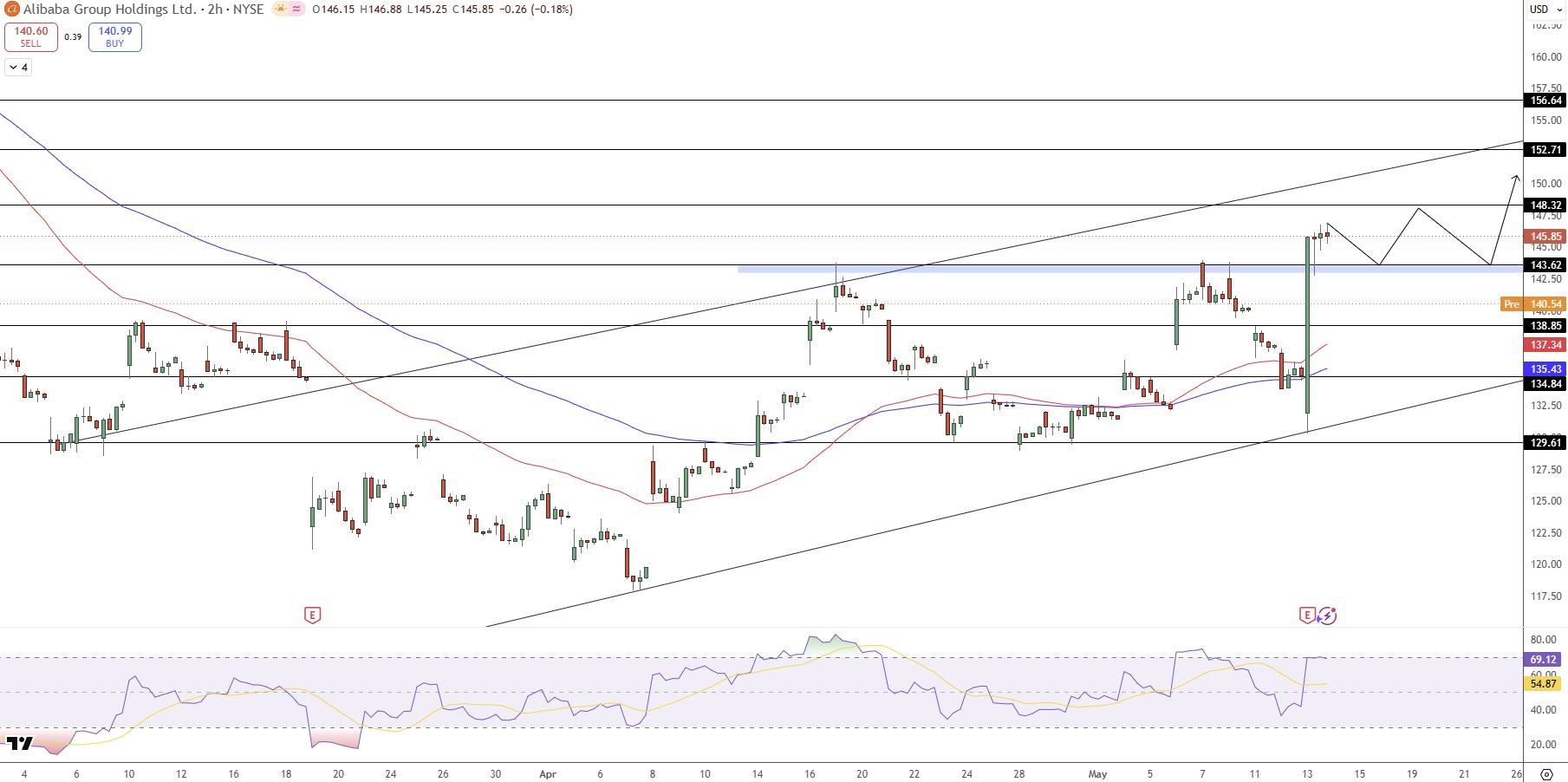
Alibaba (BABA) Price Chart - Source: Tradingview
The RSI sits in neutral territory between 55 and 60 with a bullish divergence on the decline, and there is no momentum confirmation on the current pullback, which is why a continuation in price is a likely scenario.
The first major resistance sits near $148.32, next $152.71 and finally $156.64. In the immediate zone, support is likely at $143.62 to $141.20.
Alibaba Trade Plan
Entry: Long above $146.50, as the trendline holds
Target 1: $148.32, the first resistance level above the breakout
Target 2: $152.71, the next extension price target
Target 3: $156.64, the upper channel resistance
Stop loss: Daily close below $143.60, if the trendline support fails
Why Did Alibaba's Stock Jump Even Though Earnings Missed the Mark?
Alibaba shares surged 7% to 8% after the company reported an adjusted per share (EPS) of $0.09, which fell short of the $0.22 registered a year prior. Investors were encouraged to see Alibaba Cloud Intelligence Group post a year-on-year growth of 38%, totaling $6.04 billion in revenue for the most recent quarter. This includes AI-driven cloud revenue hitting $1.3 billion, showing triple digit growth year on year.
On the call, Alibaba CEO Eddie Wu projected AI revenue as accounting for 50% or more within a year for Cloud, and Goldman Sachs reconfirmed its Buy rating on Alibaba shares. The market is focusing on Alibaba Cloud Intelligence's future growth rate and the potential for AI revenue, rather than the short-term drag that the firm's heavy investments in AI infrastructure have put on near-term profitability.
What Is Alibaba's AI Investment Plan?
Alibaba has pledged to invest more than the RMB 380 billion ($52 to $56 billion) over three years in its AI infrastructure efforts, as management has made it clear that short-term profitability is "secondary to building long-term AI competitiveness."
The investment will be focused on building AI cloud infrastructure, the Qwen series of large language models, and building computing capacity that, as a result of the United States' export restrictions on high-performance Nvidia GPUs and China's desire for computing self-sufficiency, will be able to deliver AI services to Chinese companies without reliance on U.S. components or equipment by using Huawei and other local alternatives as the basis for domestic chip manufacturers.
Should Alibaba Be Bought After Q4 FY2026 Earnings at $146?
The technical chart structure on Alibaba's shares is constructive. Alibaba shares are testing the ascending trendline support at the $143 to $144 range, the relative strength index sits in the neutral 55 to 60 zone and is showing positive divergence as the pullback extends. The holding of the $143.60 support level could target the $148.32 and $152.71 price levels as the next stops.
Fundamentally, there are multiple catalysts for the stock to rise in the next few months, including the 38% growth in cloud, the $1.3 billion AI revenue in Q4, and the $52 to $56 billion AI investment. Risks include escalation of geopolitical tensions between the United States and China, continued margin pressures in e-commerce, and the timeline for Alibaba's AI spending to generate sustained profits.
Bottom Line
The Q4 FY2026 report on earnings per share and revenue are the price of a calculated AI conquest by Alibaba, and the market is willing to pay up for this strategy going forward. A cloud segment that grew 38% year-on-year, whose revenue is expected to reach 50% AI-related in the near future, combined with Alibaba's $52 to $56 billion AI commitment make a compelling AI play in China for Alibaba, as the e-commerce segment drags down the overall performance, but is a known risk. The re-rating of the cloud segment is only just starting.
The shares are testing ascending trendline support at $143 to $144, and the relative strength index is showing positive divergence. If the stock holds the $146.50 level, the next targets are $148.32 and $152.71. A break below $143.60 would invalidate this view.
Recommended Articles







Comments (0)
Click the $ button, enter the symbol, and select to link a stock, ETF, or other ticker.