


Natural Gas (NATGAS) Is up 2.05% on Jun 25: Key Drivers to Watch



Natural Gas (NATGAS) is up 2.05% at Jun 25 03:30(ET), now at $3.291, with a 7-day up of 1.57%.
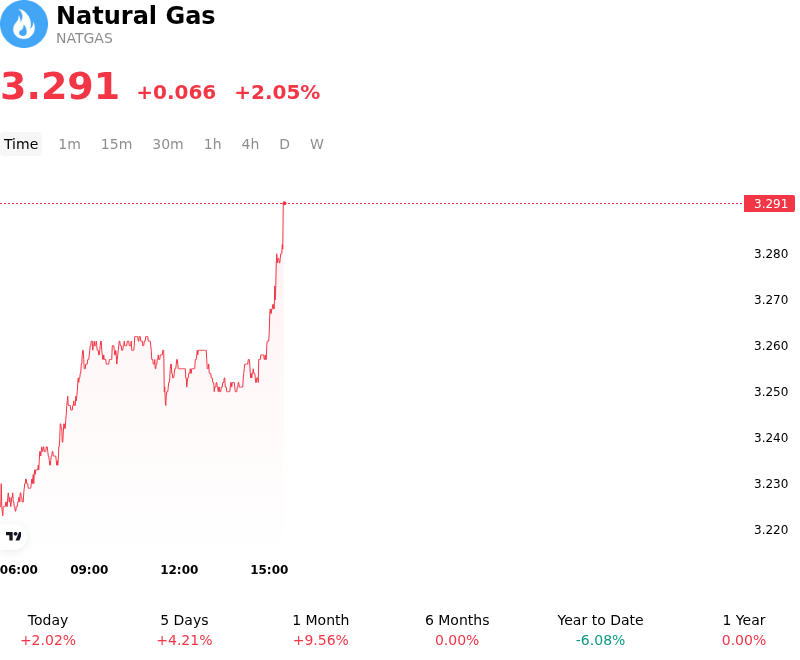
What is driving Natural Gas (NATGAS)’s stock price up today?
The upward movement in U.S. natural gas futures was primarily driven by a shift toward hotter weather forecasts, which significantly boosted projections for power sector demand. Weather models predicted above-average temperatures across key consuming regions, including the Mid-Atlantic and the Upper Midwest, extending into early July. This persistent summer heat is expected to keep utility demand elevated as power providers burn more natural gas to satisfy rising air-conditioning loads.
Adding to the bullish momentum, market participants anticipated a tighter domestic supply-demand balance reflected in the weekly storage data. Projections for the Energy Information Administration storage report indicated a relatively small weekly injection of roughly 67 billion cubic feet. This estimated build is notably below the historical five-year average gain of 75 billion cubic feet for the period. Slower inventory accumulation signals a gradual narrowing of the persistent domestic storage surplus, which has historically weighed heavily on prices, thus encouraging buyers to re-enter the market.
Supply-side adjustments and recovering export channels also supported the price advance. Domestic production in the Lower 48 states showed signs of moderation, edging down slightly to an average of 109.5 billion cubic feet per day compared to the previous month. Simultaneously, natural gas feedgas flows to major U.S. liquefied natural gas export terminals rebounded, averaging over 17 billion cubic feet per day in June. This recovery in export flows helps clear regional gluts and ensures that excess domestic dry gas production is absorbed into international supply chains.
On a broader structural level, the North American gas market continues to derive support from international supply anxieties. Although regional tensions in the Middle East have experienced periods of relief following recent diplomatic developments, structural concerns over global LNG infrastructure remain elevated. Recent operational disruptions and infrastructure risks at major global liquefaction facilities, such as Qatar’s Ras Laffan complex, have highlighted the vulnerability of global supply chains. This keeps international price premiums elevated, reinforcing long-term foreign demand expectations for U.S. LNG exports and limiting downside risk for domestic futures.
Technical Analysis of Natural Gas (NATGAS)
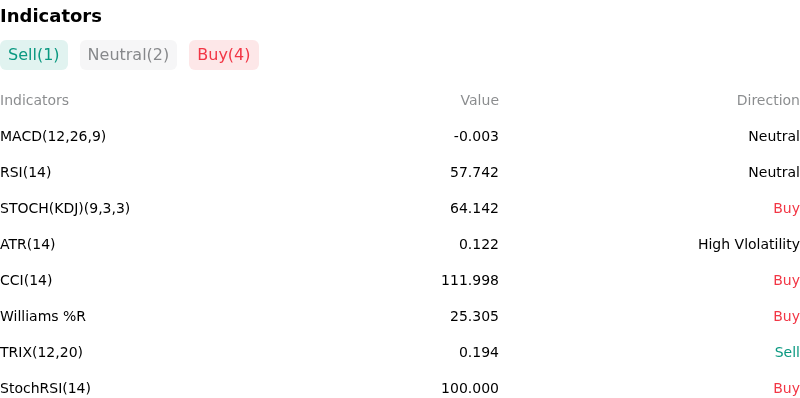
Technically, Natural Gas (NATGAS) shows a MACD (12,26,9) value of -0.003, indicating a neutral signal. The RSI at 57.742 suggests neutral condition and the Williams %R at 25.305 suggests buy condition. Please monitor closely.
More details about Natural Gas (NATGAS)
Recent Events and Risks:
- Elevated Storage Surplus: According to EIA data, U.S. working natural gas inventories remain at 2,759 Bcf, which is 151 Bcf (approximately 6%) above the five-year historical average. This persistent oversupply acts as a structural headwind, capping Henry Hub spot and futures price recoveries.
- Record Domestic Production Guidance: Supply-side downside risks remain high as the EIA recently upgraded its 2026 U.S. dry natural gas production forecast to a record 111.0 Bcf/day. Driven by robust associated gas output in the Permian Basin, this surging production threatens to push end-of-season stockpiles past the five-year historical maximum.
- Easing Global LNG Risk Premiums: International supply-disruption premiums are rapidly deflating following Qatar’s June 24 announcement that normal LNG operations at its Ras Laffan complex will resume within weeks after a brief technical outage. This, alongside progressing U.S.-Iran peace talks and normalizing traffic in the Strait of Hormuz, has pulled European TTF benchmark prices down toward two-month lows near €40.6/MWh, reducing global competition for LNG exports.
- Weather-Driven Demand Fluctuations: Intermittent regional shifts to cooler summer temperatures, particularly in major consuming areas like the U.S. Mid-Atlantic, have temporarily reduced gas-for-power demand for air conditioning, triggering prompt-month price pullbacks and exposing speculative long positions to liquidation.
This article may include AI-generated content that is human-reviewed, which is for reference and general information purposes only and does not constitute investment advice.
Recommended Articles








Comments (0)
Click the $ button, enter the symbol, and select to link a stock, ETF, or other ticker.