tradingkey.logo
tradingkey.logo
Search

Natural Gas

NATGAS
Add to Watchlist

3.220

-0.020-0.62%
Time
1m
15m
30m
1h
4h
D
W
Please select

Today

-0.62%

5 Days

+4.31%

1 Month

+2.42%

6 Months

0.00%

Year to Date

-8.08%

1 Year

0.00%

View Detailed Chart
TradingKey 图表

Key Data Points

Opening Price

3.217

Previous Closing Price

3.240
Price Range of the Day
3.1973.221
52-Week Price Range
2.6504.252

Indicators

The Indicators feature provides value and direction analysis for various instruments under a selection of technical indicators, together with a technical summary.

This feature includes nine of the commonly used technical indicators: MACD, RSI, KDJ, StochRSI, ATR, CCI, WR, TRIX and MA. You may also adjust the timeframe depending on your needs.

Please note that technical analysis is only part of investment reference, and there is no absolute standard for using numerical values to assess direction. The results are for reference only, and we are not responsible for the accuracy of the indicator calculations and summaries.

1m
5m
15m
30m
1h
2h
4h
D
W
M
1m
5m
15m
D
Buy
Sell(1)
Neutral(5)
Buy(7)
Indicators
Sell(1)
Neutral(5)
Buy(1)
Indicators
Value
Direction
MACD(12,26,9)
-0.011
Neutral
RSI(14)
55.368
Neutral
STOCH(KDJ)(9,3,3)
62.734
Buy
ATR(14)
0.128
Low Volatility
CCI(14)
34.148
Neutral
Williams %R
46.243
Neutral
TRIX(12,20)
0.226
Sell
StochRSI(14)
60.059
Neutral
Moving Average
Sell(0)
Neutral(0)
Buy(6)
Indicators
Value
Direction
MA5
3.199
Buy
MA10
3.167
Buy
MA20
3.168
Buy
MA50
2.999
Buy
MA100
3.011
Buy
MA200
3.049
Buy

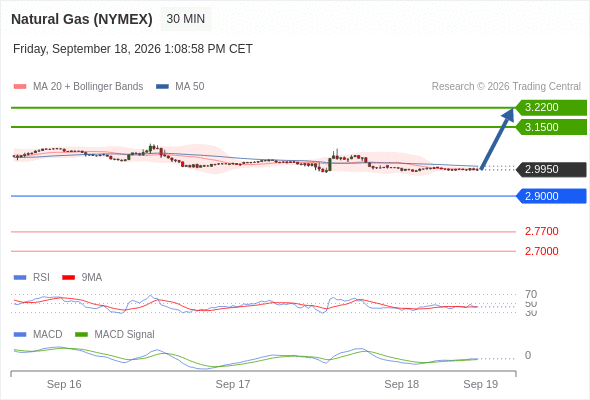
Natural Gas Trading Strategy

Intraday
Short Term
The MACD must break above its zero level to call for further upside.

Trading Strategy

The MACD must break above its zero level to call for further upside.

Alternative scenario

below 3.0900, expect 2.9600 and 2.8800.

Comment

our next up target stands at 3.4500.

14 hours ago
Source: Trading Central(Reference Only)

Natural Gas News

More news coming soon, stay tuned...

More Details of Natural Gas

Natural gas is a widely used fossil fuel that is used for heating, cooking, electricity generation, and transportation. It is also a key raw material for producing fertilizers, plastics, and chemicals. Natural gas is extracted from underground reservoirs or shale formations, then natural gas is processed to remove impurities and unwanted components, and then the processed natural gas is transported by pipelines or liquefied and shipped by tankers.

Natural gas is a highly volatile and cyclical commodity, whose price changes constantly due to supply and demand, weather, geopolitics, and other factors. Investors can profit from these price changes and trends by using different methods and platforms.

One of the main platforms for trading natural gas is the New York Mercantile Exchange (NYMEX), where the benchmark contract for natural gas futures is based on the delivery at the Henry Hub pipeline in Louisiana. This pipeline connects to multiple interstate and international pipelines that distribute natural gas throughout North America. Other methods include investing in natural gas Stocks, ETFs, or CFDs.

Natural gas stocks are shares of companies that explore, produce, process, transport, or distribute natural gas. Some of the largest natural gas producers in the world are Exxon Mobil Corporation (XOM), Royal Dutch Shell plc (RDS.A), and Chevron Corporation (CVX). Some of the leading natural gas pipeline operators are Enbridge Inc. (ENB), Kinder Morgan, Inc. (KMI), and TC Energy Corporation (TRP). Some of the major natural gas utilities are Dominion Energy, Inc. (D), Sempra Energy (SRE), and National Grid plc (NGG).

Natural gas ETFs are funds that track the price or performance of natural gas or a related index. Some examples of natural gas ETFs are the United States Natural Gas Fund (UNG), First Trust Natural Gas ETF (FCG), and iShares Global Natural Gas ETF (GAS). Natural gas ETFs offer diversification and liquidity, as well as lower fees and commissions than individual stocks. However, they also carry risks such as tracking error, leverage, and contango.

Natural gas Futures involve entering into a contract to buy or sell a specified amount of natural gas at a predetermined price and date in the future. Natural gas futures are traded on exchanges such as the New York Mercantile Exchange (NYMEX) and the Intercontinental Exchange (ICE). Investing in futures can provide leverage and flexibility, as well as the opportunity to profit from price movements in both directions. However, it also involves risks such as margin calls, expiration, and rollover costs.

Natural gas CFDs are contracts that allow investors to speculate on the price movements of natural gas without owning the commodity. Natural gas CFDs follow the price of natural gas futures or spot markets and enable traders to profit from both rising and falling prices. Natural gas CFDs are leveraged products, which means that traders can control a large amount of natural gas with a small margin deposit. However, they also involve risks such as margin calls, expiration, and rollover costs.

Natural gas is a unique asset class that has a low correlation with other markets, such as stocks, bonds, and other commodities. This means that natural gas prices can move differently or more strongly than other markets. Natural gas is also a major source of energy for various sectors and industries, such as heating, electricity, transportation, and manufacturing. Investors who have exposure to these industries can use natural gas as a hedge to protect themselves from adverse price movements or shocks in the energy market.

What factors influence the price of natural gas?

The price of natural gas is influenced by various factors, including supply and demand dynamics, weather conditions, storage levels, economic conditions, government policies, and global energy market trends. For example, in 2020, the price of natural gas plummeted due to oversupply caused by mild weather and reduced industrial demand during the COVID-19 pandemic. Conversely, extreme weather events like hurricanes or cold snaps can lead to spikes in natural gas prices as demand surges. Additionally, geopolitical tensions or disruptions in production regions can also impact the price of natural gas in the market.

What are the main ways of trading natural gas?

The main ways of trading natural gas include physical trading, futures contracts, options, and CFD (Contract for Difference) trading. Physical trading involves the actual delivery of natural gas, while futures contracts allow traders to speculate on future prices. Options provide the right to buy or sell at a specific price within a timeframe. CFD trading enables investors to speculate on price movements without owning the asset, offering leverage for amplified exposure to natural gas price fluctuations.

What exchange is natural gas traded on?

Natural gas is primarily traded on commodity exchanges such as the New York Mercantile Exchange (NYMEX) and the Intercontinental Exchange (ICE). These exchanges offer futures contracts for natural gas, allowing traders to speculate on the future price movements of the commodity. Additionally, natural gas can also be traded on over-the-counter (OTC) markets, where buyers and sellers negotiate directly with each other rather than through a centralized exchange.

Natural Gas

3.220
-0.020-0.62%
KeyAI