Indicators
Indicators
Value
Direction
MACD(12,26,9)
-0.024
Sell
RSI(14)
32.130
Neutral
STOCH(KDJ)(9,3,3)
21.449
Neutral
ATR(14)
0.052
High Vlolatility
CCI(14)
-115.512
Sell
Williams %R
86.430
Oversold
TRIX(12,20)
-0.050
Sell
StochRSI(14)
0.000
Sell


Today
-0.01%
5 Days
-0.41%
1 Month
-1.95%
6 Months
+2.67%
Year to Date
+2.77%
1 Year
+1.42%
Opening Price
11.059Previous Closing Price
11.073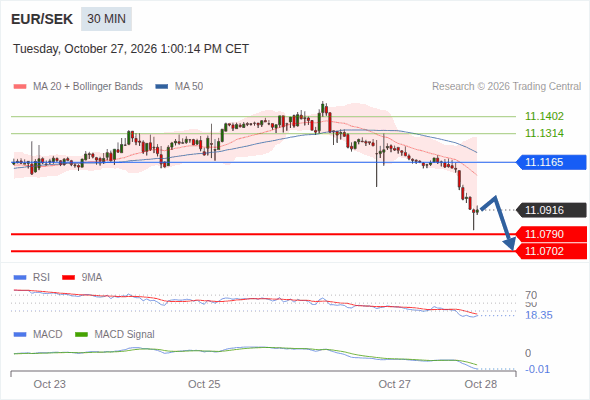
The downside prevails as long as 11.1165 is resistance, with 11.0790 and 11.0702 as targets
above 11.1165, look for 11.1314 and 11.1402.
The downside prevails as long as 11.1165 is resistance, with 11.0790 and 11.0702 as targets
Nordea strategists concede their long‑standing positive view on the Swedish Krona (SEK) has not materialized and now adopt an agnostic stance. SEK has been hurt by Middle East‑related risk‑off flows, US tech outperformance, Riksbank policy lagging the ECB, and the "Scandie trade" favouring NOK. They say SEK strength requires lower Oil prices, easing inflation and lower global short rates.
ING’s Francesco Pesole highlights that EUR/SEK has fallen about 1.8% from its early-October high, helped by French fiscal concerns and prior short-term overvaluation. The pair is now seen as fairly valued, unlike cheap EUR/USD. With the Riksbank signalling readiness to hike in November and ECB expectations repriced dovishly, ING’s one-month EUR/SEK target is 11.15, with risks skewed to further downside.
Rabobank's Senior FX Strategist Jane Foley discusses EUR/SEK, noting Sweden’s resilient economy, stronger-than-expected GDP and a hawkish shift at the Riksbank.
Brown Brothers Harriman’s (BBH) Elias Haddad notes USD/SEK is firmer on broad US Dollar (USD) strength, while Sweden’s September Consumer Price Index (CPI) data were mixed.
Societe Generale notes USD/SEK broke out of a large base in September, extending its rebound and recently posting an interim high near 10.10 before a brief pullback.
Commerzbank’s Michael Pfister and Norman Liebke describe how Swedish government tax and fuel measures have temporarily suppressed inflation, keeping the Riksbank on hold at 1.75% with hikes only expected late in the year.
The Indicators feature provides value and direction analysis for various instruments under a selection of technical indicators, together with a technical summary.
This feature includes nine of the commonly used technical indicators: MACD, RSI, KDJ, StochRSI, ATR, CCI, WR, TRIX and MA. You may also adjust the timeframe depending on your needs.
Please note that technical analysis is only part of investment reference, and there is no absolute standard for using numerical values to assess direction. The results are for reference only, and we are not responsible for the accuracy of the indicator calculations and summaries.