



TradingKey - Last Friday, U.S. President Donald Trump announced the removal of import tariffs on over 200 commonly consumed food items, covering coffee, beef, bananas, orange juice, and other staples found on American family dinner tables.
This Thursday, his administration further eliminated high tariffs on a wide range of Brazilian agricultural products, including beef and coffee, abandoning the tariff policy against Brazil implemented this summer.
This series of tariff exemptions has brought slight relief to consumers struggling with price pressures. However, one undeniable reality is that the tariff policies of the past year have imposed tangible impacts on ordinary household budgets. When you check out at the supermarket, you'll notice your bill is 10% to 15% higher than the same period last year—this is not an illusion, but genuine financial pressure resulting from tariff policy transmission.
Although President Trump firmly maintains that his comprehensive tariffs "have not increased inflation," and has publicly described rising prices as "lies" and "an outright scam," the data tells a different story.
Statistics from the U.S. Bureau of Labor Statistics show that America's annual inflation rate stood at 3% in September. From January to September this year, grocery prices have cumulatively risen by 1.4%. During Trump's second presidential term, the Consumer Price Index (CPI) has averaged an increase of 1.7%.
Multiple economists have analyzed that import tariffs gradually transmit through supply chains to the end consumer market, serving as one of the important factors driving food price increases.
In this round of price fluctuations, low-income households have been particularly hard hit—these families allocate a higher percentage of their total income to food expenses and are more sensitive to price fluctuations. Faced with persistently rising living costs, how can one safeguard family financial security and reasonably plan expenditures? This has become an urgent issue requiring resolution for many low-income households.

(Source: Freepik)
Why Don't Commodity Prices Drop Immediately After Tariff Adjustments?
Although recent tariff policies have been adjusted, market prices for goods do not fall overnight—they require time for transmission through supply chains. J.P. Morgan’s analysis shows companies previously passed only 20% of tariff costs to consumers. With tariff changes now in effect, the remaining cost transmission and price declines will take additional time.
This means you likely won’t see prices for most goods return to last year’s levels next month. A noticeable time lag exists between policy adjustments and market price responses. During this period, household budgets will continue to face significant pressure.
More concerning is that prices for some goods may never fully revert to prior levels. S&P Global research indicates that over $900 billion of the $1.2 trillion in additional costs borne by businesses will ultimately be paid by consumers. When manufacturers reconfigure global supply chains to adapt to new tariff policies—even if tariffs are later removed—their cost structures undergo irreversible changes, making it difficult for related product prices to return to original levels.
Trump Has Driven Down Prices for Some Goods
You may already notice positive changes when walking into a pharmacy. Under sustained pressure from the Trump administration, pharmaceutical industry prices have indeed softened. High-profile GLP-1 medications, for instance, are now required to be priced at $149—significantly lower than their previous $1,000+ price tags.
Additionally, the U.S. government has secured agreements with major pharmaceutical companies like Pfizer and AstraZeneca to tie new drug pricing to "most-favored-nation" standards—ensuring U.S. prices for new drugs don’t exceed the lowest prices in other developed nations.
Egg prices have also shifted noticeably. In late February, egg prices soared to over $8 per dozen. Weeks after Trump took office, the U.S. Department of Agriculture swiftly implemented a comprehensive response: providing financial aid to affected farmers, strengthening biosecurity management standards at poultry farms, and temporarily easing egg import restrictions. These measures gradually took effect, and egg prices have now fallen to just over $2 per dozen.
How Much Pressure Are Tariffs Putting on Your Wallet?
As of September this year, market price increases have become increasingly evident, particularly in the meat sector. Ground beef prices have risen nearly 13% year-over-year, while steak prices have surged 17%—marking the largest increase in over three years.
Beyond meat, everyday grocery prices are also shifting quietly. Banana prices have climbed about 7%, and while tomato prices increased only slightly by 1%, the cumulative impact of rising costs across multiple items continues to squeeze household budgets.
This inflationary pressure is palpable in any supermarket, with imported goods experiencing particularly sharp fluctuations. Take a less-than-half-pound block of Swiss Gruyère cheese as an example: it now retails for over $29 on store shelves—a stark contrast to its price just eight months ago, when the same brand and size sold for only $11.86, nearly doubling in cost.
Similar price hikes are occurring broadly across imported goods—from children’s holiday toys to everyday pantry staples. When you push your shopping cart through the checkout lane, the ever-climbing total on your receipt is a direct manifestation of global trade policy shifts in ordinary life.
The Yale Budget Lab’s latest November report reveals that since the 2025 tariff policy took effect, commodity prices have risen noticeably across different phases: a 1.3% increase in the short term (before substitution effects), and a slightly moderated but still sustained 1.1% rise in the long term (after substitution effects). Price pressures vary significantly by category, with core conclusions as follows:
Short-Term Impact (Before Substitution Effect)
• Clothing and footwear: Prices may soar over 20%
• Electronics: Rise of 17–18%
• Automobiles: Increase of 13% (translating to ~$6,500 higher for new vehicles)
• Food: Up 1.2%
Long-Term Impact (After Substitution Effect)
• Clothing and footwear: Still rising 7%
• Electronics: Up 5–6%
• Automobiles: Increase of 5% (adding ~$2,500 to new vehicle prices)
• Food: Up 1%
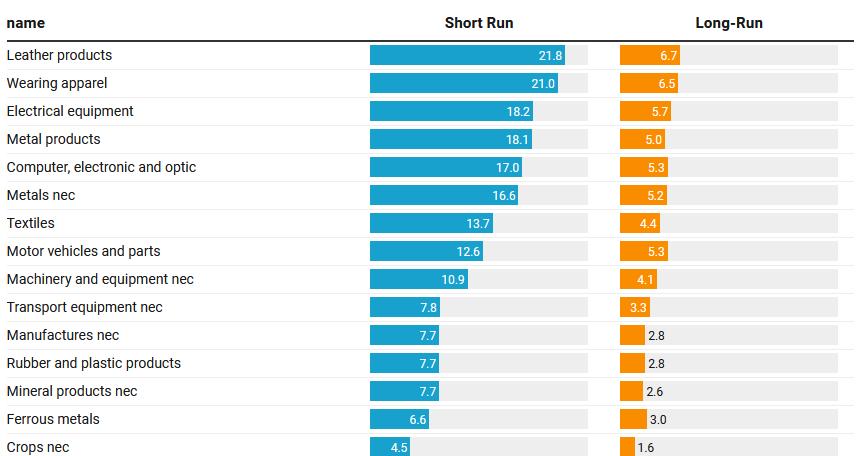
Commodity Price Effects from 2025 Tariffs through November 17; Source: The Budget Lab
Why Are Low-Income Households Hit Hardest by Tariffs?
Low-income households not only allocate a higher proportion of their income to consumption but also spend a larger share on imported goods—especially affordable imported alternatives. Inexpensive imports to the U.S., such as basic clothing and budget-friendly daily necessities, happen to be core purchases for low-income families. Current Trump-era tariff structures are effectively tailored to target low-income households, as these affordable imports are precisely their primary choices.
The Yale Budget Lab’s (YBL) September report provides clear evidence: the new tariffs implemented by the Trump administration in 2025 are projected to increase the U.S. poverty population by 650,000 to 875,000 people.
Behind these cold numbers lie tangible hardships—for low-income families, every additional dollar spent on food forces proportional cuts to other essentials like education and healthcare, leaving household budgets with virtually no flexibility.
The YBL’s latest November report further estimates that if tariff costs are fully passed to consumers, the 2025 tariffs will drive short-term (pre-substitution effect) consumer price increases of 1.2%. (For simplicity, the YBL assumes tariff impacts on real income manifest primarily through price changes rather than nominal income adjustments.)
This increase directly erodes consumer welfare. Measured in 2025 dollar purchasing power, each household will face an average short-term income loss of approximately $1,700. Even after long-term substitution effects stabilize prices at a 0.9% rise, average annual household losses remain at $1,300.
An earlier YBL study (April) revealed that Trump’s tariff policy is a "regressive" measure—meaning lower-income groups bear disproportionately heavier burdens compared to high-income households.
"Lower income consumers are going to get pinched more by tariffs," stated Ernie Tedeschi, Economic Director of the Yale Budget Lab, bluntly. Tedeschi, who previously served as Chief Economist at the White House Council of Economic Advisers under the Biden administration, emphasized that tariff-driven price hikes impose "existential pressure" on low-income families, while high-income households experience only "consumption-level" impacts—a disparity that further widens the wealth gap.
(Source: Freepik)
When the Shopping Cart Gets Heavier, How Can You Protect Your Family Budget?
Smart Clothing Choices
Look for products labeled "Made in USA," as these are unaffected by import tariffs. While style options may be limited, basic items offer better value for money.
Walmart’s "Great Value" and Target’s "Cat & Jack" brands have shifted many clothing production lines to domestic manufacturing, pricing 15%–20% lower than imported equivalents.
Additionally, capitalize on end-of-season clearance sales in February and August, when retailers urgently clear inventory with discounts of 30–50% off. Most importantly, create a must-have shopping list before each trip to avoid impulse purchases driven by promotions. Data shows planned shopping reduces unnecessary spending by 15–20%.
Optimizing Grocery Purchases
Savvy households distinguish between "long-term storage" and "short-term consumption" items. For shelf-stable goods like rice, canned goods, and paper products, bulk-buy during Costco’s Tuesday membership specials or Walmart’s Friday promotions to stock 1–2 months’ supply at once, effectively hedging against future price hikes.
Don’t overlook community resources—90% of U.S. counties host food assistance centers where low-income families can obtain basic groceries with simple income verification.
When shopping, choose discount chains like Aldi and Lidl. Their private-label household items cost 20% less than traditional supermarkets and are mostly domestically produced, making them less vulnerable to tariff fluctuations.
Extending Appliance Lifespans
When appliances malfunction, prioritize repairs over replacement. Basic repairs at community service stations typically cost $20–30—far below the $100+ price of new units.
For unavoidable major appliance replacements, time purchases strategically: Black Friday and Cyber Monday offer 35–40% discounts across major e-commerce platforms.
Tariff impacts are already a reality, but through precise shopping strategies, leveraging local resources, and smart discount timing, you can minimize future spending losses and optimize your family budget.
