


Today’s Market Recap: Three Major US Stock Indexes Fall, Samsung's Strong Earnings Fail to Boost Chip Stocks, Oil Prices Surge on Rising Iran Risks



AI Podcast


On July 7, Eastern Time, major US indices declined, led by a semiconductor sell-off. Despite Samsung’s strong Q2 earnings, concerns over high AI hardware valuations and profit-taking persisted, compounded by reports of DeepSeek’s proprietary chip ambitions. Oil prices surged over 5% following geopolitical tensions near the Strait of Hormuz and renewed US sanctions on Iranian oil, heightening inflation fears and Federal Reserve policy uncertainty. SpaceX’s Nasdaq 100 debut saw a 7% decline, reflecting investor caution. Broadly, markets remain volatile as participants prioritize de-risking amid inflationary pressures and shifting sector valuations.

Tracking market trends
TradingKey - On July 7, Eastern Time, the three major US stock indexes collectively closed lower, with the AI and semiconductor sectors once again serving as the core drag on the market. Although Samsung Electronics' second-quarter earnings preview showed that demand for AI memory remains robust, the better-than-expected results failed to boost sentiment for chip stocks. Instead, they exacerbated market concerns over high valuations of AI hardware stocks, profit-taking, and the pricing-in of positive news. Meanwhile, attacks on vessels near the Strait of Hormuz pushed oil prices higher, bringing inflation and the Federal Reserve's policy path back into focus.
At the close, the Dow Jones Industrial Average fell 0.25% to 52,930.28; the S&P 500 Index fell 0.45% to 7,503.86; and the Nasdaq Composite Index fell 1.16% to 25,818.69.
In terms of sectors and individual stocks, the semiconductor sector continued to face pressure. The Philadelphia Semiconductor Index closed down 4.65%, Micron Technology ( MU) fell by about 4.7%, SanDisk ( SNDK) fell by about 7.3%, AMD ( AMD) fell by about 6.5%, and Nvidia ( NVDA) rose slightly but failed to reverse the sector's weakness. Large-cap tech stocks also diverged. SpaceX ( SPCX) fell nearly 7% on its first day of official inclusion in the Nasdaq 100 Index. Although several brokerages initiated coverage with optimistic ratings following its IPO, the market remained cautious about its valuation and short-term gains.
In the commodities market, oil prices rebounded sharply. Brent crude closed up 5.46% at $75.93, and WTI ( USOIL) crude closed up 5.22% at $72.19. The main driver behind the rise in oil prices was allegations that Iran attacked multiple commercial vessels near the Strait of Hormuz, after which the US revoked the general license allowing Iran to sell oil and reinstated relevant sanctions.
In precious metals, gold ( XAUUSD) fell about 1.42%, briefly dipping below $4,100 during the session, and was last trading at $4,105. Rising oil prices have renewed inflation concerns, and as the market awaits the Federal Reserve minutes, investors remain cautious about whether the Fed will maintain a tight policy stance.
Market News
DeepSeek is reportedly developing its own proprietary AI chip. Reports indicate that DeepSeek, a Chinese AI startup, is advancing its own proprietary AI inference chip project to reduce reliance on chips from Nvidia and Huawei. The project remains in its early stages; DeepSeek has begun recruiting chip design engineers and is exploring collaborations with foundries and memory chip makers. This news has intensified market discussions regarding changes in the competitive landscape of AI chips, and also served as a major backdrop for the pressure felt by the US semiconductor sector on the day.
Samsung Electronics' Q2 earnings guidance beats expectations. Samsung expects its second-quarter operating profit to surge approximately 19-fold year-on-year, primarily driven by rising prices of memory chips such as DRAM, NAND, and HBM due to demand for AI servers. However, Samsung's shares fell in South Korean trading, and US chip stocks followed suit, indicating that investors' expectations for the AI memory cycle are already high, and strong earnings alone are insufficient to continue driving the sector upward. The market will next focus on HBM orders, memory pricing, and second-half demand guidance in Samsung's official financial report.
US revokes Iran oil sales licenses, raising Strait of Hormuz risks once again. Following attacks on vessels near the Strait of Hormuz, the US government revoked general licenses previously allowing Iran to sell oil and reinstated relevant restrictions. This move poses a new test to the temporary easing of tensions between the US and Iran over energy exports and shipping security that had formed since June. As the Strait of Hormuz remains a critical global energy transit corridor, any attacks or escalation of sanctions could quickly drive up crude oil risk premiums and impact market assessments of inflation and Federal Reserve policy.
SpaceX officially added to the Nasdaq 100 Index. Less than a month after its IPO, SpaceX has been added to the Nasdaq 100, becoming a new member among heavyweights in US tech stocks. Several brokerages initiated coverage with relatively optimistic ratings, believing that the Starlink satellite network, Starship reusable rockets, and potential space AI infrastructure business will support long-term growth. However, SpaceX performed weakly on its first trading day in the Nasdaq, showing that the market still prefers to digest short-term gains first amid high valuations.
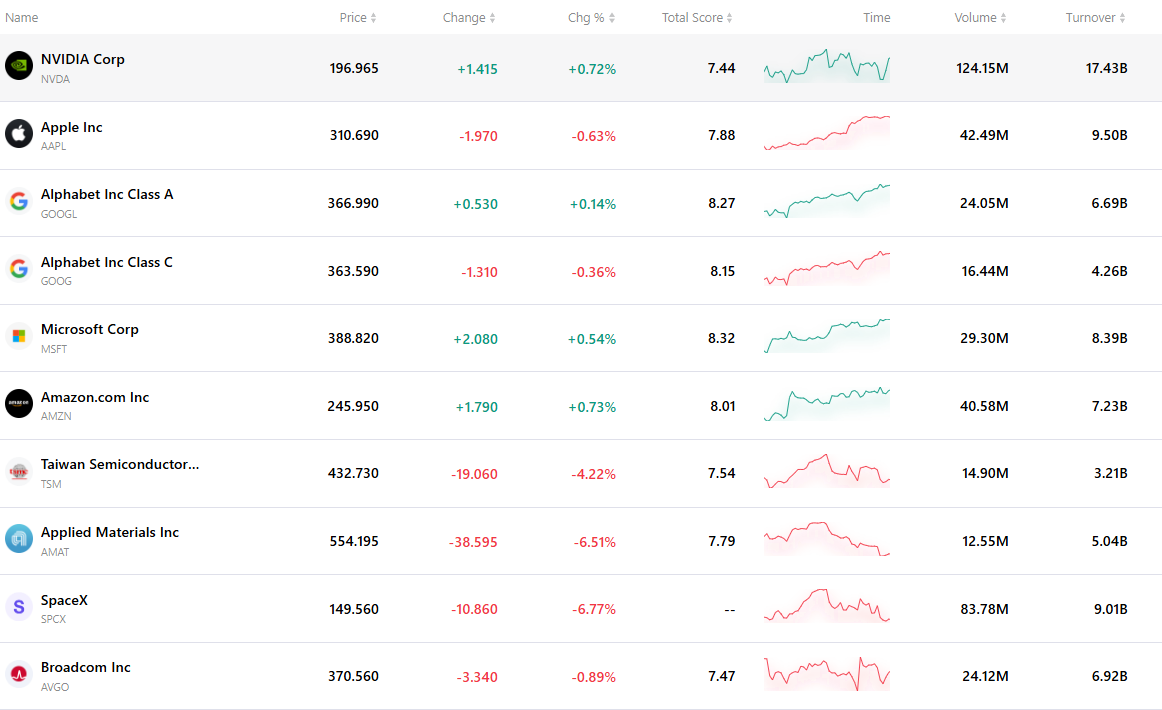
The top 10 most active stocks
The table below lists the ten most actively traded stocks in the latest market. Supported by massive trading volumes and excellent liquidity, these assets have become key benchmarks for tracking global market dynamics.
This content was translated using AI and reviewed for clarity. It is for informational purposes only.
Recommended Articles






Comments (0)
Click the $ button, enter the symbol, and select to link a stock, ETF, or other ticker.