


Why Is SK Hynix’s Stock Price Falling Instead of Rising as It Prepares for a US Listing?



SK hynix shares have declined significantly ahead of their July 10 Nasdaq listing, with a 25% drawdown from recent highs. This volatility stems from cooling investor sentiment regarding AI monetization, concerns over potential HBM oversupply, and the impact of share dilution from the US offering. Furthermore, regulatory scrutiny of high-leverage ETFs has pressured the stock. While forced buying from passive index funds upon listing may provide a valuation floor, the lack of sustained institutional demand could risk a retest of the 180,000 KRW support level, reflecting broader market skepticism toward excessive semiconductor capital expenditure.
TradingKey - SK Hynix shares weakened on the eve of its US listing, primarily due to multiple pressures including market shifts and pricing pressure.
During Asian trading hours on July 7, memory giant SK Hynix extended its decline. The stock opened lower and continued to slide, falling nearly 160,000 Korean won intraday, or 6.7%, to temporarily trade at 2,186,000 Korean won. With SK Hynix about to list in the US, why are its shares falling instead of rising?
On June 30, SK Hynix announced the launch of its US IPO process, and its stock price rose slightly that day, reaching a high of 2.749 million Korean won. Since then, SK Hynix's share price has continued to weaken, falling to a low of 2.05 million Korean won on June 3, resulting in a maximum drawdown of 25%.
SK Hynix's "US listing" was originally expected to be the most high-profile, epic listing event in the global semiconductor industry this year. The reason it turned into a stagnant situation where the stock price "fell instead of rising" in the short term is due to an entanglement of shifting macro market trends, pricing pressure from IPO dilution, and short-term capital stampeding as the positive news ran its course.
From late June to early July, Wall Street began to reflect on the phenomenon of tech giants spending hundreds of billions of dollars to build AI data centers while lacking sufficient monetization capabilities in the short term, a concern that was exacerbated in particular by Meta's ( META) move to sell computing power. At the same time, the market raised questions about Samsung and SK Hynix's massive $500 billion expansion plans, as well as whether high-bandwidth memory (HBM) might face oversupply in the short term.
SK Hynix's latest regulatory filing submitted on July 6 showed that the listing reference price was lowered from 2.555 million Korean won in late June to the closing price of 2.425 million Korean won on July 3, and the fundraising size also shrunk by $1 billion. This situation of "the closer to listing, the lower the reference price" hit the confidence of bulls chasing higher prices.
Driven by the AI frenzy in the first half of 2026, Hynix's cumulative year-to-date gain once wildly surged past 260%, making it one of the most crowded and highly leveraged stocks in South Korea. Recently, former presidential candidate Ahn Cheol-soo and the Bank of Korea warned of the amplified risks from such leveraged ETFs, even calling for their delisting, a move that undoubtedly threw cold water on the market.
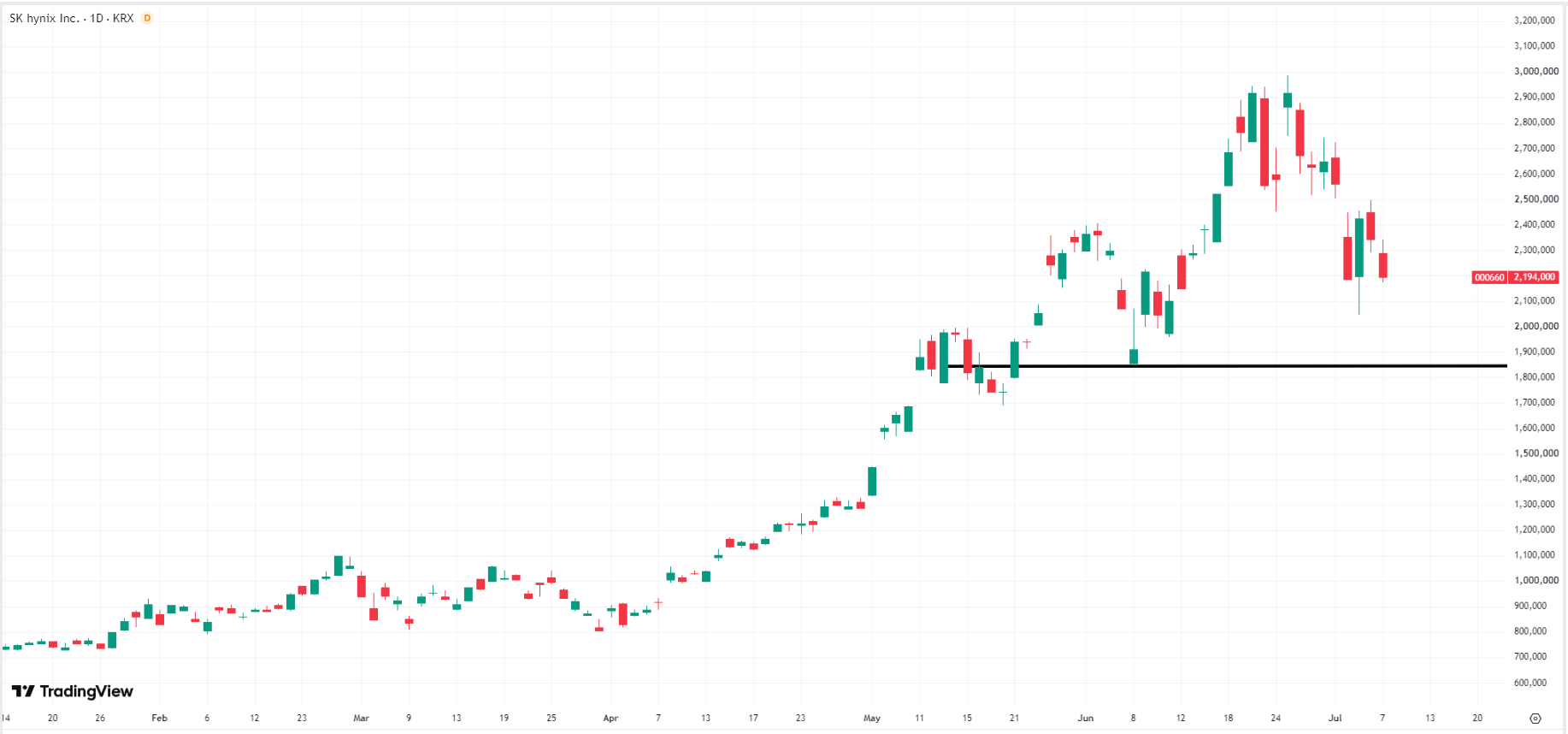 SK Hynix Stock Price Chart, Source: TradingView
On July 10, SK Hynix will officially list on the US Nasdaq and is expected to be included in the Philadelphia Semiconductor Index (SOX). At that time, massive US passive index funds (such as SOXX) will be forced to unconditionally enter the market and allocate funds, providing an extremely strong share price moat for Hynix. However, if it loses these passive capital inflows, SK Hynix is highly likely to continue falling and retest the support level at 1.8 million Korean won.
This content was translated using AI and reviewed for clarity. It is for informational purposes only.
Recommended Articles








Comments (0)
Click the $ button, enter the symbol, and select to link a stock, ETF, or other ticker.