


Has Beating Expectations Become the Norm? Nvidia Delivers Strong Q4 Results Again, but Market Remains Cautious?



AI Podcast


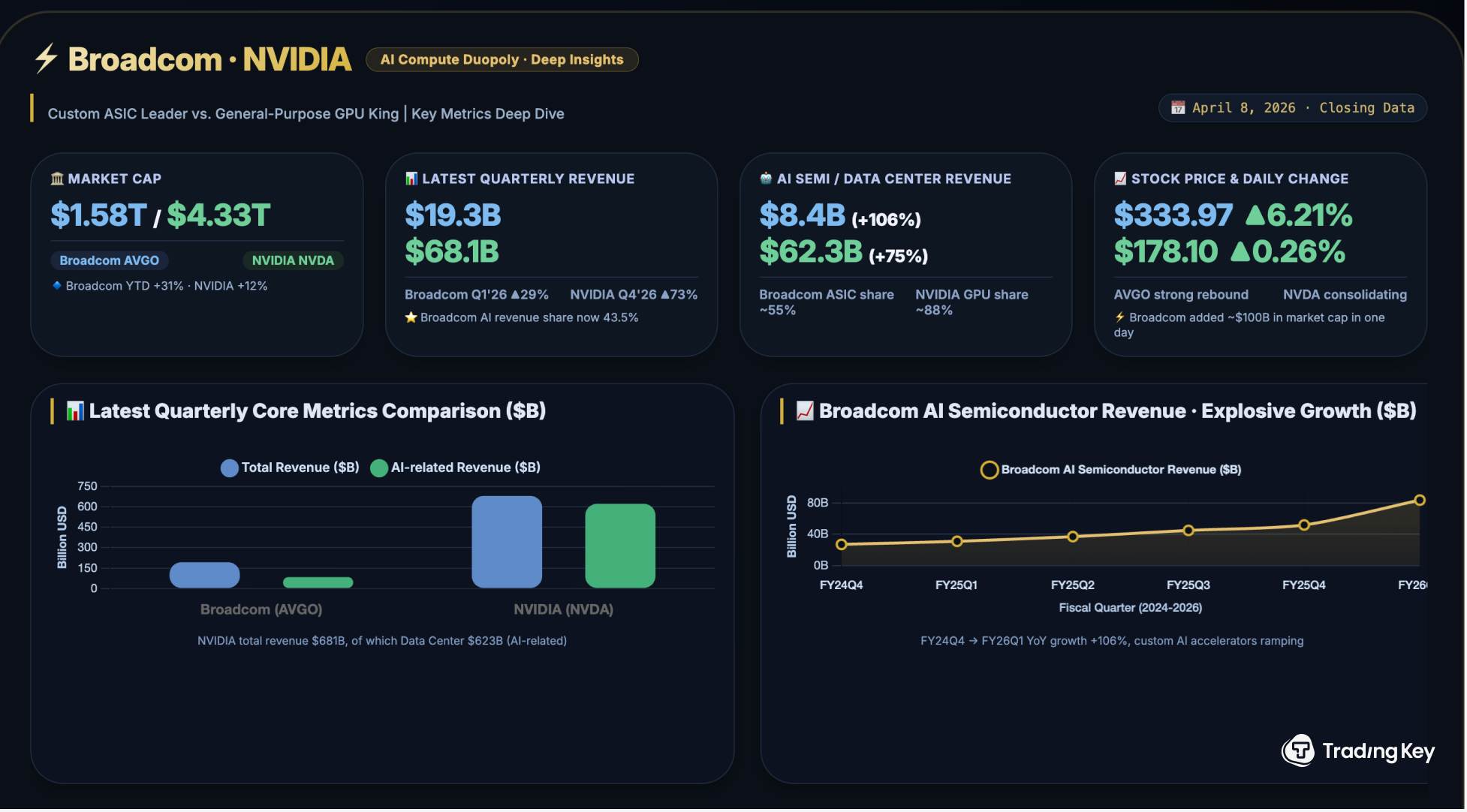
NVIDIA reported strong Q4 earnings, exceeding expectations with Data Center revenue surging 75% year-over-year to $62.3 billion, driven by AI infrastructure investments. Total revenue reached $68.13 billion, up 73%, with net profit nearly doubling to $43 billion. The company provided Q1 revenue guidance of $78 billion, surpassing market estimates. Hyperscale cloud providers remain key customers, with networking product sales increasing 263%. Despite strong results, after-hours trading showed volatility as the market priced in performance, and concerns about AI bubble theory persist. However, the report offered reassurance regarding the AI sector's growth trajectory.
TradingKey - On Wednesday,NVIDIA (NVDA) reported fourth-quarter results that beat expectations across the board, with core Data Center revenue growing 75% year-over-year to become the primary growth engine. Boosted by this, the company's stock rose over 3.8% in after-hours trading before paring gains to close up a slight 0.15%.
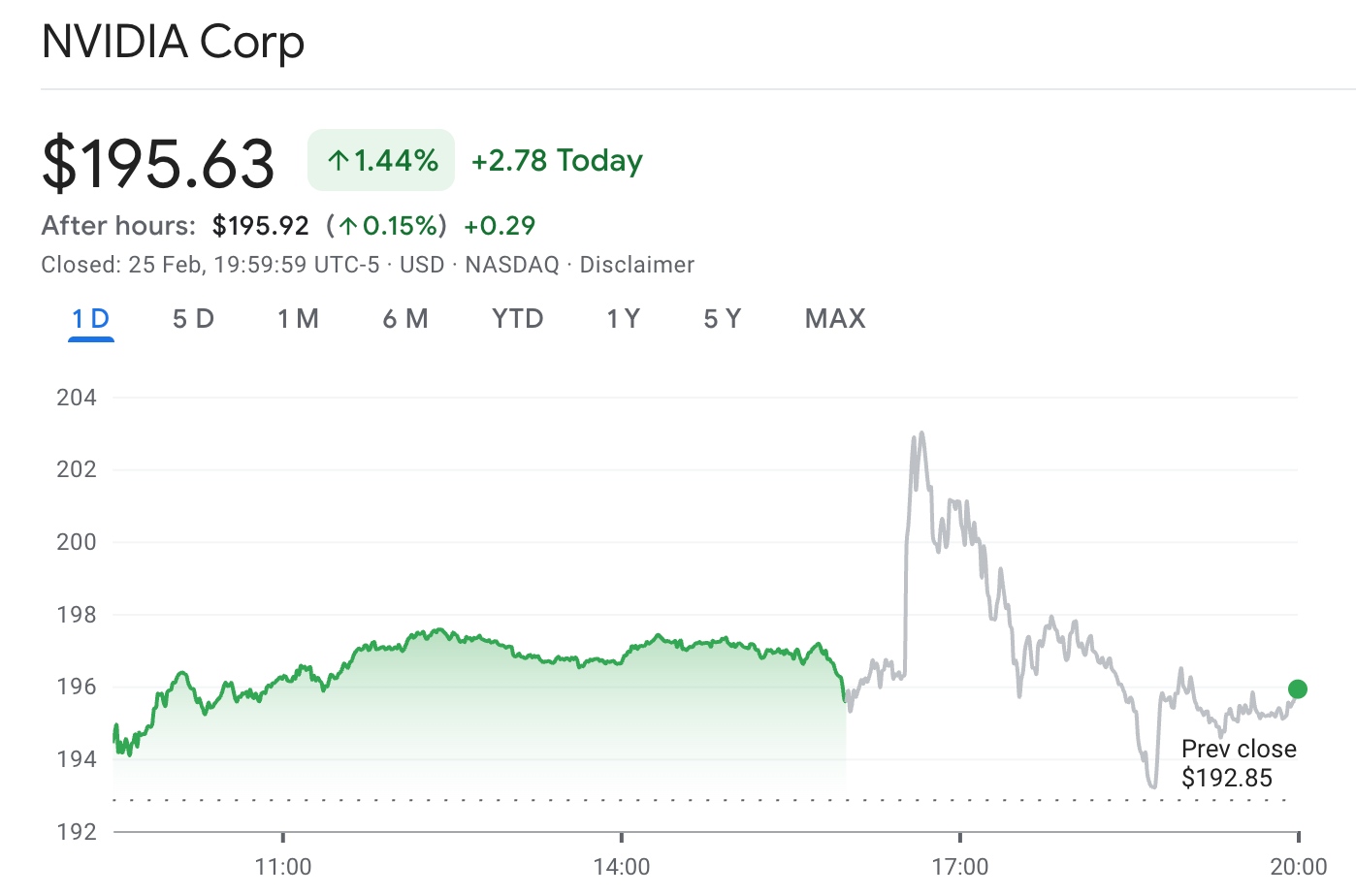
[NVIDIA After-Hours Stock Price Performance, Source: Google Finance]
The earnings report showed total revenue for the quarter reached $68.13 billion, a 73% year-over-year increase (compared to $39.3 billion in the same period last year), surpassing market expectations of $66.21 billion. Adjusted earnings per share were $1.62, also outperforming analysts' predictions of $1.53.
The Data Center segment contributed over 91% of revenue, with quarterly sales reaching $62.3 billion, significantly higher than the $60.69 billion expected by StreetAccount. This division primarily sells world-leading AI accelerator chips and continues to benefit from massive investment in AI infrastructure by tech giants. The company's net profit nearly doubled, rising from $22.1 billion a year ago to $43 billion.
Looking ahead to the first fiscal quarter, NVIDIA provided revenue guidance of $78 billion (±2%), far exceeding market expectations of $72.6 billion. The company specifically noted that this forecast excludes Data Center revenue from China, suggesting potential upside.
Since last year, NVIDIA's stock performance has outpaced major tech stocks, making it the most direct beneficiary of the AI wave. As of Wednesday's close, its cumulative gain for 2026 reached 5%, while the Nasdaq Composite fell 0.4% over the same period.
Wall Street had already reached a high level of consensus on NVIDIA's performance. Several weeks ago, the four major hyperscale cloud providers—Alphabet, Amazon, Meta, and Microsoft—released earnings reports revealing aggressive capital expenditure plans. Analysts estimate that combined capital spending for these four companies is expected to approach $700 billion in 2026, primarily for expanding AI computing clusters.
NVIDIA's Chief Financial Officer stated during the earnings call that hyperscale cloud providers 'remain the company's largest customer category,' accounting for slightly more than 50% of Data Center revenue.
Notably, sales of networking products used to connect GPU clusters reached $10.98 billion, a staggering 263% increase year-over-year. This growth was mainly driven by NVLink interconnect technology and Spectrum-X Ethernet switches, the latter of which has received bulk orders from several top-tier customers, including Meta.
Affected by tight memory chip supplies, market analysts speculate that NVIDIA may prioritize AI chip production capacity and might even skip the launch of its next-generation consumer gaming GPUs.
Judging from after-hours stock volatility, the market remains cautious. This is partly because NVIDIA's earnings beat was already a market consensus, and its stock price may have already priced in the expected results. Additionally, influenced by the AI bubble theory and views on AI's negative impact on traditional industries, the market remains relatively prudent.
Regardless, NVIDIA's earnings report served as a sedative for the market, alleviating panic over an AI bubble.
This content was translated using AI and reviewed for clarity. It is for informational purposes only.
Recommended Articles







Comments (0)
Click the $ button, enter the symbol, and select to link a stock, ETF, or other ticker.