


U.S. May Nonfarm Payrolls Preview: Can the Labor Market Open the Door to Rate Cuts? Gold, Dollar, U.S. Stocks Face Key Test



AI Podcast


The May non-farm payrolls report, due June 5 (ET), is expected to show slower job growth (85k-96k) and a stable unemployment rate (4.2%-4.3%). Average hourly earnings are projected to rise 0.3% month-over-month. The report's impact on Federal Reserve policy hinges on whether employment, unemployment, and wages signal labor market cooling. A stronger-than-expected report may support "higher for longer" rates, boosting Treasuries and the dollar while pressuring gold and high-valuation stocks. Moderate cooling could signal a "soft landing," supporting U.S. stocks. Significantly weaker data might raise recession concerns, with complex market reactions for Treasuries, gold, and equities.

TradingKey - On Friday, June 5 (ET), the U.S. Bureau of Labor Statistics will release the May non-farm payrolls report. Current market consensus expects U.S. non-farm payroll growth for May to slow further from April, with the current forecast range between approximately 85,000 and 96,000, compared to the previous reading of 115,000. The unemployment rate is expected to remain around 4.2% to 4.3%, while average hourly earnings are projected to rise 0.3% month-over-month, up from the previous 0.2%.
This NFP report will directly impact market judgments regarding the Federal Reserve's policy path. Previously, the U.S. PCE price index for April rose 3.8% year-over-year, and the core PCE rose 3.3%, indicating that inflation remains sticky. In an environment where inflation has not significantly declined, the Fed needs to see continued cooling in the labor market before it is more likely to signal easing. Therefore, the core focus of the May NFP is not just the number of new jobs, but whether the three indicators—employment, the unemployment rate, and wages—can simultaneously point toward a cooling labor market.
Based on April data, the U.S. labor market has already shown signs of marginal slowing. April non-farm payrolls added 115,000 jobs, lower than the 185,000 in March; the unemployment rate stayed at 4.3%; and average hourly earnings grew by only 0.2% month-over-month and 3.6% year-over-year. At the industry level, job growth was primarily concentrated in healthcare, transportation and warehousing, and retail, while federal government employment continued to decline and information sector jobs also extended their slide. This implies that while U.S. employment has not deteriorated comprehensively, the structure of job gains is uneven.
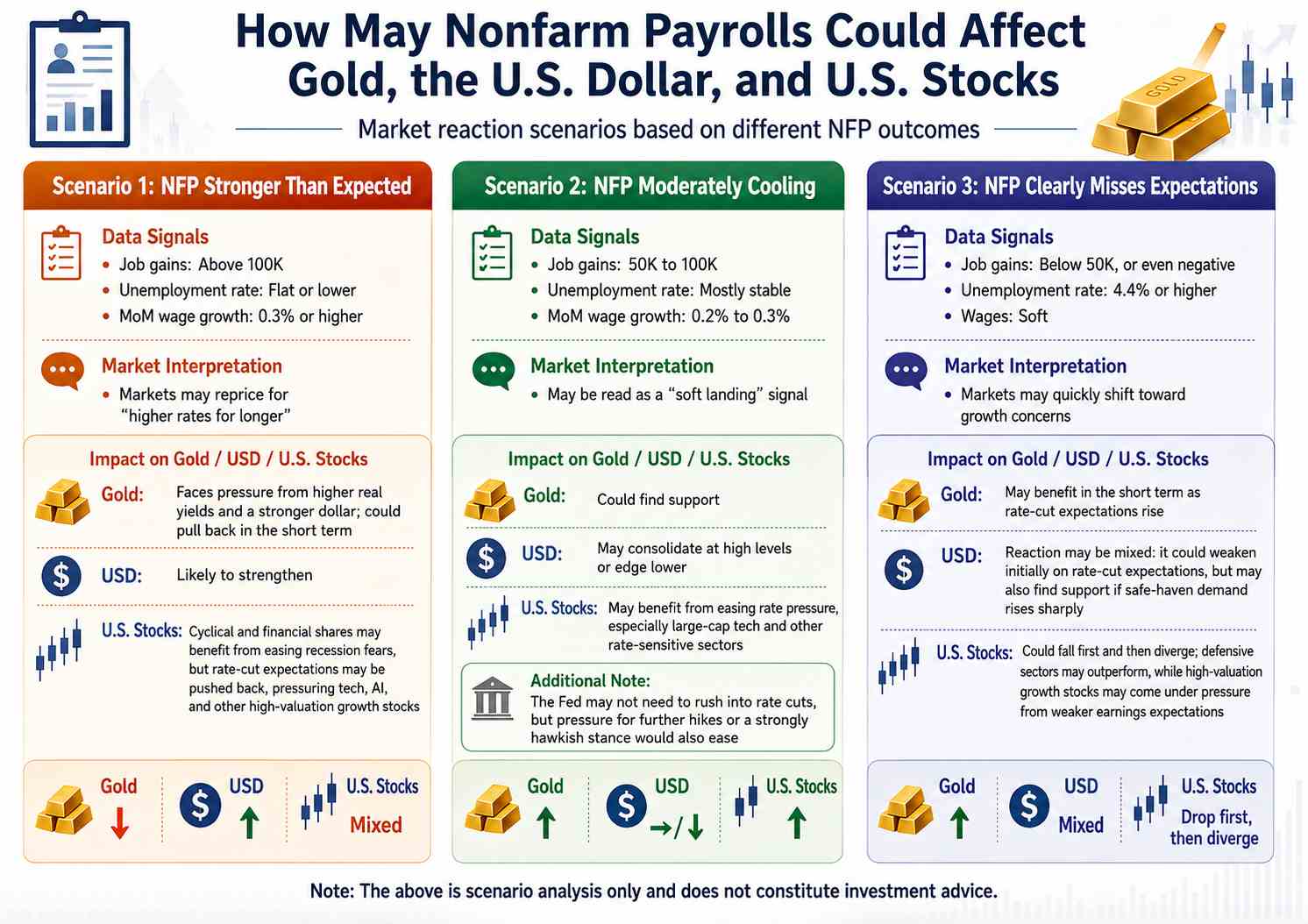
If the May NFP is stronger than expected—for example, if job growth exceeds 100,000, the unemployment rate remains steady or falls, and month-over-month wage growth reaches 0.3% or even higher—the market may reprice for "higher for longer" interest rates. In this scenario, Treasury yields and the U.S. dollar would likely strengthen, and gold ( XAUUSD) would face double pressure from rising real interest rates and a rebounding dollar, potentially leading to a short-term pullback. For U.S. stocks, a strong NFP would, on one hand, alleviate recession fears, benefiting cyclical and financial stocks; on the other hand, it would dampen rate-cut expectations, exerting pressure on high-valuation sectors like technology and AI growth stocks.
If the data shows moderate cooling—for instance, if job growth is between 50,000 and 100,000, the unemployment rate is basically stable, and month-over-month wage growth remains at 0.2% to 0.3%—it may be interpreted by the market as a "soft landing" signal. In this case, the Fed would not need to rush rate cuts, but the pressure to further hike rates or maintain a hawkish stance would also diminish. The dollar might fluctuate at high levels or pull back slightly, gold would likely gain support, and U.S. stocks could benefit from eased interest rate pressure, particularly large-cap tech stocks and rate-sensitive sectors.
If the NFP is significantly below expectations—for example, if job growth falls below 50,000 or even turns negative, and the unemployment rate rises to 4.4% or higher—the market will rapidly shift toward growth concerns. In the short term, rising rate-cut expectations might drive down Treasury yields and benefit gold; however, if investors begin to worry about a U.S. recession, U.S. stocks might drop initially before diverging, with defensive sectors performing relatively better, while high-valuation growth stocks could come under pressure due to downward revisions in earnings expectations. The dollar's response in this scenario could be complex: it might initially weaken on rate-cut expectations, but if safe-haven sentiment surges, it could also receive support from safe-haven buying.
Overall, next Friday's U.S. May NFP report will be the core factor determining short-term market direction. For gold, the most ideal scenario is cooling employment without a collapse and moderated wage pressure; for the dollar, strong employment and wages remain the primary supports; for U.S. stocks, the market most hopes to see a moderate cooling rather than overheating or sudden freezing. If the data falls within the soft-landing range, risk appetite for U.S. stocks is expected to continue; if the data deviates significantly in either direction, U.S. equity performance may be weighed down.
This content was translated using AI and reviewed for clarity. It is for informational purposes only.
Recommended Articles











Comments (0)
Click the $ button, enter the symbol, and select to link a stock, ETF, or other ticker.