


Broadcom vs Nvidia: Which AI Chip Is More Profitable to Buy?



AI Podcast


Broadcom's stock surged on significant long-term contracts with Google and Anthropic for custom AI chips (TPUs). These deals highlight a shift towards co-designed ASICs, offering superior efficiency and lower costs compared to NVIDIA's GPUs. NVIDIA, conversely, faces capacity constraints and major clients reducing reliance on its off-the-shelf products. While NVIDIA dominates general AI training, Broadcom is positioned to benefit from the growing demand for custom inference chips. Analysts are divided, but both companies are seen as undervalued, with NVIDIA favored for general AI computing power and Broadcom for custom chip development.
TradingKey - April 7, 2026: Two AI chip stocks exhibited starkly different trajectories
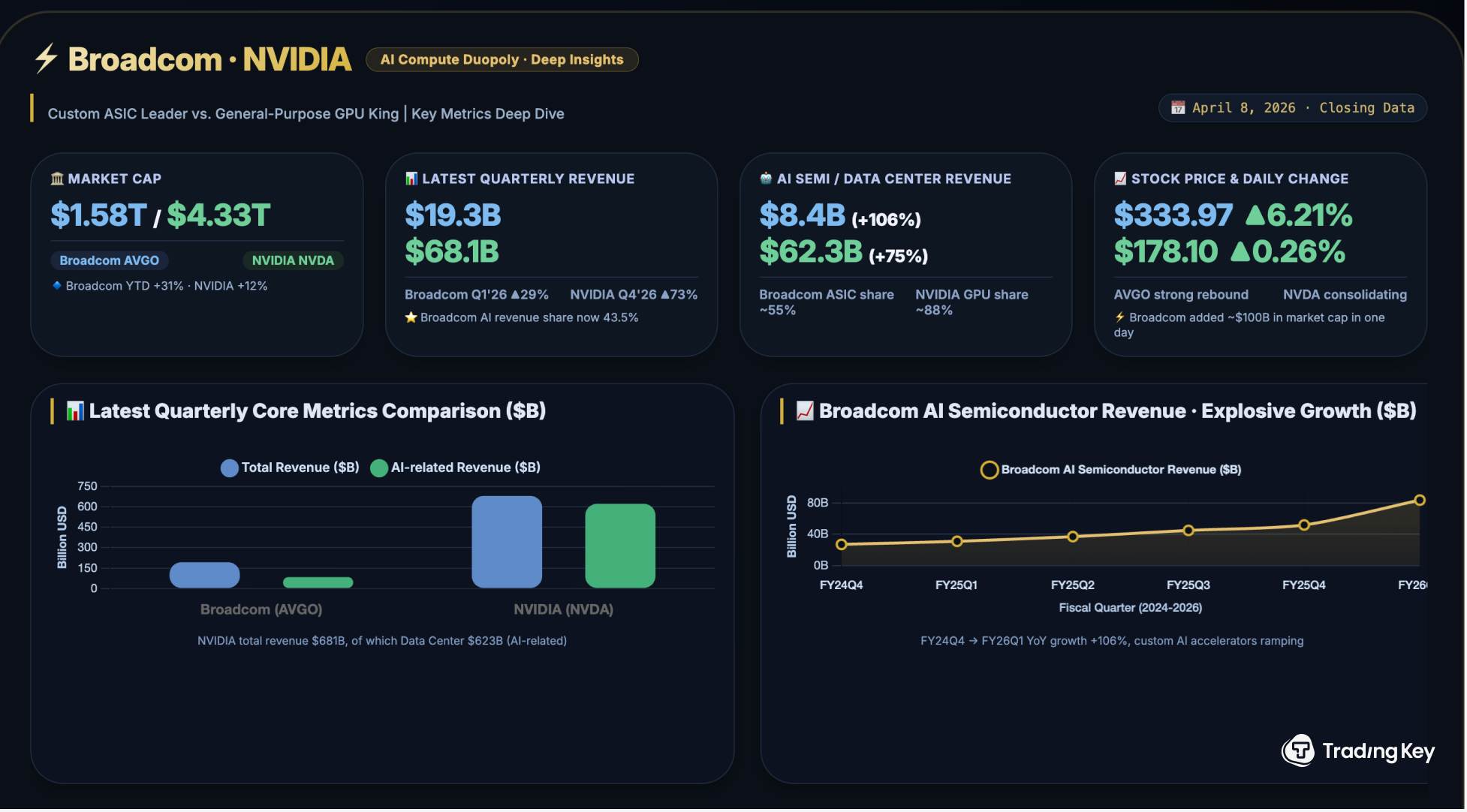
Broadcom ( AVGO ) announced a five-year contract with Google and secured a major computing power deal from AI standout Anthropic, sending its stock price up 6.21% , with trading volume surpassing $10.7 billion.
NVIDIA ( NVDA ) however, closed at $178.10 with virtually no gain. Worse still, NVIDIA's stock price has fallen more than 20% from its all-time high, officially entering a "technical bear market"
Amidst the divergence in share prices, a question has surfaced: Is the investment logic for AI chips undergoing a fundamental shift?
I. Who Is Broadcom? Why Has It Suddenly Emerged as the "Hidden Champion" Of Ai Chips?
Broadcom is no overnight success; the company has long been the world's largest custom AI chip design firm, commanding a market share of over 70% in custom AI accelerators (ASICs).
Unlike NVIDIA, Broadcom does not generate revenue by selling "off-the-shelf chips," but instead collaborates directly with Google ( GOOGL ), Meta ( META ), OpenAI, Anthropic, and other hyperscale cloud service providers to co-design proprietary AI acceleration chips—the so-called ASICs.
The TPU (Tensor Processing Unit) Broadcom designed for Google is the most successful case study: its energy efficiency ratio is 2 to 3 times that of NVIDIA's H100, and its inference costs are 30% to 40% lower. For tech giants investing tens of billions of dollars, this proposition is simply too compelling to ignore.
Beyond chip design, Broadcom also provides the high-speed network switches and interconnect components required for data centers, serving as a critical infrastructure supplier for the entire AI hardware stack.
II. Why Did Broadcom Surge? Two Deals Lock in the Next Five Years
Broadcom’s recent rally was primarily driven by two heavyweight deals.
First, securing a five-year long-term contract with Google. . Broadcom will design and supply multiple future generations of TPU chips for Google and provide the networking components required for next-generation AI data racks, extending the partnership through 2031. This implies that Broadcom has effectively cornered Google's custom AI chip orders for the next five years.
Second, securing a major computing power order from Anthropic. . Anthropic—the developer behind the Claude LLM—has seen its annualized revenue skyrocket from approximately $9 billion at the end of 2025 to over $30 billion. Starting in 2027, Broadcom will provide the firm with approximately 3.5 gigawatts of TPU computing capacity. Based on this, Mizuho Securities analysts estimate that Anthropic alone could contribute roughly $21 billion to Broadcom’s revenue in 2026, potentially reaching $42 billion in 2027.
Broadcom had previously projected AI revenue of approximately $100 billion for fiscal 2027, but Bernstein analysts noted that "this figure now appears clearly conservative."
According to the earnings report, Broadcom’s fiscal first-quarter 2026 revenue was $19.3 billion, a 29% year-over-year increase; AI semiconductor revenue reached $8.4 billion, surging 106% year-over-year—far exceeding expectations and accounting for roughly 43% of total quarterly revenue. Strong demand growth for custom ASIC chips and AI networking products served as the primary drivers of this performance.
III. Why is Nvidia Stagnating? Beset by a Triple Dilemma
Nvidia's share price weakness stems from a confluence of multiple pressures rather than a single factor.
1. Capacity Bottlenecks
Nvidia's next-generation Rubin GPUs were originally slated for mass production of approximately 2 million units in 2026. However, following delays in HBM4 (High Bandwidth Memory) certification and supply timelines from SK Hynix and Micron, KeyBanc analyst John Vinh anticipates that actual production could be revised downward to about 1.5 million units. With demand remaining robust, supply-side constraints are set to weigh on the company's ability to convert demand into realized earnings.
2. Major Customers Shifting Toward Customization
Google's long-term agreement with Broadcom signals a clear intent to reduce its reliance on Nvidia GPUs. Furthermore, tech giants such as Meta and Amazon are accelerating their development of in-house or custom AI chips. Research firm Counterpoint forecasts that Broadcom's market share in the custom chip segment will expand to 60% by 2027.
3. Valuation-Expectation Mismatch
In its most recent quarter (Q4 FY2026), Nvidia reported revenue of $68.1 billion, a 73% year-over-year increase, with data center revenue climbing 75% to $62.3 billion. Nevertheless, its share price failed to gain traction following the earnings release. Most positive expectations have already been priced in by the market, making it difficult for bullish news to drive shares higher—a scenario typically interpreted as a sign of strain on valuation logic.
IV. Core Distinction: Nvidia Sells "Universal Wrenches," Broadcom Creates "Custom Molds"
Explaining the difference between the two in layman's terms:
- Nvidia Nvidia sells 'universal wrenches' that can turn any screw. Its CUDA software ecosystem has locked in over 95% of AI developers globally, resulting in extremely high switching costs.
- Broadcom Broadcom helps major clients build 'customized molds' that turn only one type of screw, but they do so at lightning speed and lower costs. Deploying tens of thousands of ASIC chips in a large-scale data center can save hundreds of millions of dollars in annual electricity costs alone.
Counterpoint predicts that the AI chip boom will enter Phase Two—intense competition between ASICs and GPUs, and Broadcom is expected to be the biggest winner.
However, the two technological paths will coexist for the long term. With an order backlog of over $1 trillion, Nvidia remains unshakeable in general-purpose AI training and the SME market; meanwhile, as AI shifts from training to inference, the rise in market share for customized ASICs is nearly inevitable.
V. How Should Investors Choose?
Wall Street analysts are currently sharply divided, yet the general consensus is that both companies are deeply undervalued: Nvidia has a price target of $265 (current price $178.1), while Broadcom has a target price of $472.5 (current price approx. $333.97), both implying roughly 50% upside potential. However, Seaport Research analysts stand apart, assigning Nvidia a "Sell" rating and a $140 target price, contending that the trend toward custom chips and in-house development by clients will erode its market share over the long term.
For retail investors:
- For those who believe that general AI computing power will remain in short supply, Nvidia remains the primary choice.
- For those optimistic about the surge in in-house development by tech giants and inference demand, Broadcom may offer greater opportunities.
Recommended Articles







Comments (0)
Click the $ button, enter the symbol, and select to link a stock, ETF, or other ticker.