Indicators
Indicators
Value
Direction
MACD(12,26,9)
0.003
Buy
RSI(14)
65.556
Neutral
STOCH(KDJ)(9,3,3)
58.275
Neutral
ATR(14)
0.021
High Vlolatility
CCI(14)
107.444
Buy
Williams %R
26.912
Buy
TRIX(12,20)
0.053
Sell
StochRSI(14)
100.000
Buy


4.379
Today
-0.05%
5 Days
+0.20%
1 Month
+1.41%
6 Months
+2.51%
Year to Date
+3.92%
1 Year
+3.02%
Opening Price
4.375Previous Closing Price
4.381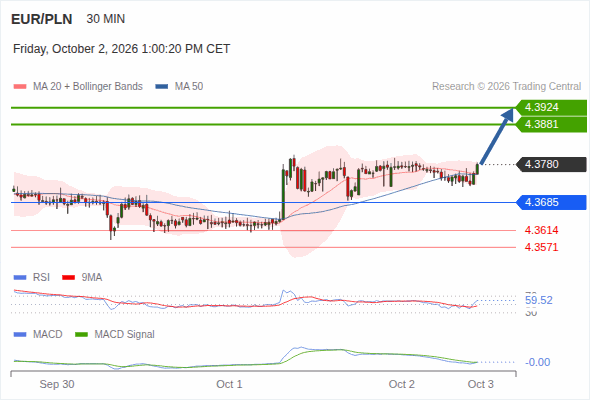
The upside prevails as long as 4.3685 is support, with 4.3881 and 4.3924 as targets
below 4.3685, expect 4.3614 and 4.3571.
The upside prevails as long as 4.3685 is support, with 4.3881 and 4.3924 as targets
ING strategist Frantisek Taborsky says Moody’s downgrade of Poland to A3 adds to pressure on CEE assets at the start of a relatively quiet second half of the month.
Frantisek Taborsky at ING argues that the stronger US Dollar (USD) following the Federal Reserve (Fed) meeting is clearly negative for emerging markets, keeping Central and Eastern European (CEE) currencies under pressure.
ING’s Frantisek Taborsky explains that a surge in energy prices, a jump in US 10-year yields to 5% and a stronger Dollar have hit CEE currencies and pushed local rates higher.
ING’s Frantisek Taborsky notes that the National Bank of Poland maintained a dovish stance, signalling no need to adjust rates potentially until mid-next year despite rising inflation.
Commerzbank’s Antje Praefcke reports that the Polish central bank kept its key rate at 3.75%, while Governor Glapiński signalled no cuts until year-end after previously sounding dovish.
ING’s Frantisek Taborsky reports that the National Bank of Poland left rates at 3.75% and provided limited new guidance, shifting focus to Governor Glapinski’s press conference. With markets already pricing around 85bp of tightening, ING sees a high bar for a hawkish surprise.
The Indicators feature provides value and direction analysis for various instruments under a selection of technical indicators, together with a technical summary.
This feature includes nine of the commonly used technical indicators: MACD, RSI, KDJ, StochRSI, ATR, CCI, WR, TRIX and MA. You may also adjust the timeframe depending on your needs.
Please note that technical analysis is only part of investment reference, and there is no absolute standard for using numerical values to assess direction. The results are for reference only, and we are not responsible for the accuracy of the indicator calculations and summaries.