


Natural Gas (NATGAS) Is up 2.66% on Jul 8: Is the Market Repricing It?



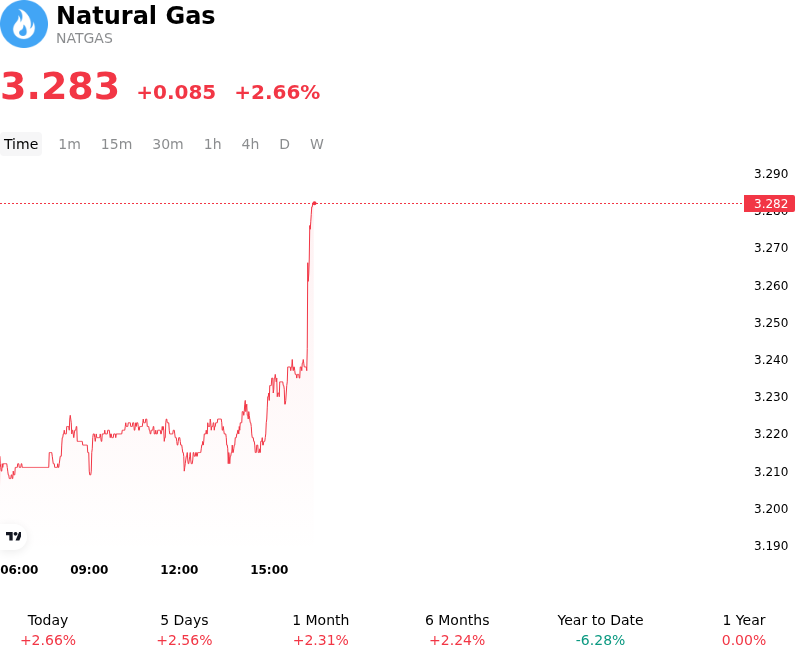
Natural Gas (NATGAS) is up 2.66% at Jul 8 04:30(ET), now at $3.283, with a 7-day up of 4.22%.
What is driving Natural Gas (NATGAS)’s stock price up today?
US natural gas futures rose to their highest level in over a week, driven by a combination of falling domestic production, stronger export demand, and geopolitical ripples in the global energy market. This upward momentum has allowed the commodity to break above a descending trendline that had capped prices since late June, attracting fresh technical buying interest from institutional market participants.
The primary catalyst on the supply side is a visible pullback in domestic dry gas production. Output in the Lower 48 states declined to around 109.4 billion cubic feet per day in early July, down from the June average of 110.0 billion cubic feet per day. This tightening of physical supply helped offset a previously bearish storage overhang, where domestic stockpiles had hovered more than six percent above the historical five-year average.
Simultaneously, demand expectations have received a dual boost. On the domestic front, speculative positioning was supported by recent intense heatwaves across the southern and western United States, which drove a massive surge in power burn as generators scrambled to meet air-conditioning needs. Although some weather models project a temporary moderation in temperatures for the eastern half of the country, long-range forecasts continue to point toward widespread, above-normal heat for the back half of July, maintaining expectations of tight near-term power sector demand.
On the export front, demand for liquefied natural gas has shown robust recovery. Daily flows to major domestic LNG export terminals climbed to an average of 18.1 billion cubic feet per day so far in July, up from 17.4 billion cubic feet per day in June.
Adding to the bullish sentiment is a sharp geopolitical risk premium stemming from international developments. A recent attack on a Qatari LNG carrier in the Strait of Hormuz drove European natural gas prices to a three-week high. Because European storage facilities remain well below their typical seasonal average for this time of year, disruption risks in the Persian Gulf have triggered concerns that European buyers will be forced to compete aggressively for Atlantic-basin cargoes, potentially pulling more US LNG volumes overseas and tightening the domestic market balance.
While structural headwinds—such as high overall inventory levels and projections of a strong El Niño pattern suppressing winter heating demand—remain key risks monitored by investors, the immediate combination of lower daily output, persistent midsummer heat, and heightened geopolitical risk has shifted the short-term balance firmly in favor of bulls.
Technical Analysis of Natural Gas (NATGAS)
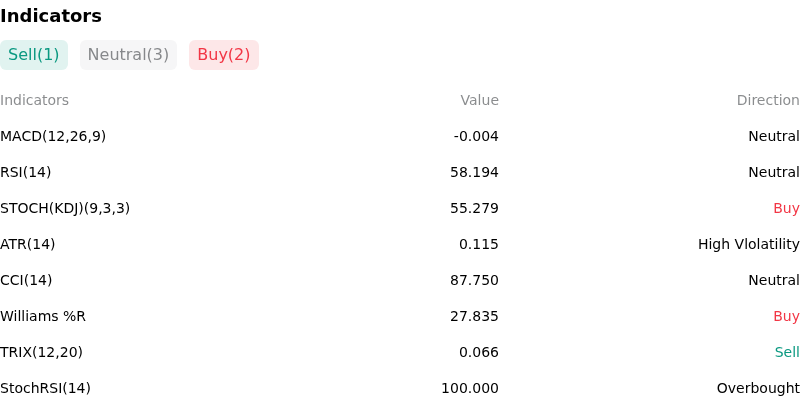
Technically, Natural Gas (NATGAS) shows a MACD (12,26,9) value of -0.004, indicating a neutral signal. The RSI at 58.194 suggests neutral condition and the Williams %R at 27.835 suggests buy condition. Please monitor closely.
More details about Natural Gas (NATGAS)
Recent Events and Risks:
- Larger-Than-Expected Storage Build: The U.S. Energy Information Administration (EIA) reported a working gas injection of 87 Bcf, significantly outpacing market expectations of a 78 to 83 Bcf build. This unexpectedly large storage injection has expanded the domestic inventory cushion to more than 6% above the historical five-year average, establishing a comfortable supply buffer that is capping immediate price upside.
- Moderating Near-Term Weather Forecasts: Short-term meteorological models have adjusted their outlooks to show cooling and moderating temperatures across the eastern two-thirds of the United States. This shift is projected to significantly lower Cooling Degree Days (CDDs), suppressing power sector demand for air-conditioning and stripping the weather-driven demand premium out of the spot and futures markets.
- Underperforming Domestic Power Demand: Institutional research highlights that domestic gas-fired power generation is underperforming expectations relative to seasonal temperatures. Analysts warn that if this domestic consumption drag persists alongside resilient production levels, incremental storage could build by up to 200 Bcf over the summer, creating significant downward pricing pressure on Henry Hub futures.
- High Prices Inducing Global Demand Destruction: According to the International Energy Agency (IEA), global natural gas consumption is forecast to contract by 0.5% in 2026, marking the third annual decline this decade. Elevated prices have catalyzed severe gas-to-coal switching in Asia's power sector and forced lower operating rates across industrial facilities, posing a long-term downside risk to structural demand.
This article may include AI-generated content that is human-reviewed, which is for reference and general information purposes only and does not constitute investment advice.
Recommended Articles







Comments (0)
Click the $ button, enter the symbol, and select to link a stock, ETF, or other ticker.