



TradingKey - Against the backdrop of persistent global economic turbulence and escalating uncertainties, effectively allocating "safe-haven assets" has once again become a core concern for investors. Entering 2025, international markets face multiple pressures, including intensifying trade frictions and slowing growth across major economies, driving capital back to gold as a traditional safe-haven asset.
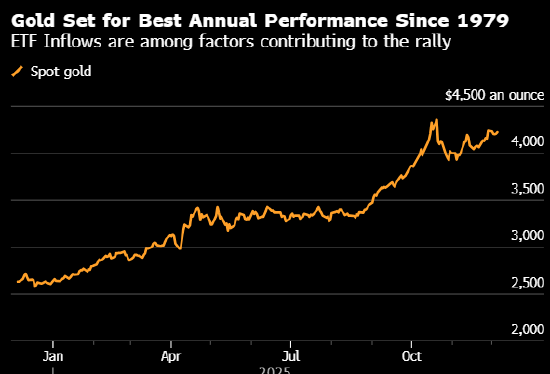
Since gold prices surpassed $4,000 per ounce this year, a more efficient and digitalized way to access gold—the Gold Exchange-Traded Fund (Gold ETF)—has become an increasingly vital component of institutional and individual portfolios.
According to the latest data from the World Gold Council (WGC), global gold ETF holdings increased to 3,932 tonnes by the end of November 2025, marking the sixth consecutive monthly growth.
Net purchases in 2025 alone exceeded 700 tonnes, making it virtually certain to become the largest single-year net addition since these products were introduced. Except for a few months, quarterly ETF fund flows have consistently shifted toward precious metals, reflecting increasingly strong structural demand for long-term risk-mitigation assets.
Notably, in the Asian market, China accounted for the majority of November’s gold ETF inflows, while India recorded net subscriptions for six consecutive months.
(Source: Bloomberg)
However, before making allocation decisions, investors need deep reflection.
Do you truly understand "Gold ETFs"? How exactly do they operate? What are their investment advantages and potential risks? And does it deserve a place in your core asset allocation?
The Meaning of Gold ETFs
A Gold ETF (Gold Exchange-Traded Fund) is an investment fund publicly traded on securities markets with physical gold as its underlying asset. This investment vehicle allows investors to indirectly participate in gold price movements electronically, without the need to physically purchase, store, or dispose of tangible gold.
Holding a Gold ETF establishes a non-physical holding relationship—ownership is registered purely in digital form. Compared to physical gold, Gold ETFs eliminate concerns regarding purity verification, secure storage, and insurance costs, offering higher liquidity and trading convenience.
In form, Gold ETFs belong to the category of commodity-based exchange-traded funds, operating with the same mechanism as other ETF products traded on stock exchanges. Once investors purchase this product on the exchange, they do not receive physical gold of equivalent weight; instead, they obtain corresponding cash returns based on current market prices when selling their shares.
For investors seeking to diversify portfolios or hedge against inflation and market volatility risks, Gold ETFs provide an efficient and convenient pathway to participate in the gold market.
The Uses of Gold ETFs
Gold Exchange-Traded Funds (Gold ETFs) are not merely financial instruments backed by precious metals; they serve multiple investment purposes. Through digitalized holding mechanisms, they enable investors to conveniently access the gold market without direct handling of physical gold, thereby fulfilling diverse roles within personal or institutional portfolios.
First, Gold ETFs provide a convenient channel for investing in the gold industry chain. While they fundamentally track gold prices, they also serve as an entry point into related sectors such as precious metals mining, processing, and transportation. For investors seeking exposure to commodity markets without directly handling physical assets or derivatives, Gold ETFs offer high accessibility and liquidity, making them an important tool for allocating commodity-based assets.
Second, Gold ETFs possess inherent advantages in risk management. Often regarded as defensive assets, they effectively hedge against inflation and systematic market volatility. During periods of severe financial market turbulence—especially when stocks or currencies experience significant depreciation—gold prices typically rise. Consequently, allocating a certain percentage of Gold ETFs within an investment portfolio is considered an effective alternative to traditional insurance strategies or bond-type assets.
For example, when the U.S. dollar weakens or global economic uncertainty increases, capital shifting toward value-preserving precious metals may drive gold prices upward. Holding relevant ETFs allows investors to profit from such movements. Simultaneously, during sharp market declines, short-term inverse products can be utilized to hedge losses, thereby enhancing the overall portfolio’s resilience.
For investors with clear medium- to long-term allocation objectives, Gold ETFs also represent an ideal choice.
How Do Gold ETFs Work?
Gold ETFs are typically established by fund management companies, primarily by purchasing gold bars meeting international standards (usually with purity no lower than 99.5%) to construct the fund’s underlying asset portfolio.
Subsequently, units corresponding to these physical holdings are created and listed for trading on securities exchanges. Each fund unit represents a digitized equivalent of physical gold ownership—one unit typically representing approximately 1 gram or other fixed weight standards of gold value.
Investors need not open precious metals accounts; they can trade these ETF shares through ordinary stock accounts, just like buying and selling regular stocks. This fully electronic operational model greatly simplifies the cumbersome processes involved in traditional physical gold purchases, such as storage, security, transportation, and purity verification.
Since each ETF share represents a portion of the actual physical holdings, its net asset value fluctuates in sync with international or domestic spot gold prices. For instance, when market gold prices rise by 2%, the corresponding fund unit’s net value typically increases by a similar proportion; if gold prices fall, it adjusts inversely. Although actual trading prices may occasionally deviate slightly from theoretical net value due to supply-demand dynamics, intraday volatility, and operational costs, they generally maintain good tracking accuracy and price transparency.
Different Types of Gold ETFs
Before delving deeply into Gold ETFs, it’s essential to recognize that these products do not exist in a single form. Based on varying underlying assets and strategy designs, Gold ETFs can be primarily classified into the following types, each suited to different investor needs and market outlooks.
- Physical Gold ETFs
These funds directly invest in standardized physical gold bars. Each fund share represents partial ownership of actual gold reserves, with its value closely tracking spot gold price movements. Investors can participate in gold price trading without concerns about physical gold storage, insurance, or purity verification.
- Gold Mining ETFs
Unlike direct physical holdings, these funds allocate capital to publicly listed mining companies engaged in exploration, extraction, and refining operations. Their performance may be influenced by factors such as corporate operational efficiency and management decisions, in addition to gold price movements.
- Leveraged Gold ETFs
Leveraged products amplify daily sensitivity to gold price movements by utilizing financial derivatives such as futures contracts and swap agreements, thereby achieving 2x or even 3x daily tracking of price fluctuations.
These products primarily target short-term traders rather than long-term investors. While leverage can generate exponential gains in volatile markets, it equally magnifies potential losses.
- Inverse Gold ETFs
Inverse Gold ETFs (also known as Short Gold ETFs) are designed to deliver returns opposite to gold price movements, enabling investors to profit from declining gold prices. They establish inverse exposure to gold prices through derivatives. When the precious metals market weakens or future declines are anticipated, these products function as a "short-selling" tool to capture profits from downward price movements.
Inverse ETFs also favor short-term trading strategies. Long-term holding may face volatility decay issues similar to leveraged ETFs.

(Source: Freepik)
Advantages of Investing in Gold ETFs
- Liquidity and Trading Convenience
Gold ETFs are traded in real time on stock exchanges, allowing investors to buy or sell at any point during market hours. Unlike physical gold, which requires time-consuming efforts to find buyers and manage delivery logistics, gold ETFs offer quick order execution. Upon settlement, funds are credited promptly according to exchange regulations, delivering significantly higher liquidity than physical bullion.
- No Storage Required, Avoiding Physical Asset Risks
Unlike gold bars or jewelry that must be stored in bank vaults—incurring security concerns and upkeep costs—gold ETFs are held electronically. This eliminates risks related to storage, theft prevention, and purity verification. As a result, investors avoid logistics and safekeeping expenses while enjoying improved capital efficiency.
- Cost-Effectiveness
Investing in gold ETFs typically incurs no subscription or redemption fees; only a low brokerage commission is required. This is substantially lower than the premiums, fabrication costs, or taxes associated with purchasing coins or jewelry.
During the holding period, there are also no minting charges or value-added services commonly bundled into physical products, making gold ETFs one of the most economical ways to gain precious metal exposure.
- Diversification
Gold prices generally exhibit a negative correlation with equity markets and tend to perform well during times of market turmoil or geopolitical tension. Allocating part of an investment portfolio to gold ETFs can enhance portfolio stability during downturns by providing an effective risk-hedging mechanism.
- Low Investment Threshold
Physical gold usually requires a substantial initial capital outlay. In contrast, most mainstream gold ETFs allow investors to start with as little as one unit. This opens access for retail investors looking to gain exposure without having to commit large sums upfront—as was commonly required when purchasing full-size bars in the past.
Disadvantages of Investing in Gold ETFs
- Management Fees Can Erode Long-Term Returns
While the overall cost of gold ETFs is lower than that of physical gold ownership, these funds typically charge a management fee—a small percentage of assets under management—to cover operational expenses. However, for long-term holders, this ongoing expense may gradually erode total returns, particularly during periods when gold prices remain relatively flat.
- Tracking Error Risk
Although gold ETFs aim to closely follow the price movements of spot gold, factors such as liquidity constraints, fund structure design, and daily fluctuations in premiums or discounts can cause discrepancies between net asset value (NAV) and trading price.
This “tracking error” reflects the fund’s inability to perfectly replicate the underlying asset’s performance and tends to become more pronounced during periods of heightened short-term volatility. Even physically backed gold ETFs may experience annualized tracking differences ranging from 0.2% to 0.5%, due to factors such as transaction costs, cash holdings within the fund, or market maker efficiency.
- Counterparty Risk
This risk is particularly relevant for synthetic ETF products that replicate performance through swap agreements or other derivatives. If a derivative issuer defaults on its obligations, it could expose the fund to significant losses or even trigger redemption suspensions. Although most mainstream ETFs implement mechanisms like third-party custodianship and multi-layer collateralization to mitigate such risks, theoretical counterparty credit risk cannot be eliminated.
The Bottom Line
Thanks to their ability to combine real-time exposure to spot gold with the flexibility of stock market trading mechanisms, gold ETFs offer investors an efficient, transparent, and easily accessible way to invest in gold.
Whether used for portfolio diversification, long-term strategic allocation, or as a safe-haven asset during economic uncertainty, gold ETFs have demonstrated unique value across multiple market environments. For individuals or institutions seeking exposure to precious metals without the complexity tied to physical storage and handling, they represent a modern financial instrument worthy of core portfolio consideration.
