



TradingKey - If there were a financial instrument that could multiply your gains when you’re right, would you use it?
, Designed to deliver amplified daily returns without altering directional market views, these products enable smaller capital to capture greater intraday price swings. Whether betting on tech stocks’ upside or hedging against index declines, they offer "enhanced" strategic options.
However, precisely because of this, they are not ordinary ETFs—their complex structure, daily reset mechanism causing path dependency on short-term volatility, and higher fees make them closer to tactical speculative tools rather than long-term allocation vehicles.
To fully understand what leveraged ETFs are, how they operate, and the critical risks investors must heed, continue reading this article.
What Is a Leveraged ETF?
"Leverage" refers to a strategy that amplifies investment exposure by borrowing capital to achieve magnified movements relative to an underlying asset.
Consequently, leveraged ETFs are funds that utilize internal borrowing or financial derivatives (such as futures, options, swaps, etc.) to target amplified daily returns. These products hold both equity positions and debt obligations, accelerating target returns through their capital structure.
Traditional non-leveraged ETFs typically track an underlying index on a 1:1 basis. Leveraged ETFs, however, aim to deliver 2x or 3x the daily performance of their benchmark index.
For example, if an index rises 1% in a day, a 2x leveraged ETF should theoretically gain 2%, and a 3x version would rise 3%—and vice versa for declines. Crucially, this strategy compounds daily and does not linearly amplify long-term returns.
The key to understanding leveraged ETFs lies in recognizing their "daily reset" feature. To maintain the target leverage ratio, these funds must rebalance daily—adjusting derivative positions based on that day’s asset value to precisely reset the next day’s leverage ratio to 2:1 or 3:1.
It must be emphasized that leverage is a double-edged sword. While it magnifies gains, it equally amplifies losses. During periods of high volatility, leveraged ETFs may experience dramatic price swings—even suffering significant value erosion within a single trading day. Due to these characteristics, leveraged ETFs are primarily designed for short-term trading strategies (typically held for one day to several weeks), not as long-term investment vehicles.
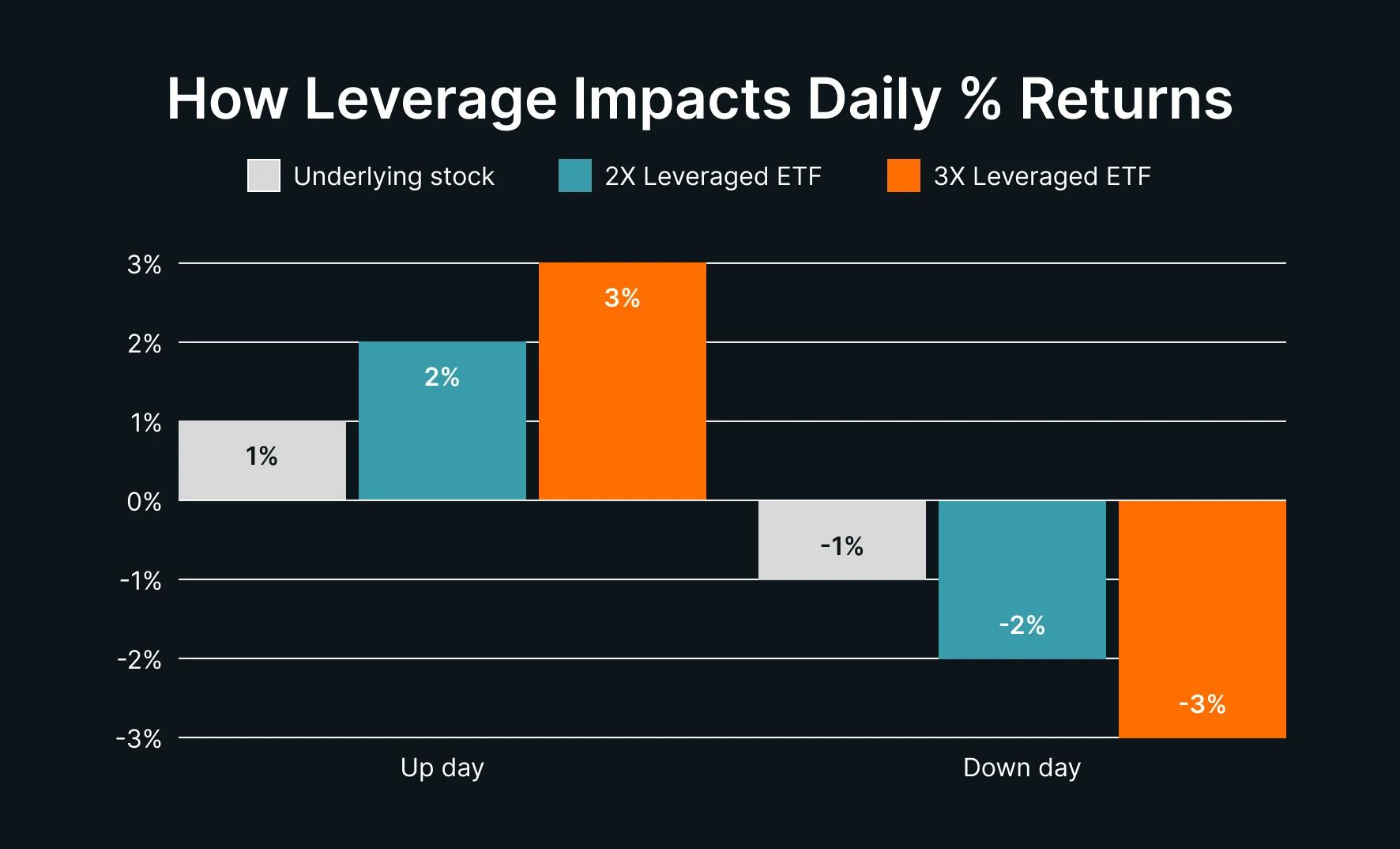
(Source: Leverage Shares)
Operational Mechanics of Leveraged ETFs
Leveraged ETFs aim to deliver multiples of the daily return of their underlying index, excluding fees and costs.
To achieve this, leveraged ETFs typically hold cash or collateral while using derivative instruments such as swap agreements to amplify portfolio risk exposure to the target multiple.
Funds adjust holdings after each trading day to ensure the predetermined leverage level is maintained at the next day’s market open.
This daily reset mechanism produces two critical consequences.
First, the long-term performance of leveraged ETFs generally does not simply equal a multiple of the underlying index’s return.
Consider a concrete example: If the S&P 500 Index falls 10% on Day 1 and rises 11.1% on Day 2—returning to its starting point—a 2x leveraged ETF would decline 20% on Day 1 and gain 22.2% on Day 2, resulting in a final net value of only 97.6% of the initial value—a 2.4% loss. This phenomenon is known as "volatility decay," particularly pronounced during volatile markets.
Second, the amplification of losses exponentially increases recovery difficulty. When lithium mining stocks plunge 20% in a single day, a 3x leveraged ETF loses 60% of its value. In a non-leveraged ETF, the stock needs only a 25% rebound to break even; for the 3x leveraged ETF, the underlying asset must surge 150% to recover the same loss.
It must be emphasized that due to their daily calculation mechanism, these funds are unsuitable for long-term continuous holding. During volatile or choppy market periods, this structure carries significant risk of long-term deviation from expected outcomes.
Leveraged ETFs vs. Traditional ETFs
Though both belong to the exchange-traded fund family, traditional ETFs and leveraged ETFs differ substantially in structure, objectives, and risk profiles.
Feature | Traditional ETF | Leveraged ETF |
Investment Method | Directly holds component stocks | Uses derivatives and swap agreements to create amplified exposure |
Tracking Target | 1:1 replication of index/asset class | 2x, 3x, etc. of the underlying asset/index’s daily return |
Creation/Redemption Mechanism | Supported; interacts with APs to keep price near NAV | Supported; interacts with APs (similar structure but different underlying mechanics) |
Return Pattern | Mirrors benchmark performance | Amplifies daily returns; affected by compounding effects |
Risk Level | Relatively low | Significantly elevated; highly sensitive to volatility |
Fee Level | Typically low | Relatively high |
Traditional ETFs track index performance by directly holding underlying securities. Their core advantage lies in the "creation and redemption" mechanism.
When an ETF’s market price deviates from its net asset value (NAV), Authorized Participants (APs) intervene through arbitrage activities—a mechanism that effectively keeps traditional ETF prices closely aligned with NAV.
While leveraged ETFs follow the same creation/redemption framework, their internal structure is fundamentally different.
They do not directly hold index components but instead employ a two-tier architecture: the bottom layer holds highly liquid assets (typically cash or short-term bonds) as collateral, while the top layer obtains amplified index exposure through total return swap agreements with counterparties like investment banks.

(Source: Freepik)
Long-Term Holding Risks of Leveraged ETFs
Highly concentrated or non-diversified leveraged ETFs are generally better suited for short-term trading strategies rather than long-term holding. This stems primarily from the "volatility drag" effect—during periods of frequent market fluctuations, net asset values are gradually eroded through compounding returns. This phenomenon intensifies with leverage: the higher the leverage ratio, the more pronounced the drag becomes.
Must Learn: "Why Leveraged ETFs Are Unsuitable for Long-Term Holding: The 'Volatility Drag' Investors Must Understand"
Advantages and Disadvantages of Leveraged ETFs
Advantages
- Excess Return Potential
Leveraged ETFs can significantly amplify underlying index returns over short periods. When investors accurately predict short-term market movements, 2x or 3x leveraged ETFs may deliver far superior returns compared to traditional investments. For example, when the S&P 500 rises 1% in a single day, a 2x leveraged ETF achieves approximately 2%, offering efficient capital utilization for short-term traders.
- Trading Convenience
Like stocks, leveraged ETFs trade on exchanges. Investors can buy and sell them through standard brokerage accounts without special permissions or qualifications. This liquidity makes them ideal tools for expressing short-term market views, especially for intraday or overnight strategies.
- Two-Way Market Participation
Leveraged ETFs provide both long and short exposure: bullish leveraged ETFs amplify gains during rallies, while inverse leveraged ETFs (e.g., ProShares UltraShort series) profit from market declines. This flexibility allows precise position adjustments based on market expectations, eliminating the need for complex short-selling mechanics.
- Indirect Derivatives Exposure
Investors gain indirect exposure to futures, options, and swap contracts through leveraged ETFs—without directly trading these complex instruments. This lowers entry barriers, enabling retail investors to access professional-grade strategies while avoiding margin requirements and settlement complexities of direct derivatives trading.
Disadvantages
- Magnified Loss Risk
Leverage is a double-edged sword. When markets move against expectations, losses are equally amplified. For instance, if a 3x long leveraged ETF faces a 5% decline in its benchmark asset, its theoretical value loss could reach 15%.
- Volatility Drag Effect
Due to the "daily reset" mechanism and compounding mathematics, leveraged ETFs often significantly underperform the simple multiple of their underlying index’s returns during volatile markets. Even if the benchmark index ends flat or slightly positive, leveraged ETFs may record substantial losses.
- High Holding Costs
Compared to low-fee standard index ETFs, most leveraged ETFs carry substantially higher annual expenses. Management fees often exceed 1%, and daily rebalancing operations generate additional internal costs that erode net value growth.
- Limited by Trading Liquidity
Specialized or niche-theme leveraged ETFs often suffer from low daily trading volumes. During extreme volatility or concentrated fund flows, liquidity shortages may cause execution difficulties and widen bid-ask spreads.
- Unsuitable for Long-Term Holding
Leveraged ETFs are fundamentally short-term trading instruments, typically designed for holding periods of no more than 1–2 days. Long-term holding not only exposes investors to volatility drag but also accumulates fees and magnifies tracking errors. Historical data shows many leveraged ETFs deviate significantly from their benchmark index multiples over 6–12 month periods, making them inappropriate for wealth accumulation or retirement planning.

(Source: Freepik)
Popular Leveraged ETFs
Hundreds of leveraged and inverse leveraged ETFs are currently available to investors, covering major global indices, sector segments, commodities, and thematic assets. Among these, certain products have become popular choices due to their broad benchmark tracking and high trading activity.
The following lists several highly liquid and widely used leveraged ETFs:
ProShares Ultra S&P 500 (Ticker: SSO)
This 2x long leveraged ETF aims to deliver twice the daily return of the S&P 500 Index. For example, if the S&P 500 rises 1% in a single day, the fund theoretically gains approximately 2%; if the index falls 1%, the fund declines by approximately 2%. As one of the most liquid leveraged ETFs, it is the preferred instrument for professional traders expressing short-term bullish views on the S&P 500.
ProShares UltraPro QQQ (Ticker: TQQQ)
A 3x long leveraged ETF targeting triple the daily return of the Nasdaq-100 Index. When the Nasdaq-100 rises 2% in one day, TQQQ theoretically gains approximately 6%; if the index falls 2%, the fund declines by approximately 6%. With its concentrated exposure to technology giants and exceptional liquidity, TQQQ has become the most popular leveraged product during tech bull markets.
ProShares UltraPro Short QQQ (Ticker: SQQQ)
The inverse counterpart to TQQQ, SQQQ provides 3x inverse leverage designed to deliver -3x the daily return of the Nasdaq-100 Index. When the Nasdaq-100 falls 1%, SQQQ theoretically rises approximately 3%; if the index gains 1%, the fund declines by approximately 3%.
Direxion Daily S&P 500 Bull 3X Shares (Ticker: SPXL)
This 3x long leveraged ETF tracks triple the daily return of the S&P 500 Index. When the S&P 500 rises 1.5% in a single day, SPXL theoretically gains approximately 4.5%; if the index falls 1.5%, the fund declines by approximately 4.5%. As one of Direxion’s best-selling products, SPXL offers more aggressive leverage exposure than SSO and is suited for experienced short-term traders.
Direxion Daily S&P 500 Bear 3X Shares (Ticker: SPXS)
A 3x inverse leveraged ETF targeting -3x the daily return of the S&P 500 Index. When the S&P 500 falls 2%, SPXS theoretically rises approximately 6%; if the index gains 2%, the fund declines by approximately 6%. During volatile market periods, SPXS often competes with SQQQ for the title of most heavily traded ETF, serving as an efficient short-term hedging tool for investors.
