


US Stocks Close: Dow Falls After Hitting Record High, Philly Semiconductor Index Drops Over 4%; Chip and Memory Stocks Lead Declines, SpaceX Falls Below Debut Price of $150



AI Podcast


Market sentiment declined as US-Iran tensions resurfaced and Samsung earnings disappointed, dragging down semiconductor stocks. The Dow, Nasdaq, and S&P 500 fell 0.25%, 1.16%, and 0.45%, respectively. The Philadelphia Semiconductor Index dropped 4.65% amid warnings that the memory chip cycle is nearing a "peak rate of change." Corporately, Amazon initiated a $25 billion bond issuance to fund AI infrastructure, while Microsoft accelerated in-house AI development to reduce reliance on partners. Additionally, rising US inflation expectations and reinstated oil sanctions on Iran present significant macroeconomic headwinds, increasing volatility across global markets.
TradingKey - The re-escalation of the US-Iran conflict and mixed earnings from Samsung both weighed on market trading sentiment, triggering a sell-off in chip and memory stocks. The three major US stock indexes all fell, though the Dow hit a historic high in early trading.
At the close, the Dow Jones Industrial Average fell 0.25% to 52,925.15 points; the Nasdaq Composite Index fell 1.16% to 25,818.69 points; and the S&P 500 Index fell 0.45% to 7,503.85 points.
Performance of technology stocks
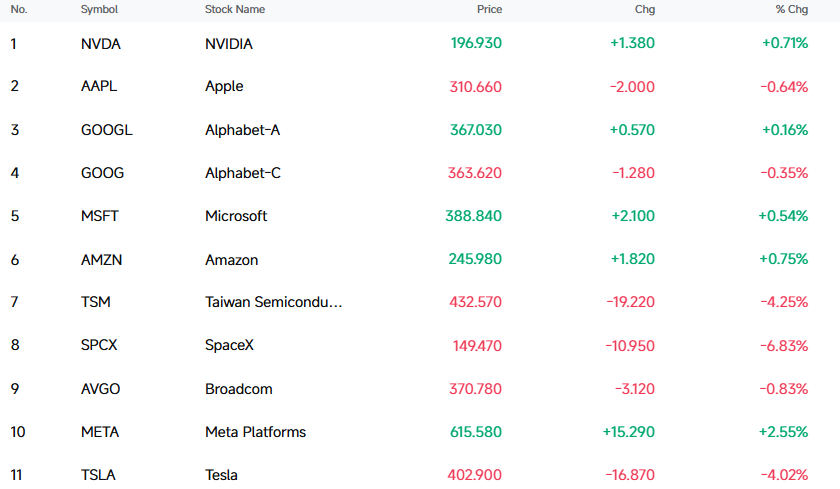
SpaceX (SPCX) fell about 7% to $149.47, slipping below its debut price of $150. Its latest market capitalization dropped below $2 trillion, ranking seventh in the U.S.
Among large-cap tech stocks, Meta Platforms (META) rose 2.55%, Amazon (AMZN) gained 0.75%, Nvidia (NVDA) ticked up 0.71%, Microsoft (MSFT) edged up 0.54%, and Google (GOOGL) rose 0.16%; SpaceX (SPCX) fell 6.83%, Tesla (TSLA) dropped 4.02%, Broadcom (AVGO) fell 0.83%, and Apple (AAPL) slipped 0.64%.
[Source: FutuBull]
The Philadelphia Semiconductor Index fell 4.65% to 12,300.52 points. Among its 30 constituents, 29 declined while only 1 advanced.
Memory stocks led the losses, with Western Digital (WDC) down 7.86%, SanDisk (SNDK) down 7.26%, Micron Technology (MU) down 4.71%, and Seagate Technology (STX) down 4.68%.
Morgan Stanley believes the memory chip industry is approaching a "peak rate of change"—evidenced by narrowing year-over-year DRAM price increases, flattening inventory improvements, and peaking EPS revision breadth. In the short term, the sector faces pressures from concentrated positioning, heightened volatility, and sector rotation, which may weigh on stock prices temporarily. However, the long-term outlook remains bullish, with earnings projected to grow by 35-40% by 2027. The key validation point lies in whether hyperscale cloud providers can maintain their capital expenditure guidance.
Among chip stocks, Intel (INTC) fell 9.66%, Arm Holdings (ARM) dropped 6.77%, AMD (AMD) slid 6.51%, and Qualcomm (QCOM) fell 1.88%.
Chinese ADRs mostly fell, with Hesai (HSAI) down 7.56%, Pony.ai (PONY) down 6.00%, Qifu Technology (QFIN) down 4.98%, Futu Holdings (FUTU) down 4.22%, and XPeng (XPEV) down 2.88%.
Corporate News
Amazon Plans to Issue at Least $25 Billion in Bonds
Amazon has launched a new round of massive debt financing, planning to raise at least $25 billion by issuing bonds across eight tranches, while confirming it will not issue additional debt for the remainder of the year. All proceeds will support its AI infrastructure expansion strategy. It is reported that prior to this financing, Amazon had already completed multiple consecutive rounds of large-scale debt issuance across the US, European, and Canadian bond markets, bringing its cumulative debt financing for the year close to $100 billion. The core driver behind this massive financing is skyrocketing capital expenditures, with the company raising its full-year capital expenditure target to $200 billion. The incremental funds will be primarily invested in computing power data centers and chip hardware. Management continues to convey its long-term investment logic to the market, defining AI as a once-in-a-lifetime historic opportunity to alleviate investor concerns over high capital consumption.
Microsoft Swaps OpenAI and Anthropic for In-House AI in Some Apps
Microsoft is accelerating its push for AI independence to reduce reliance on external models and cut costs. According to people familiar with the matter, some office applications such as Excel and Outlook have started using Microsoft's in-house "MAI" model to process AI queries, currently handling tens of thousands of requests weekly. Previously, these applications relied more heavily on models from OpenAI and Anthropic. Although MAI still accounts for a small portion of overall AI queries, it indicates that Microsoft is gradually implementing its in-house models in core products. Mustafa Suleyman, head of Microsoft AI, previously stated that the company's goal is to reduce and eventually eliminate spending on Anthropic models. Beyond office software, the MAI model has been integrated into GitHub Copilot, and an in-house speech-to-text model will be applied to products like Teams in the coming months. As Microsoft's preferential partnership with OpenAI gradually expires, the company is accelerating the build-out of its independent AI capabilities to strengthen its bargaining power and further lower inference costs.
Meta Releases New Image Generation Model Muse Image
Meta has officially launched its self-developed large image generation model, Muse Image, completing a key puzzle piece in its multimodal AI product matrix and marking the transition of its AI investment into a scale-monetization phase. As the second core product from Meta's Ultra Intelligence Lab, this model takes over from the previous Muse Spark large language model, extending capabilities from text to image and completely breaking free from its previous technological dependence on third-party image models.
SpaceX Officially Added to Nasdaq 100 Index
SpaceX was officially added to the Nasdaq 100 Index on July 7, Eastern Time. From its debut on the Nasdaq on June 12 to its inclusion in this core tech index, the process took less than a month—SpaceX set the record for the fastest inclusion since the inception of the Nasdaq 100 Index.
Industry & Macro News
EIA Expects Most Crude Production to Return to Pre-War Levels by Year-End
The U.S. Energy Information Administration (EIA) released its Short-Term Energy Outlook report, noting that on June 18, the United States and Iran signed a memorandum of understanding to end the conflict and open the Strait of Hormuz. With the signing of the agreement and increased traffic through the strait, we have raised our global oil production forecasts for the remainder of this year. We now expect most crude oil production to return to near pre-conflict average levels by the end of this year, with the majority of shut-in crude production returning online in the first quarter of 2027 (Q1 2027).
Iran Launches Missile Attacks on Merchant Ships, U.S. May Conduct Retaliatory Strikes
According to media reports, the Iranian military fired at least two missiles on Monday evening at merchant ships transiting the Strait of Hormuz. The reported attacks occurred just as a week-long agreement between the U.S. and Iran to halt attacks in the strait expired. Iran's resumption of attacks threatens to unravel the memorandum of understanding signed less than three weeks ago. The U.S. is highly likely to conduct retaliatory strikes against Iranian targets. This escalation could complicate talks aimed at ending the U.S.-Iran war.
U.S. Reinstates Oil Sanctions on Iran
According to media reports, a U.S. official stated that Iran's actions in the Strait of Hormuz are completely unacceptable and the U.S. will respond. However, U.S. negotiators are still moving forward in good faith toward a final agreement. Meanwhile, according to the U.S. Department of the Treasury's Office of Foreign Assets Control (OFAC), the U.S. has revoked a general license authorizing Iranian oil sales, with wind-down transactions permitted to continue until midnight Eastern Time on July 17.
U.S. One-Year Inflation Expectations Near 3.7% in June, Hitting New High Since 2023
The latest survey results from the Federal Reserve Bank of New York show that U.S. one-year inflation expectations reached 3.67% in June, hitting a new high since September 2023, compared to the previous value of 3.46%. Three-year inflation expectations in June stood at 3.3%, the highest since 2022. One-year income growth expectations in June rose to 2.8%, a new high since March 2025. One-year expectations for U.S. stock price movements in June hit their highest level since April 2021. Consumers expect gasoline prices to rise by 1.5% over the next year, with food prices expected to rise 5%, medical costs by 9.4%, college education costs by 5.7%, and rents by 8.3%.
This content was translated using AI and reviewed for clarity. It is for informational purposes only.
Recommended Articles










Comments (0)
Click the $ button, enter the symbol, and select to link a stock, ETF, or other ticker.