


Japan and South Korea Stocks Plummet at Open: Samsung Electronics, SK Hynix and Kioxia Plunge Collectively, SoftBank Defies Trend to Advance



AI Podcast


Japanese and South Korean markets faced sharp declines on July 7, driven by heightened geopolitical risk after an LNG carrier attack in the Gulf of Oman. The KOSPI dropped 3.57% to 7,763.8, while the Nikkei 225 fell 0.43% to 69,440.37. Tech heavyweights led the sell-off, with Samsung Electronics declining over 4% amid labor unrest and mixed Q2 earnings—revenue of 171 trillion KRW missed estimates, despite operating profit beating expectations at 89.4 trillion KRW. Conversely, SoftBank gained 0.92%. Investors are rotating away from volatile, leveraged sectors due to rising uncertainty surrounding critical energy shipping routes.
TradingKey - Japanese and South Korean stock markets plunged at the open, with the KOSPI index falling below the 8,000 mark and the Nikkei 225 dropping below 70,000. Samsung Electronics, Kioxia, and SK Hynix fell sharply across the board, while SoftBank rose against the trend.
During the early Asian trading session on July 7, Japanese and South Korean stock markets opened lower and continued to slide. Among them, South Korea's KOSPI index fell sharply by 3.57%, losing the 8,000-point mark to trade temporarily at 7,763.8 points; the Nikkei 225 Index fell 0.43%, breaking below 70,000 points to trade temporarily at 69,440.37 points.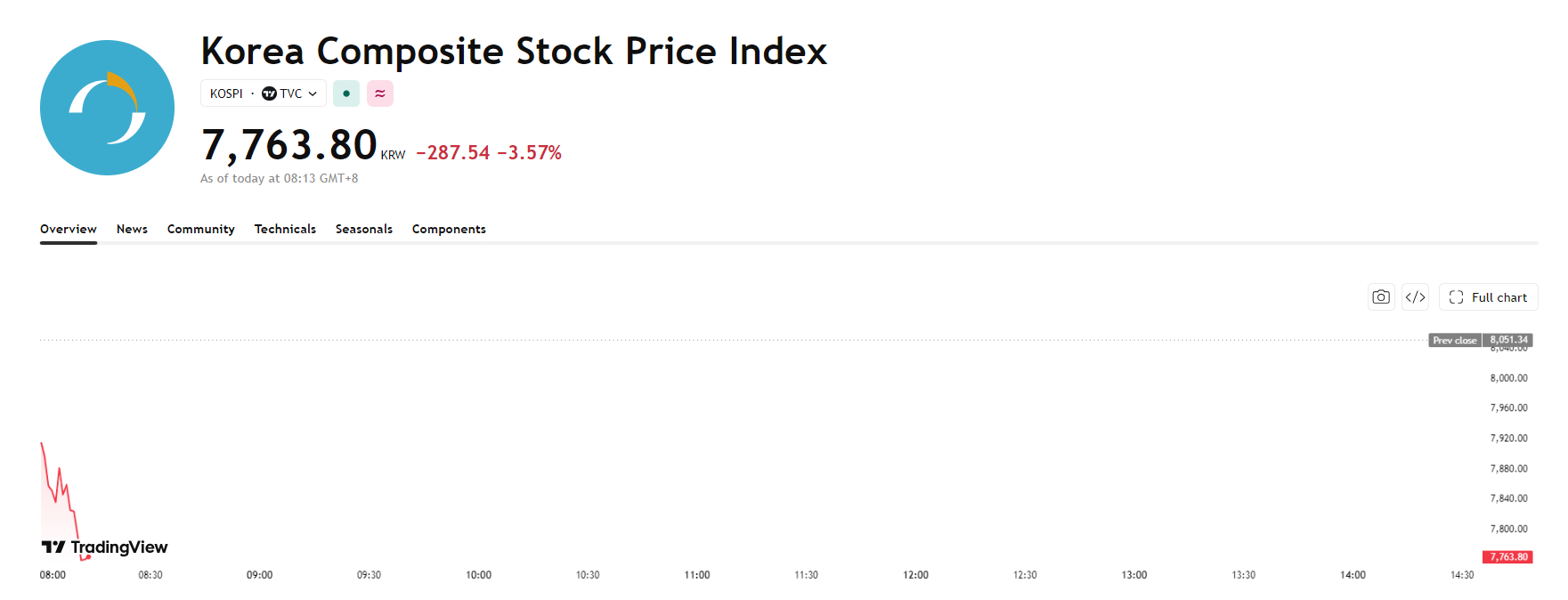 KOSPI Index Chart, Source: TradingView
In terms of individual stocks, SoftBank was the sole gainer, while other heavyweights fell collectively. Among them, Samsung Electronics plunged at the open, falling over 4% to trade temporarily at 305,500 KRW; SK Hynix fell 1.84% to trade temporarily at 2,300,000 KRW; Kioxia dropped 6.75% to trade temporarily at 76,120 JPY; SoftBank opened higher and continued to rise, gaining 0.92% to briefly reclaim the 6,000 threshold, trading temporarily at 6,034 JPY.
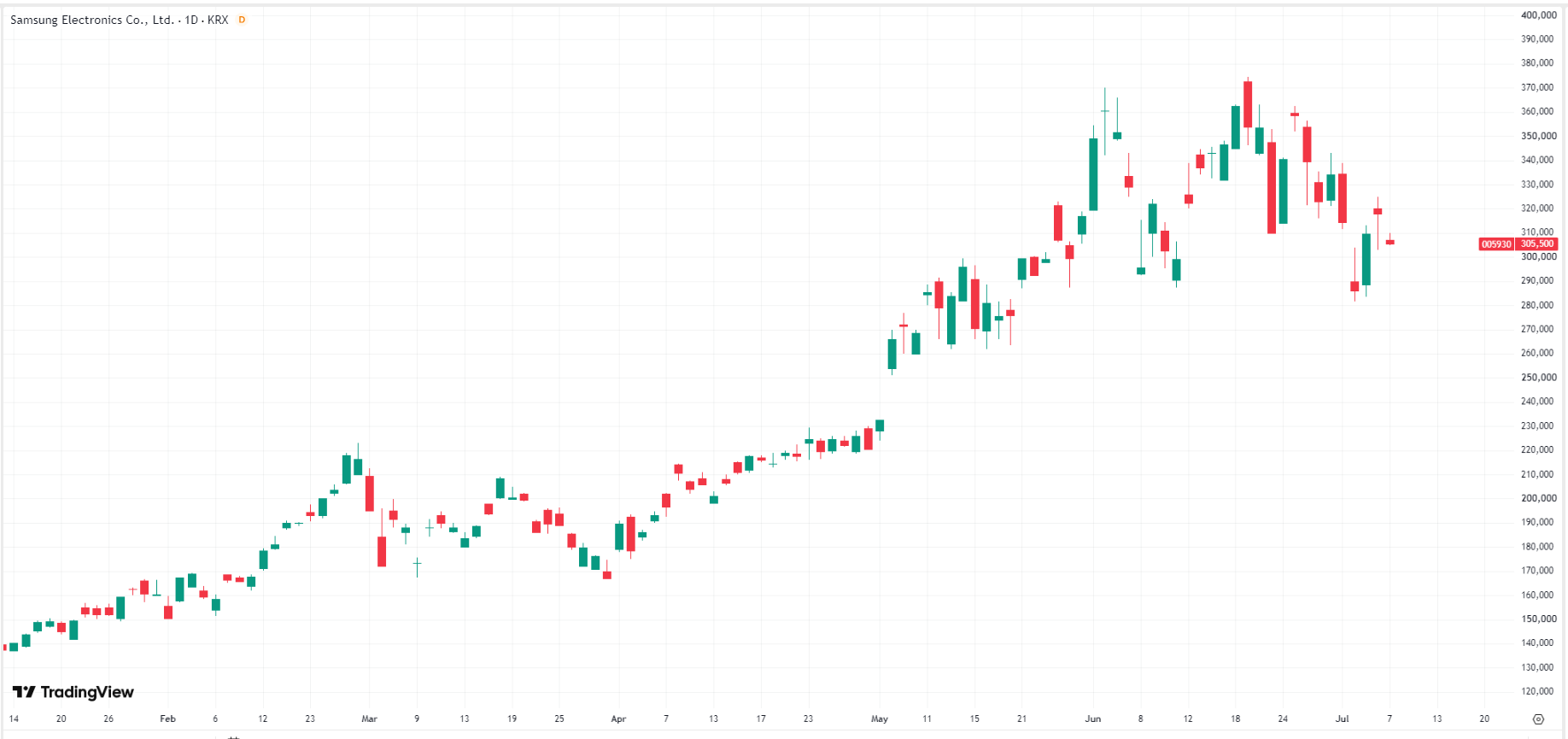 Samsung Electronics Share Price Chart, Source: TradingView
A major piece of negative news suddenly hit the market during early trading: a liquefied natural gas (LNG) carrier was attacked in the Gulf of Oman, a sensitive maritime area near the Strait of Hormuz. Because this involves a critical global energy shipping route, market risk aversion was instantly reignited, and capital immediately pulled back from the highly volatile and highly leveraged Japanese and South Korean tech sectors.
In addition, Samsung Electronics' share price was hit by planned employee protests sparked by inconsistent internal incentives, as well as its newly released, mixed Q2 earnings guidance. According to the published data, total Q2 revenue was 171 trillion KRW, lower than the market expectation of 173.9 trillion KRW, while operating profit was 89.4 trillion KRW, slightly higher than the market expectation of 87.3 trillion KRW.
This content was translated using AI and reviewed for clarity. It is for informational purposes only.
Recommended Articles





Comments (0)
Click the $ button, enter the symbol, and select to link a stock, ETF, or other ticker.