


Intel Shares Fall Over 11% to Break 30-Day Moving Average. Samsung’s 1.4nm Process May Impact Core Business, Morgan Stanley Recommends Reducing Chip Stock Holdings



AI Podcast


On July 7, Eastern Time, Intel shares dropped over 8% after falling below key moving averages. Samsung’s decision to delay its 1.4nm process production to 2029 aims to prioritize 2nm yields, potentially influencing Apple’s future supplier diversification. Concurrently, Intel announced price hikes for specific consumer and server processors. Market sentiment remains cautious, with Morgan Stanley underweighting semiconductors in favor of hyperscale cloud providers. This rotation reflects a cooling in high-beta chip stocks after significant gains, suggesting further potential for correction despite sustained interest in the broader AI sector.
TradingKey - On July 7, Eastern Time, Intel ( INTC) fell to as low as $108.36, simultaneously breaking below its 5-day, 10-day, 20-day, and 30-day moving averages. As of press time, it was still down over 8%, trading at $111.78. It is reported that Samsung plans to put its 1.4nm advanced process technology into mass production in 2029. The market believes this move by Samsung may further narrow its competitive gap with Intel and TSMC, and it is highly likely to secure orders from Apple.
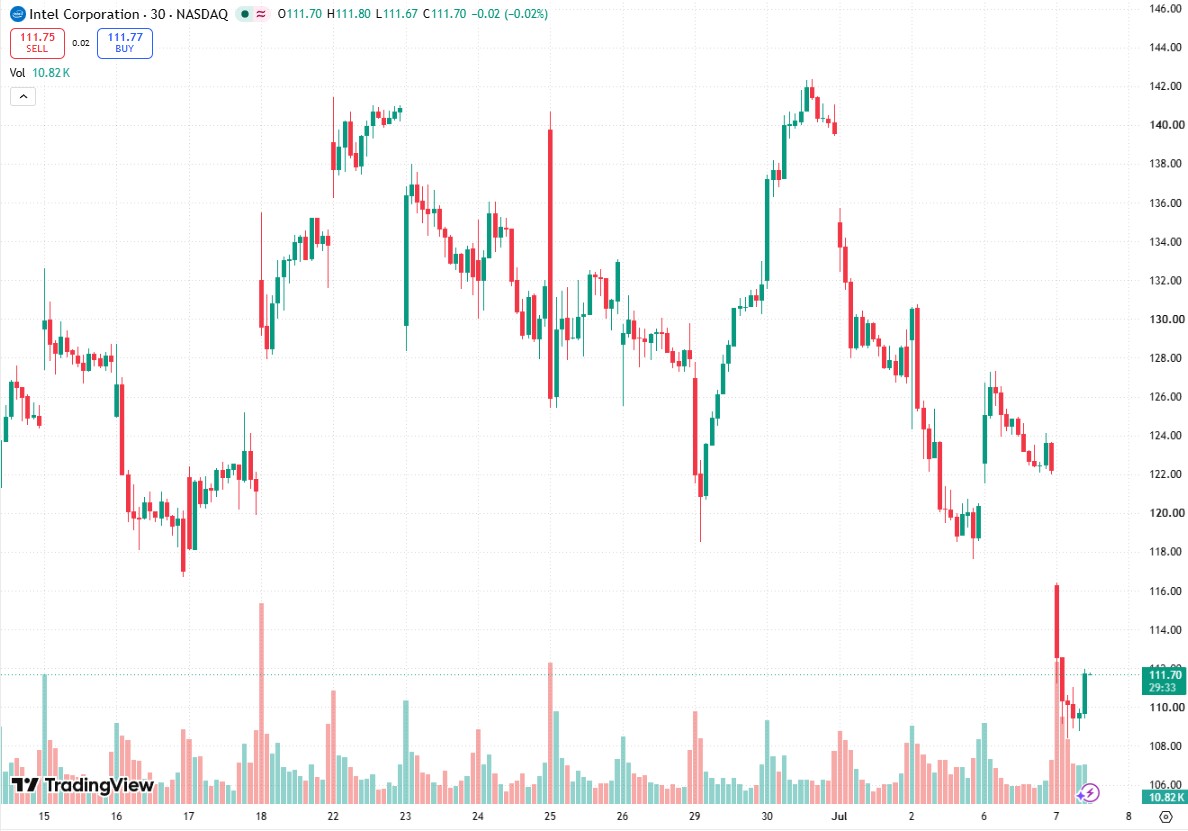
[Source: TradingView]
Previously, rumors circulated in the market that Samsung's 1.4nm development had been shelved. However, the latest news shows that Samsung has not given up but has chosen to postpone its progress.
According to South Korean tech media outlet The Bell, Samsung has adjusted its mass production target for the 1.4nm process (SF1.4) from the original 2027 to 2029.
The report also stated that the company actually just adjusted its R&D priorities—concentrating resources on improving yields for the 2nm GAA process (SF2) and the second-generation 2nm GAA process (SF2P), thereby delaying the overall mass production timeline for SF1.4 by two years to 2029.
The market generally believes that Apple may transition to the 1.4nm node after using two generations of TSMC's 2nm process to avoid further escalation of capacity competition for advanced processes in the future.
Currently, TSMC's monthly capacity for 3nm wafers has reached approximately 175,000 pieces, but supply remains tight, and a similar supply-demand situation is expected to extend into the 2nm era. Meanwhile, the cost of advanced processes continues to climb. The industry estimates that TSMC's 1.4nm wafer price is around $45,000 per piece, and 2nm is around $30,000, representing a difference of about $15,000; this will not only push up Apple's chip procurement costs but may also be further passed down to end-product retail prices. Against this backdrop, Apple has begun seeking more supply options for its next-generation chips. Intel's 18A-P process has reportedly been included in the evaluation scope for Apple's future M7 chip, indicating that Apple is not averse to introducing new advanced process suppliers besides TSMC to mitigate supply risks.
On the other hand, Intel officially confirmed yesterday that it is raising the official recommended prices for some of its consumer and server-grade processors, with increases ranging from tens of dollars to over a thousand dollars.
Among them, in the consumer market, price hikes are targeted only at two "Plus" series products, Core Ultra 7 270K Plus and Core Ultra 7 250K Plus, with increases of $30 to $50, translating to an effective price hike of about 15% to 16%. Meanwhile, Xeon 6 "Granite Rapids" processors in the server product line have doubled compared to their retail prices in mid-2025.
At the same time, Morgan Stanley's latest research report explicitly stated that it is underweighting semiconductors and shifting toward hyperscale cloud providers. The institution noted that after experiencing historic gains since late March, chip stocks have cooled down significantly recently. High-beta momentum stock portfolios (i.e., memory and chip stocks) recorded their largest two-day drop since the COVID-19 pandemic. The firm judges that this correction "may have further to go."
It is worth noting that the firm also stated this is not a bearish view on AI, but rather a rotation of capital. Funds will rotate from chip stocks, which have seen large previous gains, into cloud computing providers.
This content was translated using AI and reviewed for clarity. It is for informational purposes only.
Recommended Articles









Comments (0)
Click the $ button, enter the symbol, and select to link a stock, ETF, or other ticker.