


Nvidia Shares Under Pressure Pre-Market on Reports DeepSeek Is Developing Its Own AI Inference Chips



AI Podcast


As of July 7, Eastern Time, Chinese AI startup DeepSeek is developing proprietary inference chips to reduce reliance on external suppliers, causing a 1.5% pre-market decline in Nvidia shares. DeepSeek recently raised RMB 51 billion, valuing the firm at RMB 400 billion. The company is transitioning from a light-asset model to building self-owned data centers and expanding headcount to support infrastructure. While this strategic shift targets the high-growth inference market, DeepSeek faces significant challenges, including stringent U.S. export controls on advanced manufacturing and high-bandwidth memory, which may impede the development of competitive, domestically produced AI silicon.
TradingKey - On July 7, Eastern Time, media reports indicated that Chinese AI startup DeepSeek is independently developing its own AI inference chips, a move that could reduce its reliance on Nvidia ( NVDA) and Huawei chips. Following the news, Nvidia shares fell as much as 2% in pre-market trading. As of press time, Nvidia's pre-market stock price was trading at approximately $192.62, down 1.5%.
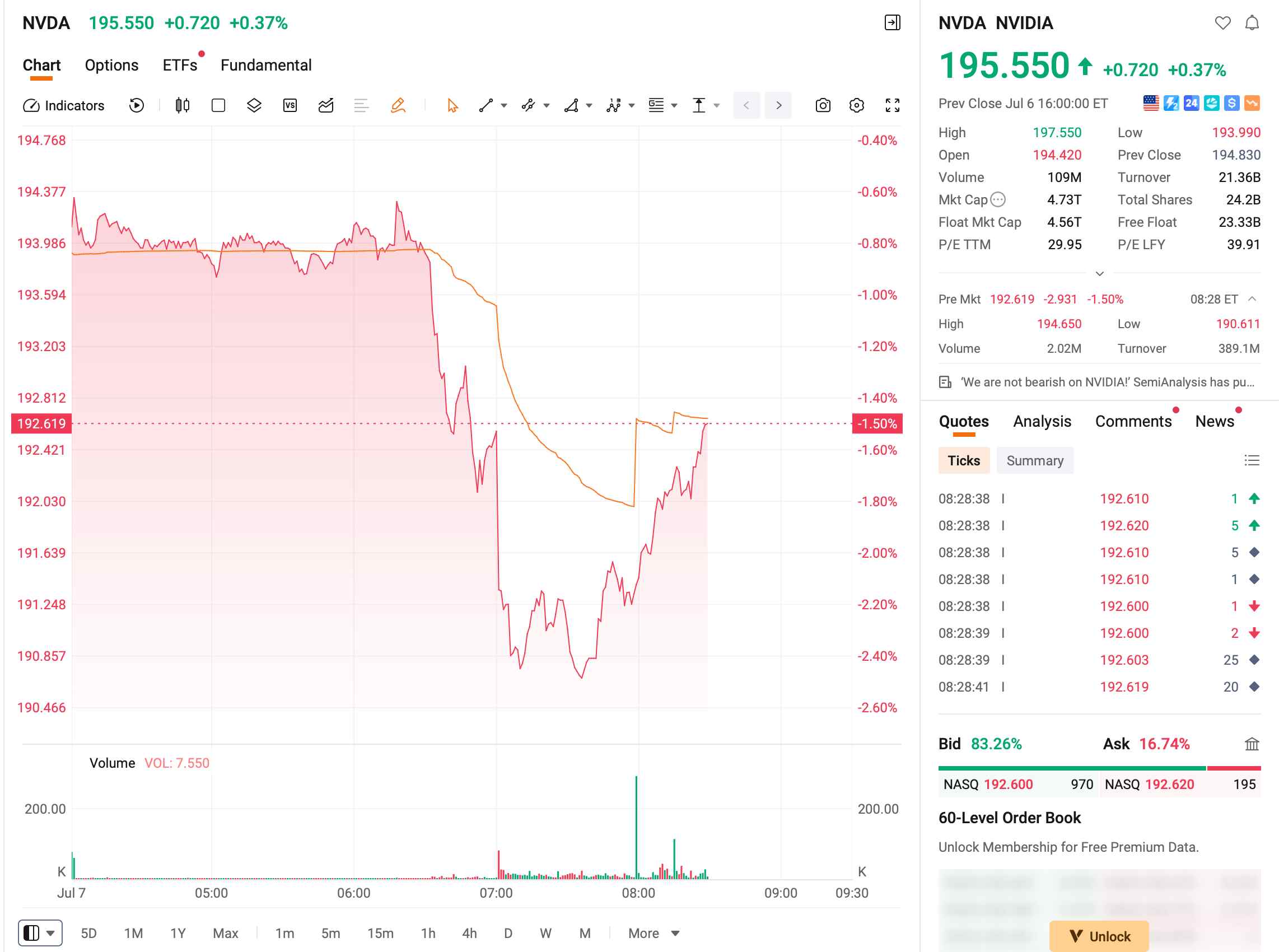
[Source: Futu]
The chip is designed specifically for the inference stage—the process where trained models generate responses for users—rather than for training new models. This positioning targets the fastest-growing sector of AI computing demand. As AI applications become more widespread, industry computing power is shifting from model training to model operation, and dedicated inference chips typically offer lower costs and lower power consumption than general-purpose GPUs.
DeepSeek's chip R&D efforts began about a year ago, and the company has already entered into discussions with chip design, foundry, and memory companies. In recent months, DeepSeek has stepped up its recruitment of chip design engineers, though the hiring is being conducted privately without public job postings.
If DeepSeek successfully enters the chip design space, it would mark a significant shift in the company's strategy. DeepSeek became globally renowned more than a year ago for releasing two highly efficient AI models. The base model for its R1 inference model was trained on Nvidia's H800, a chip banned from export to China by the U.S. government in late 2023. Since then, DeepSeek has gradually shifted its workloads to Huawei Ascend chips, with its V4 model released in April this year already adapted to Huawei processors.
First Round of Financing Finalized: RMB 51 Billion Raised, Post-Investment Valuation Reaches RMB 400 Billion
According to media reports, DeepSeek completed its Series A funding round on June 16, raising approximately RMB 51 billion (about $7.5 billion), with a post-money valuation approaching RMB 400 billion (about $59 billion). This marks the largest single-round financing record in China's AI industry to date.
Founder Liang Wenfeng personally contributed approximately RMB 20 billion (about $2.9 billion), making him the largest single investor in this round. Other investors include: Tencent contributing approximately RMB 10 billion (about $1.5 billion); the CATL ecosystem contributing approximately RMB 5 billion (about $730 million); NetEase, JD.com, Monolith Management, and IDG Capital contributing approximately RMB 3 billion (about $440 million) each; Loyal Valley Capital and Showstream contributing approximately RMB 1.5 billion (about $220 million) each; and the National Artificial Intelligence Industry Investment Fund contributing approximately RMB 980 million (about $144 million).
This funding round employed an extremely rare transaction structure. Except for the National Artificial Intelligence Industry Investment Fund, the funds from all external investors must be injected into a limited partnership managed by Liang Wenfeng, rather than directly into the DeepSeek entity. External investors do not hold voting rights in the company, have no board seats, and can only share in the financial returns based on their contribution ratios, while being subject to a five-year lock-up period. The National Artificial Intelligence Industry Investment Fund is the sole exception, taking a direct equity stake and holding voting rights.
From Light-Asset to Heavy-Asset: Doubling Recruitment and Building Self-Owned Data Centers
This funding is rapidly translating into action. On June 25, DeepSeek posted large-scale recruitment information on social media platforms, covering 33 positions across seven major categories, including algorithms, R&D, operations and maintenance, products, data engineers, and functional departments. These positions belong to different directions than the aforementioned chip design roles. DeepSeek stated in the recruitment post that it is "working hard to at least double the size of all departments."
At the same time, DeepSeek is also laying out its own computing power infrastructure. Since the beginning of this year, the company has posted its first batch of data center positions in Ulanqab, Inner Mongolia, covering operations and maintenance, delivery, and design planning directions, marking the company's transition from a light-asset model R&D approach to a heavy-asset model of self-built computing clusters.
DeepSeek's self-developed chips align with the trend of global AI developers. Last month, OpenAI released its first custom inference chip, Jalapeno, developed in cooperation with Broadcom ( AVGO )—and Anthropic is also considering building its own AI chips.
However, chip design is far from easy. Developing a competitive AI chip typically requires years and substantial capital. The manufacturing process also faces obstacles; U.S. regulations prohibit Chinese design firms from using the most advanced overseas foundries, and other export controls restrict China's access to high-bandwidth memory chips, which are key components for AI inference chips.
This content was translated using AI and reviewed for clarity. It is for informational purposes only.
Recommended Articles









Comments (0)
Click the $ button, enter the symbol, and select to link a stock, ETF, or other ticker.