


Samsung Earnings Preview: Can Second-Quarter Results Push Share Price to Challenge 400,000 Won?



AI Podcast


Samsung Electronics’ share price rose over 4% on July 6, fueled by expectations of a Q2 operating profit near 8.6 trillion KRW, driven by surging AI memory demand and DRAM/NAND price hikes. While revenue growth is anticipated, investors are prioritizing margin quality, cost management, and progress in HBM product certification to compete with industry rivals. Success in securing high-profile AI partnerships and demonstrating improved HBM market share are critical catalysts for valuation expansion. If Q2 results exceed market expectations, the stock may target 400,000 KRW; otherwise, high volatility and "sell the news" profit-taking risks persist.
TradingKey - Benefiting from Samsung Electronics' upcoming Q2 earnings report on July 7, Samsung Electronics' share price continued its rebound in early Korean trading on July 6, reaching a high of 325,000 KRW, up over 4% from the previous close of 309,500 KRW. This indicates that capital is still betting on the earnings elasticity driven by AI memory demand. Previously, Samsung's stock price had plummeted alongside the semiconductor sector amid high volatility in Korean tech stocks, but it quickly recovered, stimulated by news of memory price hikes, AI orders, and potential foundry collaborations.
While a high growth rate in Samsung's earnings is almost a foregone conclusion, the key lies in whether the company will continue to revise its guidance upward.
In terms of market expectations, Samsung's second-quarter operating profit could reach approximately 8.6 trillion won, representing a massive year-on-year surge of about 18 times, and is poised to refresh its profit record for the third consecutive quarter. For the market, a substantial increase in Samsung's second-quarter profit is almost a foregone conclusion; the key focus of this second-quarter earnings report is whether the growth rate can beat the already high expectations.
Over the past few quarters, demand for AI servers has driven continuous price increases for DRAM, NAND, and High Bandwidth Memory (HBM). As one of the world's largest memory chipmakers, Samsung has been a direct beneficiary of this supply-demand imbalance.
Compared with the first quarter, memory prices continued to strengthen in the second quarter, with demand for server DRAM, enterprise SSDs, and HBM from AI data center clients remaining robust. According to Reuters, average prices for DRAM and NAND rose by approximately 44% and 53%, respectively, in the second quarter, serving as the core driver for Samsung's profit explosion. For investors, if Samsung's reported operating profit is close to or higher than 8.6 trillion won, it will support a continued rise in the stock price; if it falls short of expectations, the stock price may experience a pullback due to 'sell the news' profit-taking, even if the year-on-year growth rate remains impressive.
HBM remains the most closely watched key to victory in the market.
In Samsung's upcoming Q2 earnings report, the most critical point lies in the progress of its HBM business. Over the past year, SK Hynix has clearly led the HBM field, securing a higher valuation premium by virtue of its position in Nvidia's supply chain. Although Samsung still maintains an advantage in traditional memory capacity, investors have been closely watching its HBM product certification, mass production, and the speed of customer onboarding.
If Samsung releases more positive signals regarding HBM3E, HBM4, Nvidia orders, or large cloud customer onboarding in its earnings report or conference call, its stock price could see further valuation recovery. Conversely, if management only emphasizes price increases for traditional DRAM and NAND without providing clear information on HBM market share gains, the stock price may remain volatile or even continue to pull back.
Recent reports that Samsung is in talks with Anthropic regarding custom AI chip cooperation, and discussions related to manufacturing Google's ( GOOGL) next-generation AI chips, have also fueled market imagination regarding Samsung's return to advanced nodes and the AI supply chain. While such news is beneficial for short-term sentiment, what can truly shift valuations remains whether orders, yields, customer certifications, and profit margins can show sustained improvement.
Margins and Cost Pressures Matter More Than Revenue
Against the backdrop of a high probability of strong revenue performance for Samsung in the second quarter, the quality of its profit margins has become a key focus of this earnings report. While the price hikes in AI memory offer significant profit elasticity, Samsung also faces several cost pressures. First, following a compensation agreement with chip division employees, expenses related to bonuses and stock incentives may impact short-term profits. Second, Samsung is ramping up investments in AI chips and advanced memory, and rising capital expenditures could depress free cash flow. Third, if industry capacity expands too quickly in the future, the market will worry that the current high-price cycle may peak prematurely.
For investors, Samsung's second-quarter earnings report cannot be judged solely by the absolute value of its operating profit; they must also look at whether the semiconductor division's profit margins continue to expand. If the profit margin is significantly higher than expected, it indicates that Samsung is not only benefiting from rising prices but has also improved its product mix, capacity allocation, and customer structure. If the profit margin falls short of expectations, even with strong revenue, the market may shift its focus to examining pressures from costs, bonuses, and capacity expansion.
Samsung Share Price Forecast: Stock Expected to Rise to 400,000 KRW in July
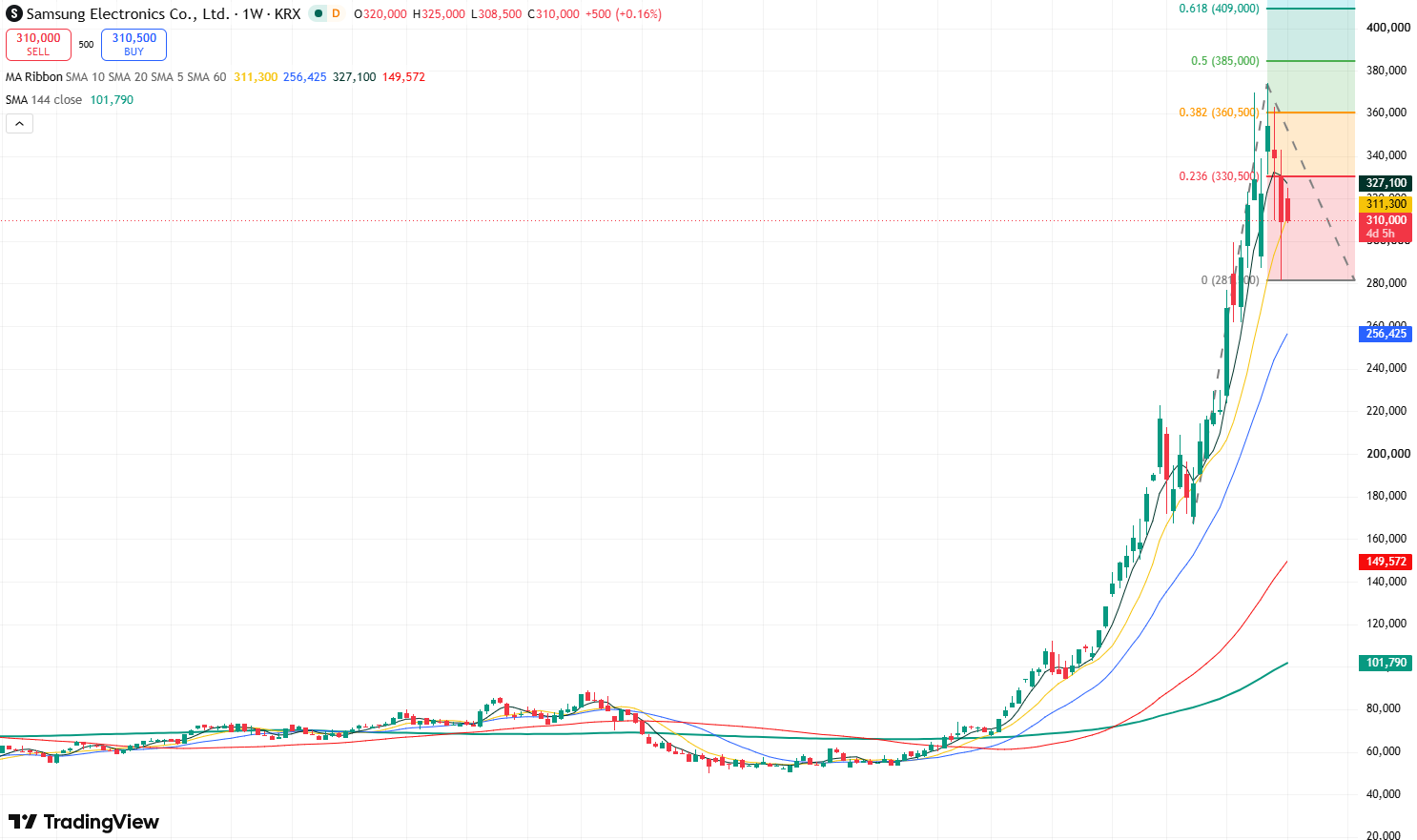
Samsung Electronics weekly stock chart, Source: TradingView
Looking at the weekly chart of Samsung's stock price, the share price has undergone a correction for two consecutive weeks, briefly falling below the SMA10 and the 300,000 KRW mark last week. However, by the end of the week, it closed firmly above both the SMA10 and the 300,000 KRW level, indicating strong support at the 300,000 KRW threshold.
At present, the primary overhead resistance level facing the stock price is around 330,000 KRW. If the stock can effectively break through and stabilize above this level, it will open up upside potential toward its historical high of 374,500 KRW. Furthermore, if it sets a new historical high, the path toward the 400,000 KRW mark will be cleared.
On the downside, if the stock price falls below last week's low of 281,500 KRW, it will enter a deeper correction phase, potentially testing the support level near 260,000 KRW.
This content was translated using AI and reviewed for clarity. It is for informational purposes only.
Recommended Articles







Comments (0)
Click the $ button, enter the symbol, and select to link a stock, ETF, or other ticker.