


2026 Global AI Industry Deep Observation: Technological Leadership Is Not the End Game, Analyzing the Commercialization Watershed of Anthropic and OpenAI



AI Podcast


Generative AI's evolution pivots from technical races to commercial efficiency by 2026. Anthropic's rapid revenue growth from $1B to $30B in 15 months highlights a shift where commercial leadership decouples from technical prowess. Investors prioritize real enterprise output over model scale. Anthropic's B2B focus yields higher revenue efficiency than OpenAI's broad consumer strategy, which faces projected 2026 losses. Anthropic's valuation reflects enterprise software logic, while OpenAI's premium bet is on future potential. Anthropic builds a B2B moat with security and long context, impacting sectors like programming via Cursor. Perplexity and Meta also challenge paradigms with search and social data integration.

In the grand narrative of generative AI's evolution, 2026 is regarded as a key watershed moment transitioning from a "technical arms race" to "commercial monetization efficiency." A milestone event that shook the market was Anthropic, a company founded by former core members of OpenAI, achieving a revenue leap from $1 billion to $30 billion in just 15 months. This growth rate is not only unprecedented in the AI sector, but even compared to SaaS benchmark Salesforce—which took a full 20 years to reach a similar revenue scale—Anthropic’s growth curve can be called a miracle in industrial history.
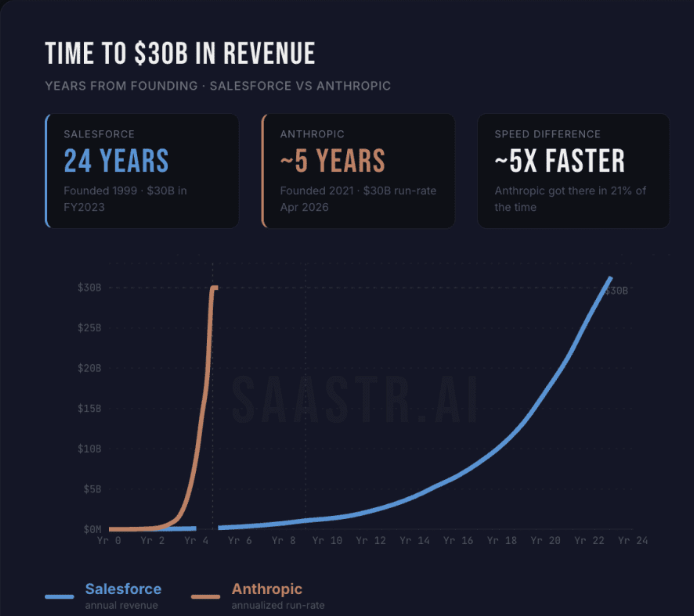
Source: SaaStr
The current industry consensus is undergoing a profound shift: technical leadership has become completely decoupled from commercial leadership. Investors are no longer simply obsessed with parameter scale or marginal benchmark differentials; instead, they are focusing on how models translate into "real output" for enterprises.
I. The Efficiency Game: Anthropic's "Precision Strike" vs. OpenAI's "Full Encirclement"
Against the backdrop of comparable model strengths, the two giants have chosen starkly different paradigms for their profitability paths. Anthropic's core strategy can be summarized as "extreme B2B focus." Currently, 80% of the company's revenue originates from enterprise clients (To B), and the number of large clients spending over $1 million annually has surpassed 1,000, with this figure doubling in the past two months. Among the Fortune Global 10, eight have deeply embedded Claude into their core business workflows.
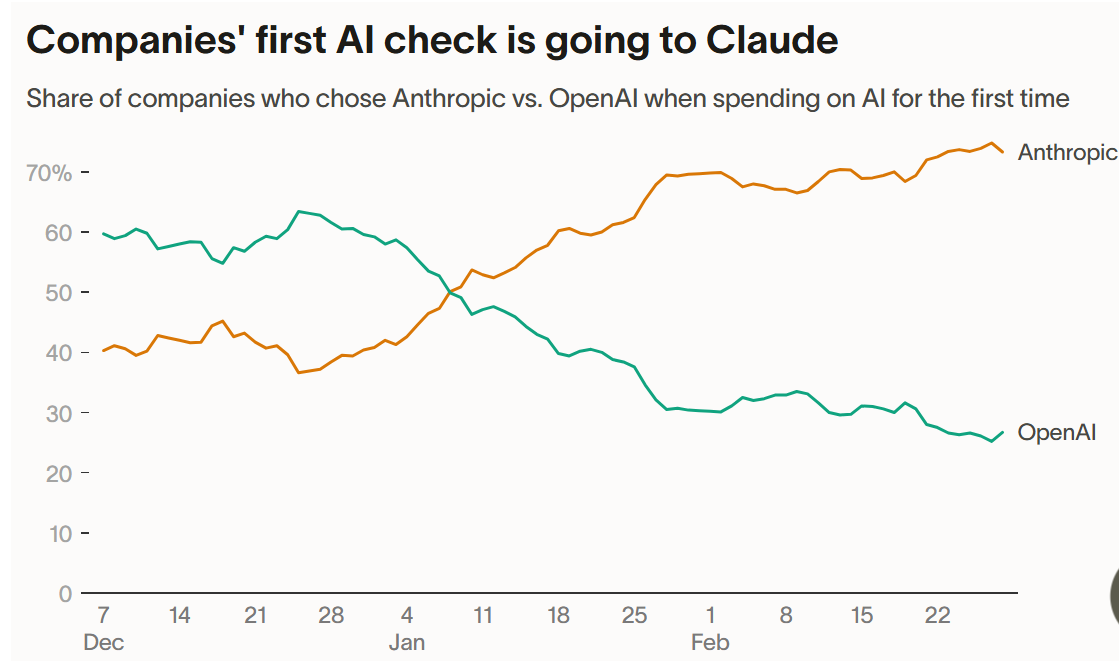
This high level of focus has yielded an astonishing return on investment. Data indicates that Anthropic's revenue efficiency per dollar of training cost is nearly four times higher than that of OpenAI. Unlike OpenAI's lavish brand marketing, Anthropic heavily invests its budget in professional sales teams, aiming to assist enterprises hand-in-hand with the vertical integration of AI and workflows. According to institutional surveys, over 70% of enterprises purchasing new AI tools in 2026 designated Anthropic as their primary target.
Source: Ramp
In contrast, OpenAI is undergoing a costly "traffic long march." As the traffic king with 900 million weekly active users, ChatGPT is undoubtedly the absolute hegemon of the consumer (C-end) market. However, an overextended front—covering the Sora video model, search, hardware investments, and advertising platforms—has led to projected losses for OpenAI of $14 billion in 2026. Although Chief Product Officer Fidji Simo has sounded a "red alert" and urgently scaled back non-core projects to tilt resources toward the Codex programming tool and the enterprise market, the massive organizational inertia makes this transition highly challenging.
II. Valuation Divergence and Capital Market Logical Departure
From the underlying data of financial reports, the growth slopes of the two parties have shown significant divergence. By the end of 2025, Anthropic's annualized recurring revenue (ARR) was approximately $9 billion, soaring to $30 billion by April 2026. While OpenAI's monthly revenue remains at the $2 billion level, with ARR growing from $20 billion to $24 billion, its growth curve is clearly flattening.
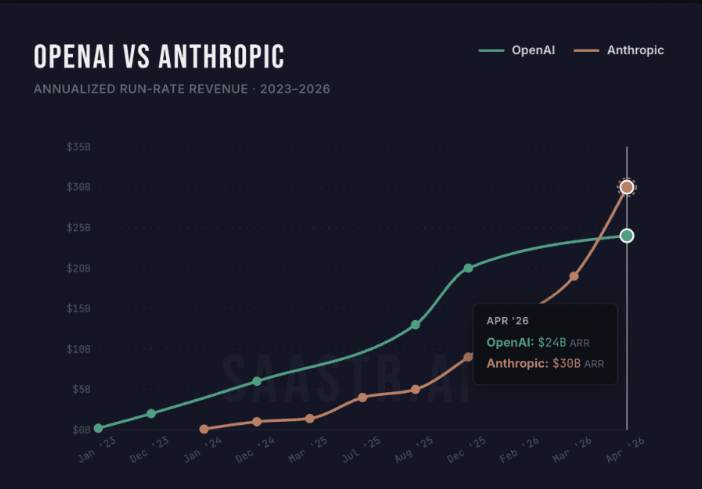
Source: SaaStr
More alarming is the cost structure: it is predicted that by 2030, Anthropic's average annual training cost will be about $30 billion, whereas OpenAI will need to pay a staggering $125 billion to maintain its massive ecosystem.
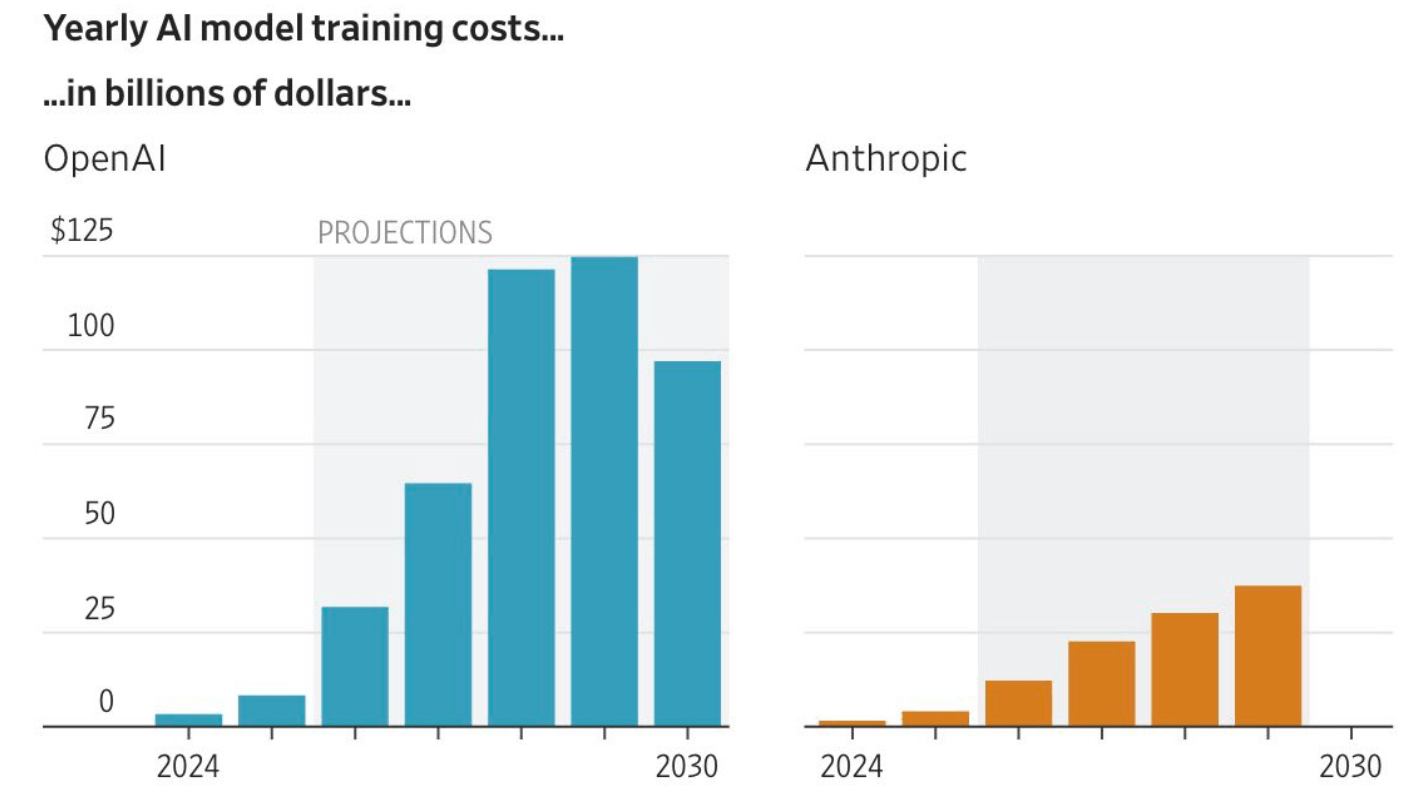
Source: WSJTech
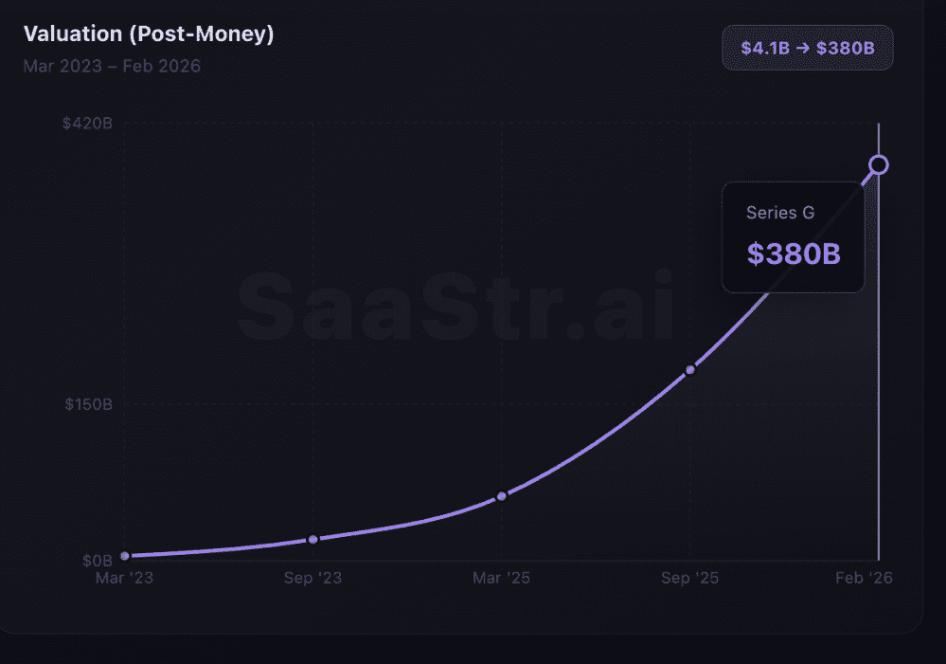
This financial performance is directly reflected in valuation logic. In its Series G funding round in February 2026, Anthropic was valued at $380 billion, representing an ARR multiple of approximately 13x. This multiple reflects the market's view of it as a high-growth, high-certainty professional enterprise software company. Meanwhile, OpenAI's valuation surged to $852 billion in a late March funding round, a multiple as high as 35x.
Source: SaaStr
This 22x premium is essentially a massive bet on the "ultimate imaginative space." The capital market is betting that OpenAI can become the entry-level "super app" for the next generation of the internet. However, a notable detail is that while OpenAI has a higher book valuation, its shares have recently faced a cold reception in secondary private markets; conversely, Anthropic, due to its clear commercialization path and an IPO planned for October 2026 (aiming to raise over $60 billion), has become the hottest asset among institutional investors.
III. Vertical Deep-Diving: Security and Ultra-Long Context Building the B2B Moat
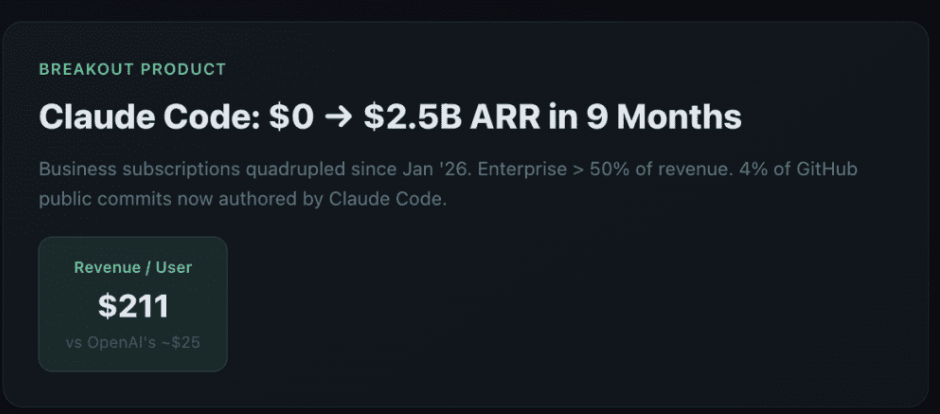
The reason the Claude series of models has established extremely high switching costs in the enterprise market is its pursuit of logical stability and security. In the field of programming, Claude has become the underlying choice for top AI development tools like Cursor. Claude Code achieved an ARR of $2.5 billion in just nine months, a figure that exceeds most mature listed companies. Currently, 4% of public code commits on GitHub are completed by it, and this is expected to surpass 20% by year-end.
Source: SaaStr
Security and an ultra-long context window (1 million tokens) constitute Anthropic's moat. Its latest model, Mythos, has demonstrated vulnerability-finding capabilities and complex financial modeling abilities that have even drawn intense internal attention from the Federal Reserve. To support this level of computational demand, Anthropic signed a 3.5GW TPU computing power agreement with Google and Broadcom; this scale of power consumption is equivalent to the total electricity usage of a city of 3 million people.
IV. Ecosystem Breakouts: The "First-Mover Advantage" in AI Programming
While the model layer is engaged in intense crossfire, application-layer players represented by Cursor have proven that "deeply embedding into workflows" is the shortest path to monetization. Although Cursor's underlying logic is highly dependent on Claude's model capabilities, it has successfully achieved a qualitative leap from a "dialogue tool" to a "production environment" through vertical engineering encapsulation.
Cursor's success lies in its reshaping of "context awareness": it is not just an API calling a model, but a collaborative system capable of real-time understanding, retrieval, and modification of a user's entire local codebase. This deep interactive barrier has caused its ARR to double from $1 billion to $2 billion in just three months. Currently, 67% of employees at Fortune 500 companies use Cursor, driving more than 150 million lines of code generated daily.
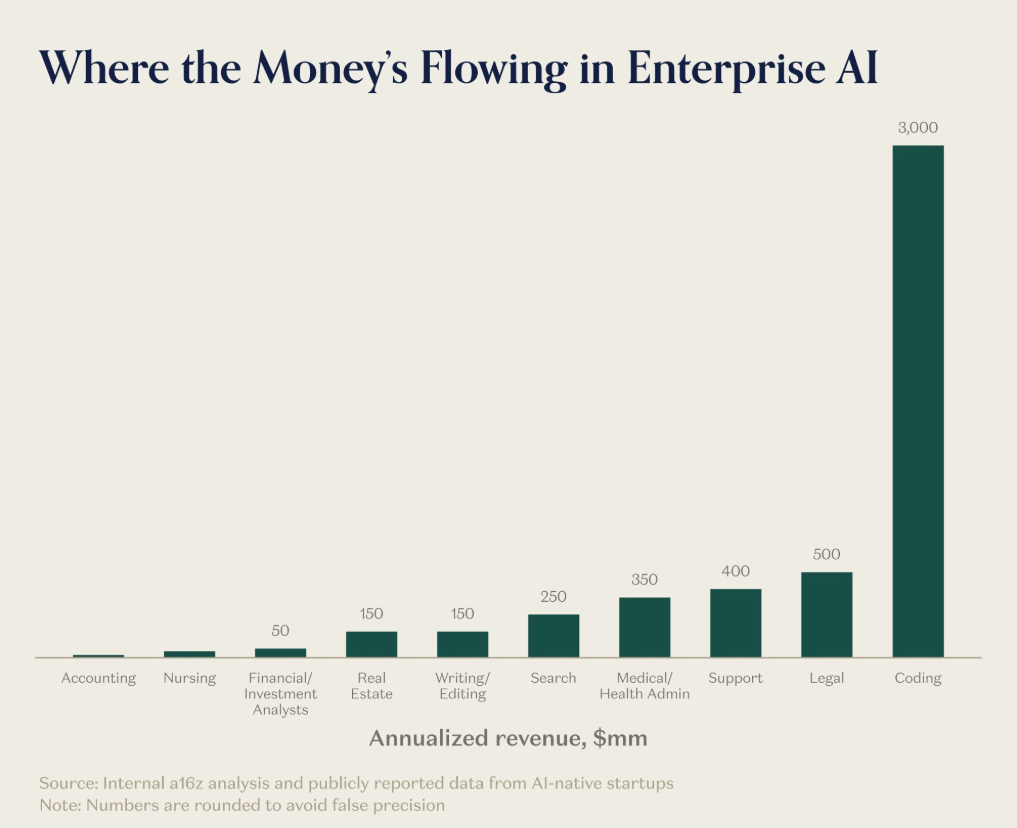
The programming track was able to break out first because of its characteristics of "outcome certainty" and "closed-loop feedback." AI-written code can achieve high-efficiency performance breakthroughs through reinforcement learning. Anthropic's early focus on the programming track not only provided it with high-quality training feedback data but also established an "easy to enter, hard to leave" niche at the enterprise development end through ecosystem partners like Cursor.
Source: A16Z
V. Paradigm Challenges: The Search Revolution and the Dimensional Strike of Social Data
In addition to the programming track, Perplexity and Meta are challenging existing AI business logic from two other dimensions.
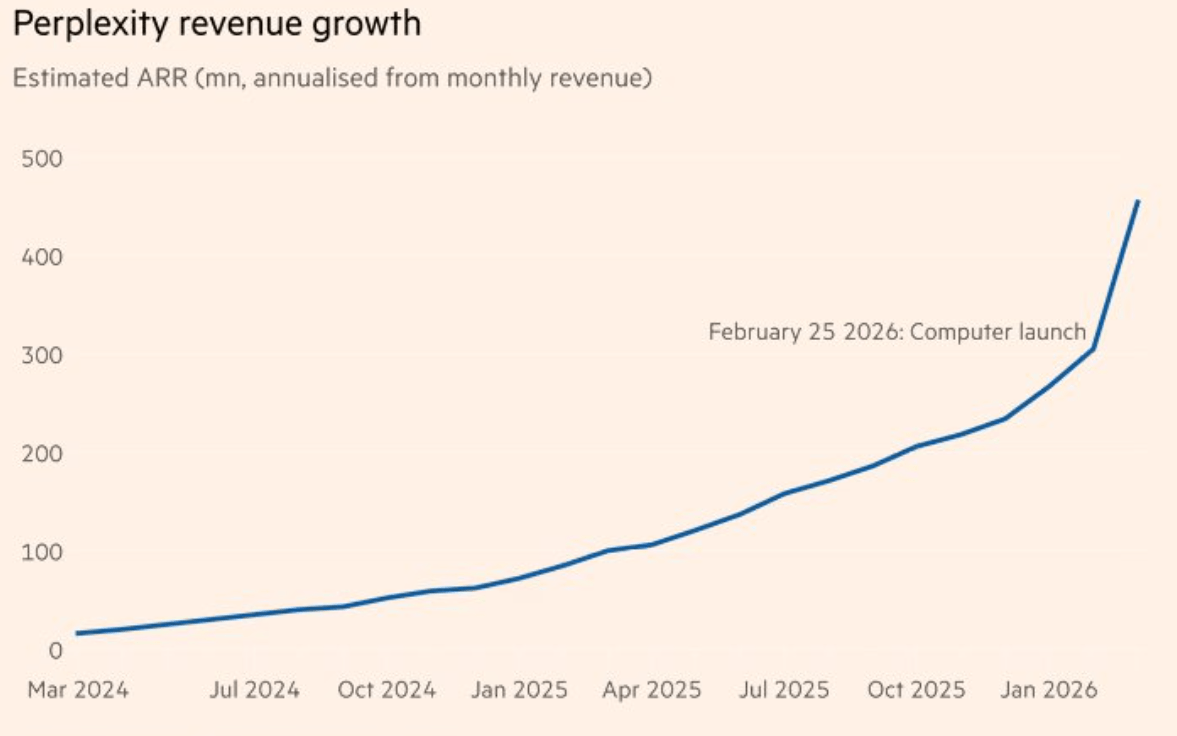
Perplexity, with its "search-first" and "digital agent" features, is transforming traditional generative dialogue into a trusted research tool. Its ARR has surpassed $450 million, with a monthly growth rate as high as 50%. Its core competitiveness lies in the "Computer" tool it launched, which can call up to 19 models to execute complex cross-platform multi-step tasks. Despite copyright lawsuits and valuation pressure of up to 44x, its exploration of the "search-as-agent" path is forcing traditional search giants to reform.
Source: FT Research
Meanwhile, Meta 's Muse Spark (projected code-named Avocado) demonstrates the "data hegemony" of a social giant. Meta is in no rush to monetize through API licensing; instead, it utilizes the social behavior data of its 4 billion global users to build a personalized recommendation loop that others cannot replicate. In 2026, Meta plans capital expenditures of $115 billion to $135 billion, with the logic of transforming AI into infrastructure to enhance existing advertising and e-commerce efficiency. This strategy of using existing profits to cover incremental investment gives it an extremely high tolerance for error in the AI race.
VI. Conclusion: The "Android Moment" of the AI Industry
We are at the "Android moment" of the AI industry. Looking back at the smartphone market before 2010, the ultimate winners were not necessarily those with the highest technical benchmarks, but companies that could most quickly capture user mindshare and build high switching costs.
Industry data from 2026 has clearly revealed a fact: the AI industry is evolving from a single battle for the throne into a multipolar territorial division. Anthropic has occupied the niche of enterprise infrastructure, OpenAI has held onto the C-end traffic entrance, and Cursor and Perplexity have made breakthroughs in vertical applications and search. For investors, the criteria for judging winners have evolved: those who can transform AI from an "expensive experiment" into an "indispensable workflow core" will be the ones to gain long-term market recognition in the upcoming IPO wave.
This content was translated using AI and reviewed for clarity. It is for informational purposes only.
Recommended Articles








Comments (0)
Click the $ button, enter the symbol, and select to link a stock, ETF, or other ticker.