


$4,500 Becomes Life-or-Death Line for Gold Bulls, Will Gold Prices Continue to Fall This Week?



AI Podcast


Gold prices fell below $4,600 due to stalled U.S.-Iran negotiations, which, combined with rising oil prices, fueled inflation expectations and limited the Federal Reserve's monetary policy options. Markets await the Fed's interest rate decision and Powell's commentary for direction. A hawkish stance or sustained high oil prices could pressure gold towards $4,500, while a less hawkish tone might trigger a rebound. Technically, the $4,500 level is critical. A breach would invalidate an inverse head-and-shoulders pattern, potentially leading to deeper declines. Holding $4,500 supports a bullish outlook.
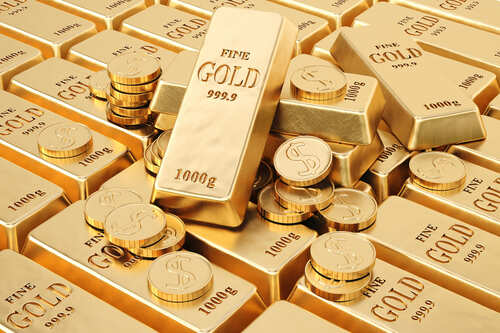
TradingKey - On Tuesday (April 28), weighed down by the deadlock in U.S.-Iran negotiations, gold ( XAUUSD) fell below the $4,600 level that day, with a maximum intraday decline of nearly $150.
As of the Asian session on April 29, gold prices have not staged an immediate recovery, but are instead trading weakly within the $4,580 to $4,610 range.
Notably, the Federal Reserve's latest interest rate decision will be announced on April 29, Eastern Time.
Higher oil prices fuel inflation expectations; markets focus on Powell’s remarks.
The current weakness in gold prices is primarily due to the lack of further signs of de-escalation in the U.S.-Iran conflict, leading to a continuous rise in U.S. inflation expectations and significantly limiting the Federal Reserve's room to adjust interest rates.
Latest news indicates that Trump is dissatisfied with Iran's most recent proposal. Iran has suggested setting the nuclear issue aside until the war concludes and maritime disputes in the Gulf are resolved, whereas the U.S. insists the nuclear issue must be addressed first, resulting in another diplomatic stalemate.
Reacting to the news, Brent crude held firm above $100 on Tuesday, closing at $103.65, and continued its rally today, with prices briefly surging toward $105; meanwhile, today WTI crude oil prices once again rose above $100. The renewed increase in oil prices has heightened U.S. inflation expectations, continuing to drag gold prices lower.
Amid rising U.S. inflation expectations, market focus today is squarely on the upcoming Federal Reserve interest rate decision. While the consensus expects the Fed to remain on hold and maintain rates at 3.5%-3.75%, Powell's commentary will be the primary driver for market direction.
If Powell continues to highlight the resilience of inflation or voices increased concern over the risk of secondary inflation from energy prices, the market will further solidify expectations for interest rates to remain higher for longer, exerting considerable pressure on gold. Conversely, if his rhetoric is less hawkish than anticipated, gold prices may see a technical rebound.
Technical Analysis: The $4,500 mark becomes a critical make-or-break level for bulls.

From the daily chart of gold, gold prices plummeted on April 28 due to the U.S.-Iran situation, briefly breaking below the $4,600 mark and closing at $4,597.30; the breach of the $4,600 psychological level significantly bolstered bearish market sentiment.
Meanwhile, the Relative Strength Index (RSI) is hovering around 38, indicating that the market has not yet entered oversold territory and suggesting potential for further downside in the short term.
Regarding moving averages, the 10-day moving average crossed below the 20-day moving average to form a death cross, further reinforcing the downward bias in gold's short-term trend; however, gold's accelerated decline yesterday saw a quick rebound upon hitting the 144-day moving average, showing the line still offers strong support.
Currently, bearish forces maintain the upper hand in the short term, and a continued test of the 144-day moving average and yesterday's low of $4,554.76 remains likely; if this low is breached, gold may further test the $4,500 psychological level.

On gold's 4-hour chart, the price action currently maintains an inverse head-and-shoulders structure, but if gold continues to fall and breaks below the left shoulder at the $4,500 psychological level, the structure will be invalidated, opening room for a deeper correction toward the $4,360 support level and the $4,100 psychological level further below.
However, if gold holds the $4,500 psychological level, the inverse head-and-shoulders structure will remain valid, significantly strengthening bullish forces and likely sparking a technical recovery, with gold retaining the possibility of reaching $5,000.
Therefore, the most rational approach currently is not to trade based on sentiment but to focus on the key $4,500 level. If Powell's upcoming remarks lean hawkish or oil prices continue to drive up inflation expectations, gold will likely test the $4,500 mark; if the speech doesn't reinforce high-rate expectations and the U.S.-Iran situation does not escalate further, gold prices could see a strong recovery rally.
This content was translated using AI and reviewed for clarity. It is for informational purposes only.
Recommended Articles







Comments (0)
Click the $ button, enter the symbol, and select to link a stock, ETF, or other ticker.