


Today’s Market Recap: AI Momentum Lifts U.S. Markets as Tariff Battles and Global Trade Tensions Unfold



Track the Market Trend
TradingKey - On February 25, 2026, U.S. stock indexes advanced as enthusiasm around artificial intelligence steadied investor sentiment. The S&P 500 gained 0.81% to close at 6,946.13, while the Nasdaq Composite climbed 1.26% to 23,152.08, supported by strength in technology shares. The Dow Jones Industrial Average added 0.63% to finish at 49,482.15.
Nvidia (NVDA) rose 1.44% ahead of its earnings release after the bell and extended gains in after‑hours trading, buoyed by strong revenue forecasts that reinforced its role as a bellwether for AI stocks. Other AI‑related names, including Taiwan Semiconductor Manufacturing (TSM), Dell Technologies (DELL), and Micron (MU), also advanced further after hours.
In contrast, Lowe’s slipped following its results. NovoCure (NVCR) surged 27.68% to $14.99 on regulatory progress ahead of its earnings report, while MannKind (MNKD) dropped 36.82% to $3.50 after its partner United Therapeutics announced a competing inhaler. Salesforce (CRM) fell more than 5% after market close despite beating earnings expectations, as concerns about AI disruption weighed on sentiment.
Markets overall calmed after recent turbulence, with muted reaction to Tuesday’s State of the Union address. Investors are now focused on upcoming earnings from major technology companies to gauge the trajectory of the AI sector. Nvidia’s latest results reassured those worried about the sustainability of AI growth, with its CEO suggesting one breakthrough could create more millionaires in five years than the internet did in two decades. Jeff Bezos emphasized the scale of AI’s impact, and Cathie Wood projected the sector could represent an $80 trillion opportunity by 2030 — equivalent to the combined value of multiple tech giants.
Market Headline
In his first State of the Union address of his second term, Donald Trump declared that tariffs had boosted the stock market, which he described as reaching record highs, while inflation had “plummeted.” He expressed regret over the Supreme Court’s decision against the tariffs and said he hoped tariffs could replace the modern income tax system. He also stated that immigration would be allowed legally, called on major technology companies to build their own power plants and factories, mentioned receiving 80 million barrels of oil from Venezuela, and urged legislation to ban members of Congress from trading stocks.
The U.S. Trade Representative announced that the “global import tariff” imposed on certain countries will rise from the recently implemented 10% to 15% or higher. The Supreme Court had ruled that the original tariff measures lacked legal authorization, prompting Trump to shift to a different legal basis to continue imposing tariffs.
The U.S. Trade Representative also said Washington would continue to advance the implementation of the Phase One trade agreement with China and pursue Section 301 investigations. China’s Ministry of Commerce responded that it is willing to work with the U.S. under the guidance of the two leaders’ consensus, using existing trade consultation mechanisms to focus on implementing agreed outcomes and exploring areas of mutual interest. However, if the U.S. insists on pushing forward with investigations or imposing tariffs and other restrictive measures, China will take all necessary steps to firmly defend its legitimate rights.
China and Germany issued a joint statement emphasizing that economic and trade cooperation is a vital part of their bilateral relationship and that they are committed to deepening mutually beneficial collaboration. Both sides stressed the importance of open dialogue, fair competition, and reciprocal market access. China noted Germany’s concerns about reducing dependency, trade imbalances, and export controls, while Germany acknowledged China’s concerns about the securitization of economic issues and restrictions on high‑tech exports. Both countries agreed to address these issues through candid dialogue to ensure a long‑term, balanced, reliable, and sustainable economic relationship.
Nvidia reported a 73% year‑over‑year increase in fourth‑quarter revenue, with both total revenue and data center revenue reaching record highs. Driven by strong demand for Blackwell chips, gross margin rose above 75%, the highest in 18 months. Data center revenue exceeded expectations, accelerating 75% year‑over‑year, with networking revenue up more than 260%. Gaming revenue fell short of expectations, down 13% quarter‑over‑quarter due to channel inventory issues. Nvidia warned that supply constraints could pose headwinds in Q1 and beyond. Its Q1 revenue guidance midpoint was 4% above the most optimistic buy‑side forecasts, representing nearly 77% year‑over‑year growth, excluding China’s data center computing revenue. Starting in Q1, non‑GAAP results will include stock‑based compensation. CEO Jensen Huang said computing demand is surging and agent applications are booming, raising the company’s chip revenue target beyond $500 billion, though he noted the space data center economy remains underdeveloped. Nvidia shares rose nearly 4% after hours before reversing lower.
ByteDance’s valuation has climbed to $550 billion. Investment firm General Atlantic plans to sell part of its stake, with the valuation up 14.6% from secondary market transactions in November 2025 at $480 billion, and 66% higher than last year’s employee buyback price. Strong financial performance, with annual profit expected to reach $48 billion — surpassing Meta — and easing uncertainty around TikTok’s U.S. operations, have supported this elevated valuation.
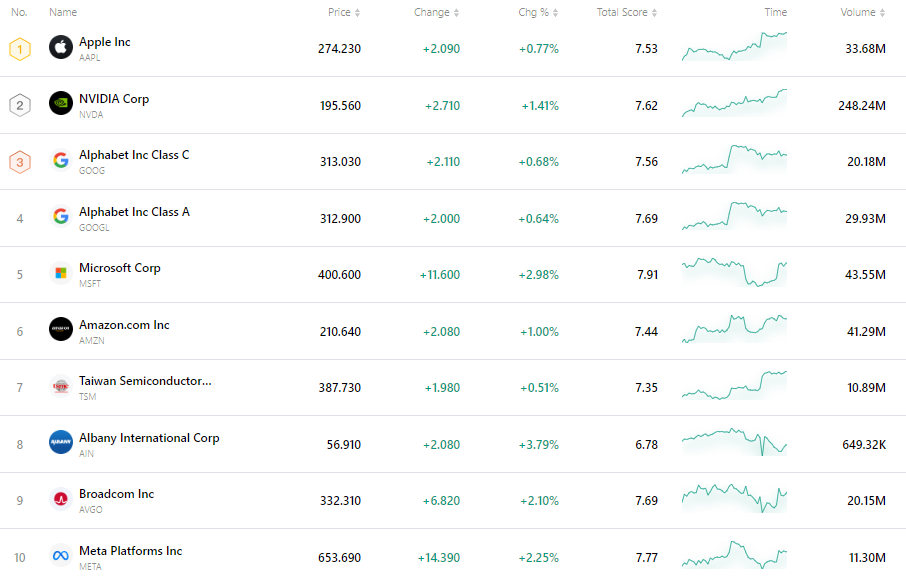
Top 10 Most Traded Stocks
The chart below lists the ten most actively traded stocks in the market. Due to their massive trading volumes and high liquidity, these stocks serve as critical benchmarks for tracking global market dynamics.
Recommended Articles









Comments (0)
Click the $ button, enter the symbol, and select to link a stock, ETF, or other ticker.