


Today’s Market Recap: Microsoft’s AI Spending Sparks Concerns, 10% Plunge Weighs on U.S. Markets



Track the Market Trend
TradingKey - On January 29, 2026, the S&P 500 Index ended lower by 9.02 points, or 0.13%, at 6,969.01. The Dow Jones Industrial Average rose 55.96 points, or 0.11%, to close at 49,071.56. The Nasdaq Composite fell 172.33 points, or 0.72%, to close at 23,685.12.
Large-cap technology stocks dominated trading, with Microsoft (MSFT) dropping 9.99% to $433.50. According to Bloomberg, the $357 billion loss in market capitalization was the second largest for any company in a single trading session. A strong set of results from Meta Platforms (META) helped partially offset broader index weakness.
Despite reporting better-than-expected Q4 earnings, ServiceNow (NOW) fell 9.94% to $116.73. The broader software sector sold off on persistent concerns that advances in artificial intelligence could disrupt traditional enterprise offerings. Salesforce (CRM) and Adobe (ADBE) also posted declines, pressured by investor caution over long-term business model impacts.
Apple (AAPL), reporting after the market close, also beat expectations, supported by persistently strong iPhone demand.
Nio (NIO) closed 3.92% higher at $4.77 after receiving renewed attention from analysts. Coverage named the company a leading candidate in the autonomous vehicle space and reaffirmed a Buy rating with a $7 price target. Market focus remains on whether investor sentiment can continue to improve in the face of recent volatility.
AT&T (T) rose 4.32% to $25.11 following upgrades from analysts and solid fourth-quarter 2025 earnings. Trading volume reached 62.3 million shares—approximately 37% above its three-month average of 45.6 million shares. Since its public market debut in 1983, AT&T’s stock has appreciated by 547%.
Cryptocurrencies declined sharply. Bitcoin fell 6% to a two-month low, while Ethereum dropped over 7%, falling below the $2,800 mark.
Precious and industrial metals experienced abrupt reversals following strong rallies. Spot gold surged as much as 3.3% early in the session, briefly approaching the historical high of $5,600 per ounce, before plunging nearly 9% from the day’s peak and trimming losses by the close. Silver touched a new all-time high of $121 before retreating more than 12%. Copper climbed more than 11% intraday and ended the New York session still up more than 6%.
Crude oil extended its advance for a third straight day, gaining 3% amid rising tensions between the U.S. and Iran. U.S. WTI crude traded above $65 per barrel.
Market Headline
Microsoft recorded its steepest single-day loss since 2020, wiping $430 billion in value. Microsoft shares plunged 12% intraday and closed down nearly 10% at $433.50, hit by investor concerns over surging capital expenditures related to AI and data center infrastructure. The loss amounts to roughly $430 billion in market capitalization—the second-largest in U.S. market history, behind only Nvidia’s $593 billion wipeout triggered by DeepSeek’s low-cost AI model last year. The selloff weighed heavily on broader tech sentiment and reignited fears over the return on heavy AI investments.
Apple's quarterly results beat expectations, powered by strong iPhone and China sales. Apple reported fourth-quarter revenue up 16% year-over-year and earnings per share up 18%, both ahead of forecasts. Revenue from iPhones jumped 23%, while R&D spending rose 32%—also exceeding expectations. Services revenue rose 14%, slightly below estimates, while Mac and wearables declined by 6.7% and just over 2%, respectively. Greater China revenue beat expectations by 17% amid record-setting iPhone demand. CEO Tim Cook noted the installed base surpassed 2.5 billion devices globally. Apple now forecasts Q1 revenue growth of 13%–16%. The stock reversed losses in extended trading, rising more than 2% at one point.
SanDisk (SNDK) surged after strong earnings driven by AI-fueled storage demand. Memory chipmaker SanDisk reported better-than-expected results for fiscal Q2 2026, driven by increasing needs for data storage amid rapid AI deployment. Both revenue and profit significantly exceeded forecasts and internal guidance. Shares jumped nearly 15% in after-hours trading, with analysts pointing to AI infrastructure growth as the main performance driver.
SpaceX reportedly mulls merger with Tesla (TSLA) or xAI ahead of major IPO. Bloomberg reports that SpaceX is considering a potential merger with either Tesla or AI firm xAI. Reuters also noted earlier discussions between SpaceX and xAI to complete a merger ahead of a large public listing planned later this year. Strategic consolidation could streamline operations across AI and space technology platforms led by Elon Musk.
SAP (SAP) stock plunged after missing cloud backlog targets. SAP shares dropped 11%, marking their worst single-day performance since 2020, after fourth-quarter cloud backlog growth came in at 25%—short of the previously promised 26% target. The CEO attributed the miss to longer sales cycles tied to geopolitical uncertainties. However, markets focused on slowing cloud demand and the growing threat of generative AI replacing legacy software offerings. SAP announced a multi-billion-euro share buyback to boost investor confidence, though its effectiveness remains uncertain.
Samsung posted record Q4 revenue led by explosive growth in memory chip profits. Samsung Electronics reported Q4 revenue of 93.8 trillion Korean won, with operating profit up 209% year-over-year to 20.1 trillion won. The semiconductor division contributed 80% of total profit, with memory segment profit rising 465%. Samsung regained the top spot in DRAM sales, re-entering Nvidia and Google’s HBM3E supply chains. The company has completed development of HBM4, capable of 11.7Gbps transfer speeds, with mass shipments to Nvidia starting next month. Analysts project Samsung’s 2026 operating profit to reach 180 trillion won, up 314% y/y.
SK Hynix outperformed Samsung in annual profit, reshaping the AI memory landscape. In a notable shift, SK Hynix reported a 2025 annual operating profit of 47.2 trillion won, surpassing Samsung for the first time. With 57% share of the HBM market and strong orders from Nvidia, SK Hynix has become the leading beneficiary of surging AI demand. While Samsung is betting on HBM4 to reclaim momentum, the rivalry between the two chipmakers could redefine South Korea’s semiconductor industry and its role in the global AI supply chain.
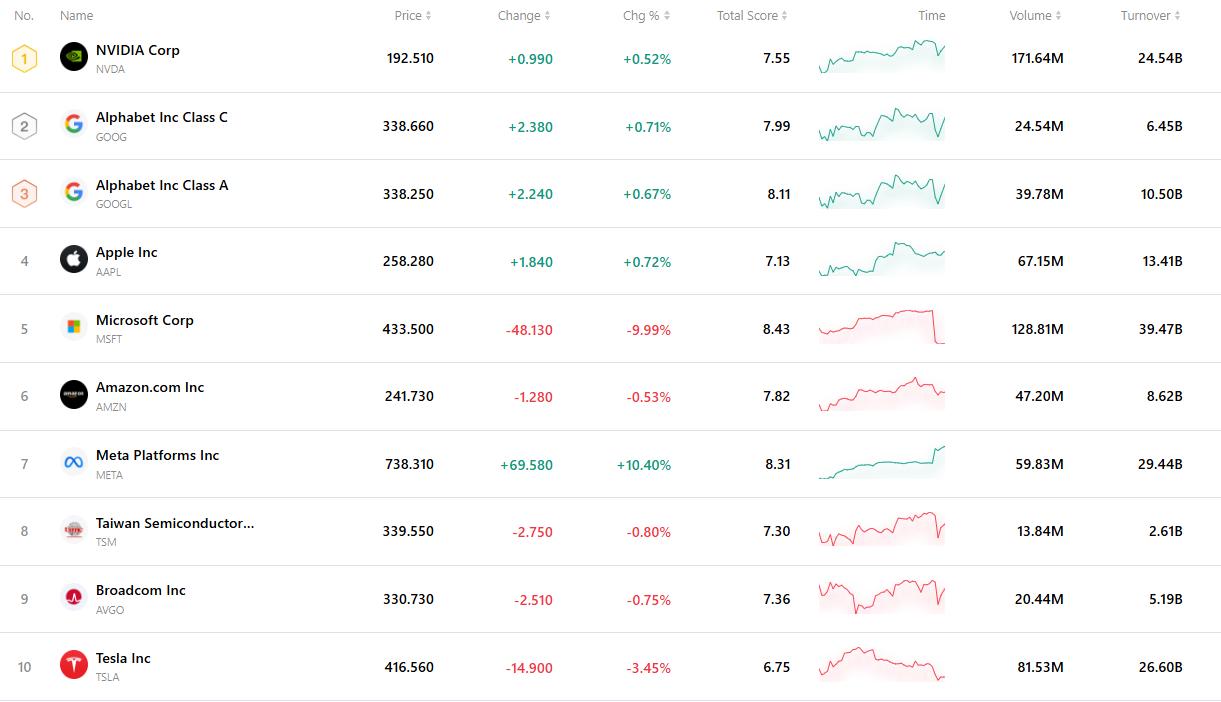
Top 10 Most Traded Stocks
The chart below highlights the ten most actively traded stocks in the current market. With their substantial trading volumes and high liquidity, these names serve as key benchmarks for tracking global market dynamics.
Recommended Articles





Comments (0)
Click the $ button, enter the symbol, and select to link a stock, ETF, or other ticker.