


IBM Shares Surge 12%. US Government Bets on Quantum Computing, IBM Shares Seen Reaching $400



AI Podcast


The U.S. government plans to invest approximately $2 billion in nine quantum computing companies through equity stakes, elevating the sector to strategic industrial asset status. This initiative, funded by the CHIPS and Science Act, aims to build a domestic supply chain. IBM, receiving significant funding for a quantum chip manufacturing facility, saw its shares surge, signaling market reassessment of quantum computing's commercial viability. While this policy reduces R&D financing pressure and raises industry valuation, technical challenges like error correction persist. IBM's established infrastructure and clear roadmap support long-term growth potential, though competition and regulatory concerns remain.

TradingKey - On May 21 ET, the U.S. government planned to provide approximately $2 billion in funding to nine quantum computing-related companies and participate through equity investment, becoming the focus of the tech stock market this week. Driven by this news, IBM shares surged 12.43% on Thursday, marking a significant recent single-day gain; D-Wave ( QBTS ), Rigetti ( RGTI ), GlobalFoundries ( GFS) and other quantum-related stocks also strengthened in tandem, indicating that the market is re-evaluating the possibility of quantum computing transitioning from a long-term scientific research concept to a strategic industrial asset.
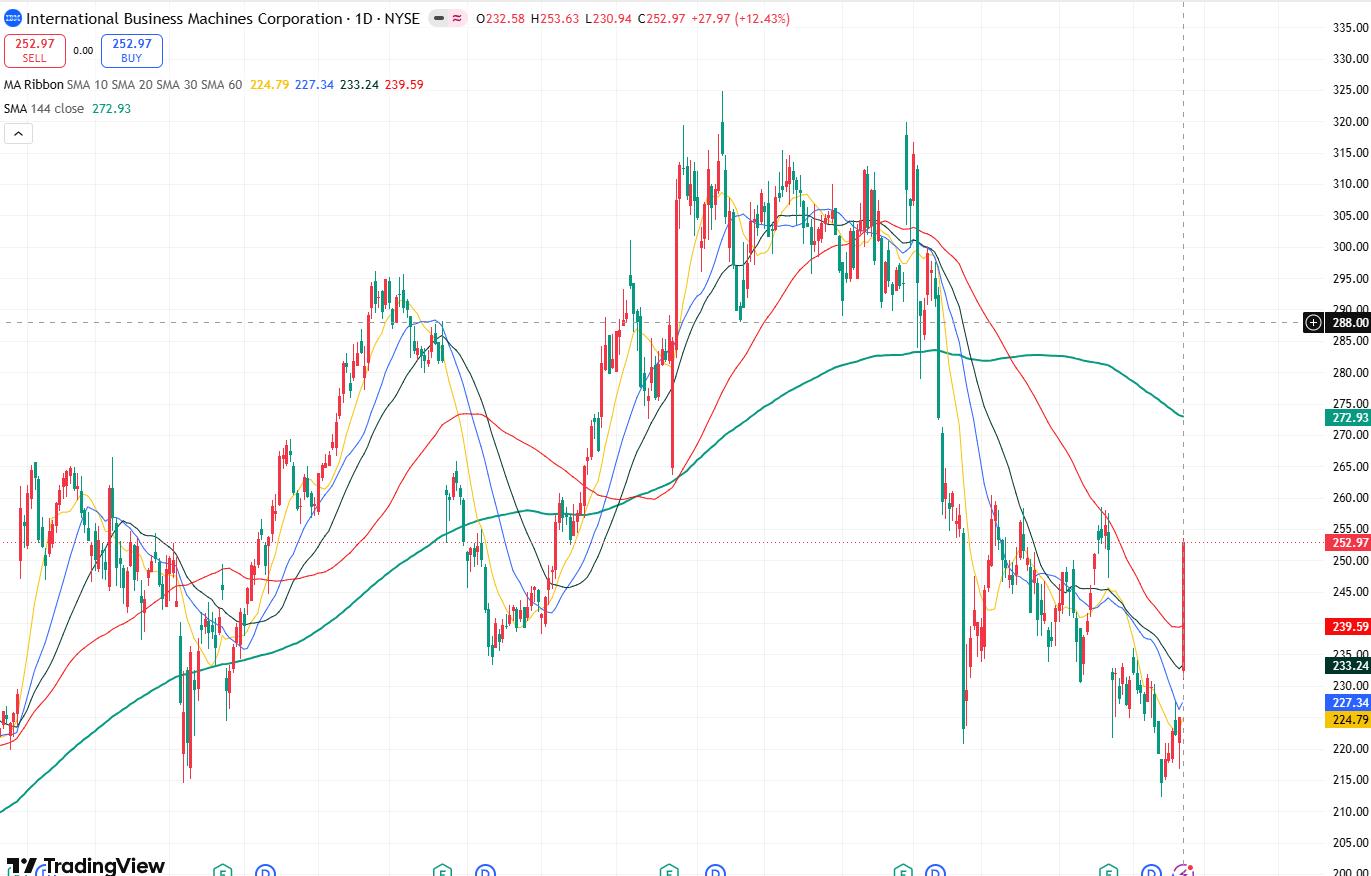
IBM daily stock price chart, Source: TradingView
The US government has elevated quantum computing to the level of a strategic industry.
The core shift in this policy is that the U.S. government is no longer merely supporting the quantum industry through traditional subsidies, but instead plans to deeply involve itself in the development of relevant companies by acquiring minority stakes.
According to multiple media reports, the U.S. Department of Commerce will provide approximately $2 billion in total support to nine quantum hardware and manufacturing companies using funds from the CHIPS and Science Act, while simultaneously acquiring minority stakes in these firms. The list includes IBM, GlobalFoundries, D-Wave, Rigetti, Infleqtion ( INFQ ), PsiQuantum, Atom Computing, Diraq, and Quantinuum. The policy's goal is to build a domestic supply chain spanning from quantum chip manufacturing and wafer foundry services to hardware systems and software ecosystems.
This signifies that the U.S. positioning of quantum computing is changing; it is no longer just a frontier research direction for universities, laboratories, and tech giants, but is being incorporated into the strategic framework of semiconductor supply chains, national security, cryptographic security, and future computing power competition.
For the industry, this policy support could bring a threefold impact.
First, it reduces R&D financing pressure for quantum hardware companies. Given the long commercialization cycles, high capital expenditures, and technical roadmap uncertainties of quantum computing, government funding can help companies extend their R&D runway.
Second, it raises the industry's valuation anchor. Direct government equity stakes or investment participation essentially labels the industry as critical strategic infrastructure.
Third, it accelerates industry divergence. Companies receiving financial support may gain first-mover advantages in equipment, talent, production capacity, and customer resources, while those not selected may face higher financing pressure and valuation discounts.
For capital markets, this will significantly enhance policy certainty, financing capabilities, and valuation potential for quantum computing companies.
However, positive policy developments do not mean commercialization is mature. Quantum computing still faces challenges such as quantum error correction, stability, scalability, manufacturing yields, and real-world application verification. Government funding can accelerate industrial infrastructure construction but cannot bypass technical validation cycles.
Therefore, short-term stock price increases reflect improved policy expectations and risk appetite, while long-term value still depends on whether companies can translate their scientific research roadmaps into commercially deployable products.
Drivers Behind IBM's Stock Surge: Resonance of Capital Scale and Manufacturing Standing
IBM has become the most prominent target in the current rally, primarily due to the significant scale of policy support it has received. According to reports, IBM will receive approximately $1 billion in funding and plans to match that with its own capital to construct the first dedicated quantum chip manufacturing facility or standalone quantum wafer platform in the U.S. Barron’s reported that the project, dubbed Anderon, will involve an investment of approximately $1 billion each from IBM and the U.S. government.
This directly explains why IBM’s stock price has surged. IBM is not merely a quantum play; it is perceived by the market as a core infrastructure provider within the U.S. quantum supply chain. Compared to quantum startups still in the early stages of commercialization, IBM possesses mainframes, enterprise software, hybrid cloud, AI, and long-term R&D capabilities, making its quantum business more likely to be integrated into the long-term procurement systems of governments, corporations, and research institutions.
Furthermore, IBM is benefiting from more than just capital subsidies; it is seeing a revaluation of its industrial standing. Quantum computing was previously viewed by the market as a long-term technology with an unclear path to revenue realization. However, direct government support for quantum chip manufacturing facilities effectively elevates IBM’s quantum roadmap from an R&D project to a national-level manufacturing platform. This has prompted investors to reassess IBM’s position in the future of high-end computing infrastructure.
IBM Future Outlook: Medium-to-Long-Term Share Price Projected to Reach $400
Looking ahead, IBM's advantage lies in its relatively clear quantum roadmap and its ability to integrate quantum computing with enterprise clients, cloud platforms, AI, and high-performance computing. According to IBM's official quantum roadmap, the company plans to launch its first fault-tolerant quantum computer, "Starling," in 2029, targeting 200 logical qubits and 100 million quantum gates; by around 2030, IBM plans to further advance large-scale fault-tolerant quantum computing.
This roadmap is a key foundation for the market's bullish outlook on IBM. The primary dividing line in the quantum computing industry currently lies in achieving stable, error-correctable, and scalable fault-tolerant quantum computing. If IBM can advance Starling as planned and validate its practical value in fields such as chemical simulation, materials science, financial modeling, optimization problems, or cryptographic security, its quantum business could gradually transition from scientific research services to high-value enterprise-grade computing services.
Another advantage for IBM is its stable business fundamentals. Latest financial reports show that IBM's first-quarter revenue and non-GAAP profit both exceeded market expectations, with its software business—particularly Red Hat—maintaining growth. This means that even if quantum computing struggles to contribute significant revenue in the short term, IBM still has its software, consulting, AI, and infrastructure businesses providing cash flow support to sustain longer R&D cycles.
However, risks cannot be overlooked. First, the timeline for quantum computing commercialization remains uncertain, and the market may refocus on revenue realization after short-term hype. Second, while the U.S. government's equity stake model brings funding and endorsement, it may also trigger discussions regarding regulation, governance, and policy dependency. Third, IBM faces competition in technical roadmaps from companies such as Google, Microsoft, Amazon, Quantinuum, PsiQuantum, and IonQ.
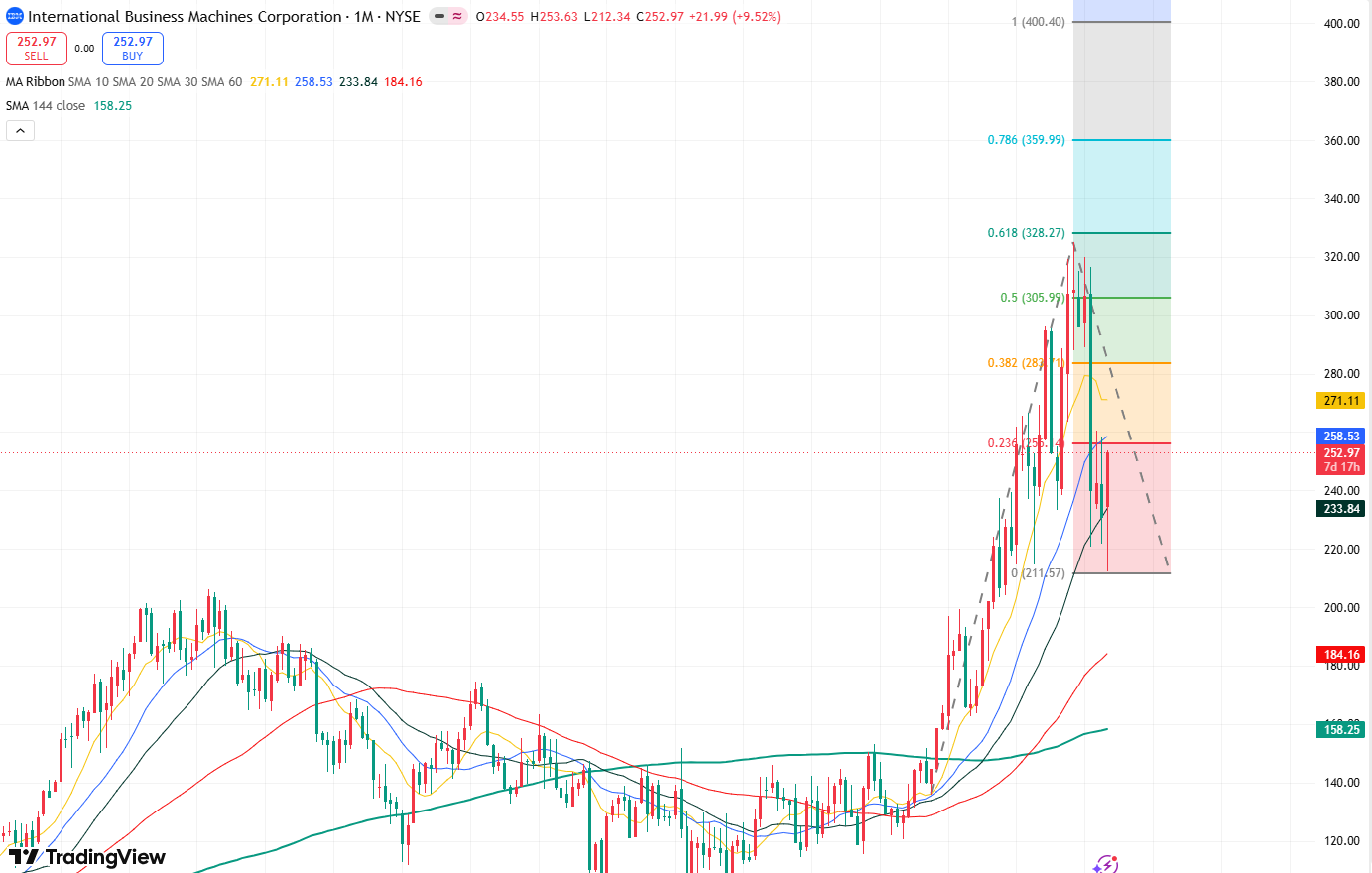
IBM stock monthly chart, Source: TradingView
From a technical perspective, the primary resistance level for IBM to watch is $256.80. If the stock breaks through this level with strength and consolidates above it, it will open up upside potential toward its previous all-time high of $324.90. Should the stock break above $342.90 in the future, it will challenge the $400 psychological milestone.
This content was translated using AI and reviewed for clarity. It is for informational purposes only.
Recommended Articles











Comments (0)
Click the $ button, enter the symbol, and select to link a stock, ETF, or other ticker.