


Arm Market Value Surpasses $300 Billion, SoftBank’s 87% Stake Makes It the Biggest Winner, How Arm Drives Wall Street Wild With CPUs?



AI Podcast


Arm's market capitalization exceeded $317.3 billion, driven by AI computing demand, with its stock surging over 33% in two days. This significantly boosted SoftBank's holdings, yielding over $220 billion in profit. Bernstein initiated coverage with an "Outperform" rating, targeting $300, citing Arm's CPU dominance in generative AI's evolution to "Agentic AI." Arm's energy efficiency positions it to benefit from increased CPU demand for AI inference. The company reported Q4 revenue growth of 20% and net profit surge of 49%. Arm also launched its first AGI CPU for data centers, securing over $2 billion in future orders.
TradingKey - Driven by the strong catalyst of explosive global demand for AI computing power, chip architecture giant Arm ( ARM) reached a historic milestone.
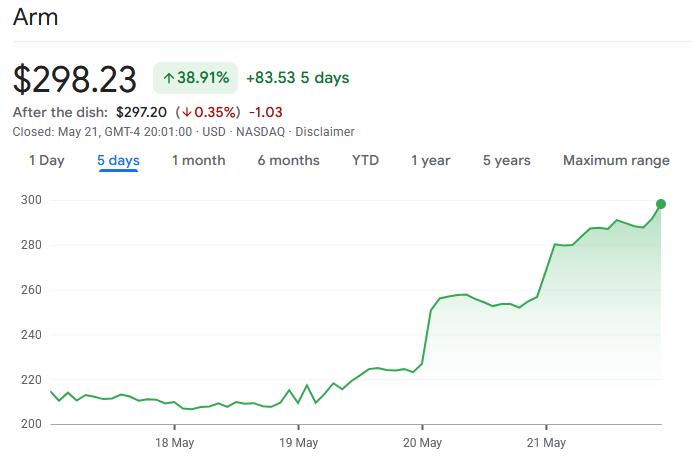
On May 21, the stock closed up 16.16%, continuing to set new record highs as its total market capitalization surged past $317.3 billion, crossing the $300 billion threshold for the first time. In the previous trading session, Arm's share price had already recorded a gain of 15.05% to close at $256.73, hitting an intraday high of $259.44. In just two trading days, its stock price has surged by a cumulative total of over 33%, with its market value soaring by more than $70 billion.
This historic breakthrough has brought SoftBank Group, Arm's largest shareholder, and its founder Masayoshi Son the most stellar returns of their investment careers. It is estimated that SoftBank invested a cumulative total of approximately $40 billion to hold an 87% stake in Arm through its 2016 privatization acquisition and a pre-IPO buyback in 2023. Today, the book profit on this investment exceeds $220 billion, representing a return of as high as 550%.
At the same time, ARM's strong performance has directly driven a synchronized rise in SoftBank's stock price. On Friday, SoftBank's shares surged 13.75% in the Tokyo market, following a 20% single-day spike on Thursday, adding over $35 billion to its market value in one day.
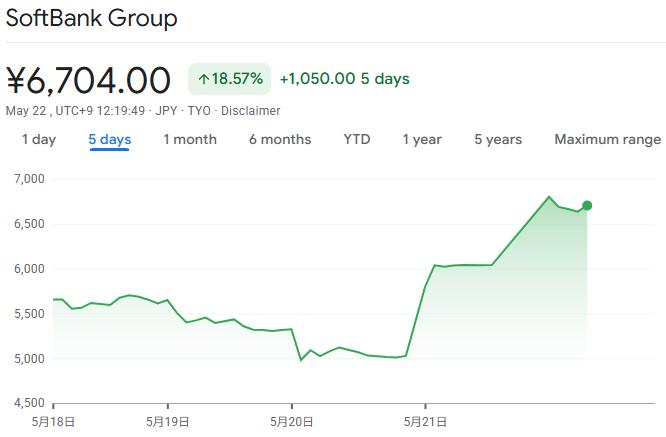
In addition to Arm's strong performance, news emerged of US listing plans for OpenAI, in which SoftBank holds a stake of over 10%. Furthermore, its digital infrastructure portfolio company, SB Energy, announced it will confidentially submit a registration statement for an IPO. This confluence of positive news has collectively driven a recovery in the market valuation of SoftBank.
Vey Sern Ling, Senior Equity Advisor at UBP, stated in an interview that SoftBank's current share price has begun to reflect the value of its core assets, including the surging Arm and the upcoming OpenAI IPO. However, he also cautioned that investors typically apply a valuation discount to holding companies because it is difficult for shareholders to fully capture the entire value of subsidiary assets, noting that Net Asset Value (NAV) or Sum-of-the-Parts (SOTP) valuation methods should be viewed with caution.
Why Bernstein Is Bullish on Arm?
The core catalyst driving ARM's strong gains this week came from an in-depth research report by the prominent investment bank Bernstein. Initiating coverage on ARM, the firm assigned an "Outperform" rating with a price target of $300.
Bernstein's optimistic outlook centers on the generational iteration of AI technology. Analysts noted that generative AI is rapidly evolving from the 1.0 era of chatbots to the 2.0 era of "Agentic AI" capable of autonomously executing multi-step tasks. This trend is directly driving a "renaissance" for CPUs—running AI agents requires processing significant amounts of complex logic, leading to a surge in market demand for CPUs.
With its unrivaled energy efficiency, Arm is poised to be the primary beneficiary of this structural trend. Bernstein estimates that Arm's CPU market share could quadruple over the next four years, targeting a total addressable market of $137 billion, with profits potentially increasing fivefold by 2030.
Arm's robust financial results underpin these optimistic expectations. In its most recent fiscal quarter, Arm's revenue grew 20% year-over-year to $1.49 billion, while net profit surged 49% to $313 million, reflecting the expanding demand for its chip architecture across segments from mobile to cloud computing.
Besides Bernstein, several other major investment banks have also raised their valuation expectations for ARM recently. Jefferies ( JEF) significantly hiked its price target from $210 to $290, while Citi ( C) notably raised its growth projections for the server CPU market.
How Arm Leverages CPUs for a Strategic Breakthrough
In the past, when discussing artificial intelligence computing power, the market's attention was almost without exception focused on NVIDIA ( NVDA) and its powerful GPUs. The reason is that in the first stage of AI development—the "model training" phase—extremely massive parallel computing capabilities are required, and GPUs, with their architectural advantages, became the undisputed "computing power kings" during this stage.
However, as technology progresses into the second stage—the inference phase, where trained models are deployed for practical applications—market demand is clearly shifting from training-side GPUs toward CPUs responsible for coordination and task execution. Especially with the gradual popularization of AI agent systems that require minimal human intervention, the influence of CPUs in daily data center operations is rising rapidly. According to industry analysis, the market size for server CPUs is expected to reach $137 billion by 2030.
This confidence is not mere talk; Arm's royalty income in the data center sector has doubled year-over-year, proving that in an AI era that values power efficiency and heat dissipation, its low energy consumption advantage has become a highly competitive weapon.
In addition to traditional architecture licensing, Arm experienced a key leap in its business model this year. Previously a pure intellectual property (IP) licensor, Arm officially launched its first self-developed AGI CPU for AI data centers in March, announcing its entry into chip product design. This high-end chip, manufactured using TSMC's advanced 3nm process, was confirmed for adoption by social media giant Meta immediately upon its release.
To the market's further surprise, management revealed that combined order demand for this self-developed chip for the 2027 and 2028 fiscal years has exceeded $2 billion, far surpassing conservative market expectations for the new product's initial phase.
This content was translated using AI and reviewed for clarity. It is for informational purposes only.
Recommended Articles








Comments (0)
Click the $ button, enter the symbol, and select to link a stock, ETF, or other ticker.