


What Did Trump Buy and Sell in the First Quarter? Where Is the Boundary Between Policy and Capital Behind 3,600 Transactions?



AI Podcast


President Trump's Q1 2026 financial disclosure reveals significant portfolio rebalancing, with transaction volumes between $220 million and $750 million. Holdings in tech giants like Amazon, Meta, and Microsoft saw reductions, while substantial new positions were established in semiconductor companies such as Nvidia and Broadcom, alongside software firms. Notably, a new position in Dell preceded a public endorsement, and increased Intel holdings followed U.S. government investment. These transactions, alongside past instances, raise market concerns regarding information asymmetry, potential policy signaling, and the erosion of fair dealing principles in U.S. capital markets.
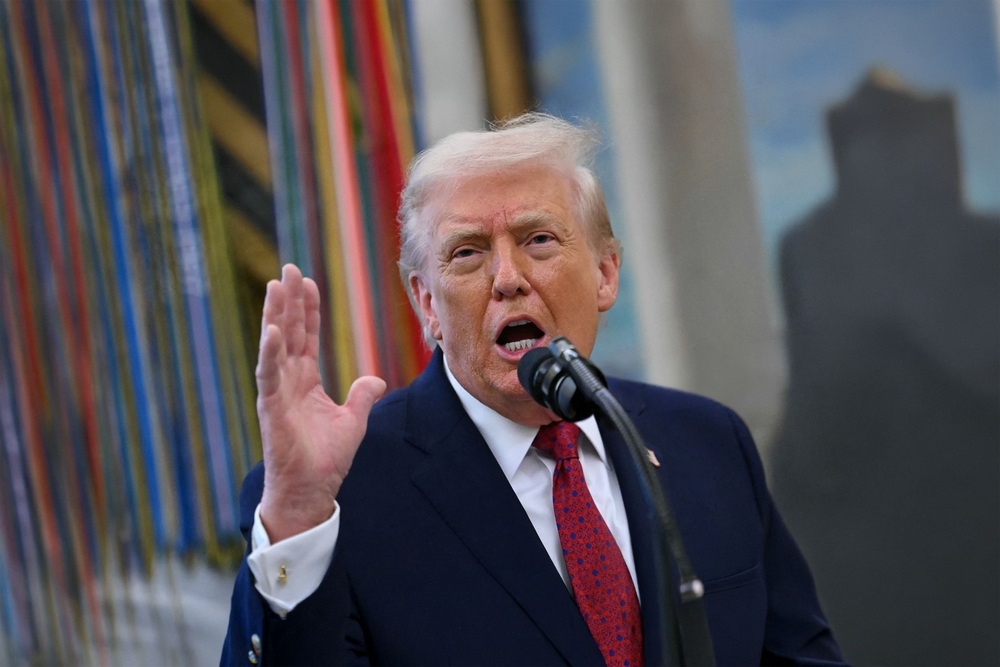
TradingKey - U.S. President Trump recently submitted his latest financial disclosure filings to the Office of Government Ethics (OGE), disclosing approximately 3,600 securities transactions in a single release and indicating a significant rebalancing of his investment portfolio during the first quarter of 2026.
According to the documents, the lower bound of Trump's cumulative securities transaction volume from January to March this year was approximately $220 million; if estimated by the upper bound of the disclosure range, the total could be as high as $750 million. The transactions cover multiple core sectors such as technology, finance, and communications, including Microsoft ( MSFT ), Apple ( AAPL ), NVIDIA ( NVDA ), Meta ( META ), Amazon ( AMZN ), Oracle ( ORCL ), Broadcom ( AVGO ), Goldman Sachs ( GS) and Bank of America ( BAC) and other heavyweight U.S. equities, with some municipal bond allocations also included in the disclosure.
It should be noted that the U.S. federal disclosure system only requires officials to report transaction amount ranges without providing specific execution prices, timing, or details of gains and losses, making it difficult for external observers to accurately assess actual investment returns. The documents also do not clearly distinguish the security types for some assets (such as common stock, convertible bonds, or corporate bonds), yet the scale and timing of certain transactions still carry significant signaling value.
Reducing holdings in traditional tech giants, establishing large positions in chip stocks
In the first quarter of 2026 portfolio rebalancing, Trump made significant structural adjustments to positions in several tech giants. Disclosure filings show that Amazon, Meta, and Microsoft, three core holdings, each saw high-tier divestments ranging from $5 million to $25 million per transaction, ranking among the largest-scale operations in his trading activity for the quarter.
Notably, the reductions did not equate to a complete exit. Records from the same period show that Trump maintained small-scale additions in the aforementioned three companies; multiple Meta purchases were concentrated at the start of the year, with single transactions ranging from $1,001 to $500,000, while purchase sizes for Amazon and Microsoft ranged between $1,001 and $5,000,000.
Meanwhile, the semiconductor sector became a primary focus for new positions this quarter. Nvidia and Broadcom both received new allocations in the $1 million to $5 million range, while Texas Instruments ( TXN ), Synopsys ( SNPS) and Cadence Design Systems ( CDNS) and other chip design and EDA tool providers also appeared on the buy list of the same magnitude. Apple similarly recorded a significant increase of $1 million to $5 million, reflecting continued optimism toward the hardware ecosystem leader.
At the same time, Oracle, ServiceNow ( NOW ), Adobe ( ADBE) and Workday ( WDAY) all saw new position entries exceeding $1 million. Disclosure documents noted that the timing of these purchases coincided with a valuation pullback in software stocks, driven by market concerns over AI substitution effects and declining earnings visibility.
Market Confidence Under Scrutiny
At the same time, two transactions have drawn additional market attention due to the potential correlation between their timing and the policy background.
Disclosure documents show that on February 10, 2026, an account belonging to Trump established a new position worth between $1 million and $5 million in Dell Technologies ( DELL) Class C shares. Notably, this position was initiated prior to his public endorsement of Dell hardware products at a White House event in early May this year. The chronological order of these two events has inevitably sparked public discussion regarding the boundaries between personal investment decisions and policy signals.
Intel ( INTC) has also seen changes in its holdings against a unique backdrop. Filing records show that starting in early March 2026, Trump gradually increased his stake in the domestic chipmaker through multiple transactions. This series of purchases occurred following the U.S. government's late 2025 decision to make a significant equity investment in Intel.
Since the start of Trump's second term, the U.S. capital markets have repeatedly witnessed a phenomenon of high synchronization between "policy announcements" and "market reactions."
Earlier this year, media outlets reported cases of trades with "exceptionally precise timing" prior to major policy announcements, involving options, commodity futures, and prediction market positions, raising market concerns over potential information asymmetry. Trump himself has also faced questioning from some lawmakers for publicly declaring "now is a great time to buy" on the eve of tariff policy adjustments, with calls for an investigation into whether his trading activity involved market manipulation or the use of inside information.
Analysts point out that the focus of the controversy has moved beyond the technical question of whether a single trade is compliant, pointing instead to three core issues: whether the president possesses forward-looking policy information inaccessible to ordinary investors; whether the pace of his asset allocation forms a potential coupling with industrial policy and the diplomatic agenda; and whether the timing of major policy releases could indirectly influence changes in his family's wealth.
For financial markets, the deeper risk lies in the potential erosion of institutional credibility. Legal and regulatory experts in Washington warn that if the market forms a general perception that "policymakers are simultaneously active traders," the long-standing principle of fair dealing in U.S. capital markets could face substantial challenges.
This content was translated using AI and reviewed for clarity. It is for informational purposes only.
Recommended Articles












Comments (0)
Click the $ button, enter the symbol, and select to link a stock, ETF, or other ticker.