


IBM First-Quarter Revenue Grows But Shares Sell Off: Revenue Growth Slows, Core Business Simultaneously Cools



AI Podcast


IBM's Q1 2026 results showed revenue growth of 9% year-over-year to $15.9 billion, with adjusted EPS of $1.91. All segments, including Software, Consulting, and Infrastructure, grew. However, the stock declined 7% as growth rates decelerated compared to the prior quarter. The Infrastructure segment led growth, driven by mainframe systems. While Software revenue increased, its growth rate slowed, raising concerns about core valuation support. Despite maintaining full-year guidance, the market's elevated expectations for AI monetization and rapid expansion were unmet, leading to profit-taking and concerns about AI disruption.
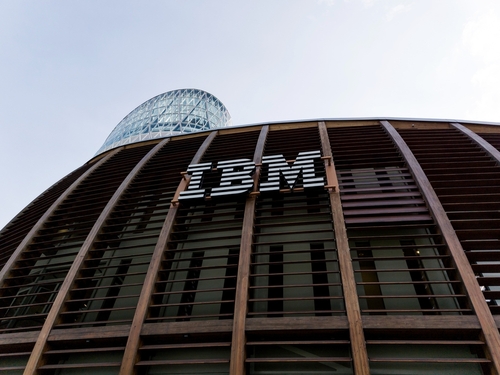
TradingKey - Software Giant IBM Q1 results showed revenue growth, yet the stock price declined as revenue growth began to slow and core business segments also experienced decelerating growth.
On April 22, IBM announced its Q1 2026 financial results, reporting revenue of $15.9 billion, up 9% year-over-year, or 6% on a constant currency basis; adjusted earnings per share were $1.91, surpassing market expectations of $1.81.

Meanwhile, the Software, Consulting, and Infrastructure segments all achieved growth, with Software revenue up 11%, Consulting up 4%, and Infrastructure up 15%. Free cash flow also rose to $2.2 billion. The company maintained its full-year guidance for constant currency revenue growth of over 5% and expects full-year free cash flow to increase by approximately $1 billion year-over-year.
Following the earnings report, IBM shares fell 7% in after-hours trading, with its cumulative year-to-date decline reaching 14.49%.
Revenue maintains growth, but the growth rate is declining.
On the surface, IBM's total revenue and earnings per share performed strongly, but the market's focus lies on the fact that IBM's growth rate has begun to slow. Although IBM's first-quarter revenue grew 9% year-over-year, it clearly decelerated compared to the 12.2% growth rate in the previous quarter.
Looking at the segment breakdown, the Infrastructure business performed best, growing 15% to $3.33 billion, which exceeded the market expectation of $3.16 billion. Mainframe systems remained a highlight, with IBM noting that Z-series mainframe hardware revenue surged 51%, as the z17 model continued to outperform previous product cycles.
While Software, IBM's most critical high-margin business, maintained growth, its growth rate also slowed significantly, with first-quarter software revenue rising only 11.3% compared to 14% in the previous quarter. A growth slowdown in such a key business may lead the market to worry whether the company's core valuation support is beginning to weaken.
Consulting revenue grew 4% to $5.27 billion, marking the segment's highest growth rate since 2023, though it was slightly below market expectations.
Overall, there were no fundamental issues in IBM's earnings report, but its performance failed to exceed market expectations. In the current market environment, particularly for mature tech companies like IBM, a lack of positive surprises is often interpreted by the market as failing to meet ideal performance levels.
Why is the stock price falling?
IBM shares tumbled 7% in extended trading following its earnings release. This market reaction was driven not by a fundamental flaw in the report, but by the company's failure to meet the market's elevated growth expectations.
Ahead of the results, the market had set high benchmarks for IBM. Investors were looking for evidence that AI innovations would not cannibalize core software and consulting business, while also seeking proof of the company's ability to monetize AI into tangible revenue. However, signs of decelerating growth in the first quarter failed to satisfy the appetite for rapid expansion. Given rich valuations and heightened sensitivity to the AI competitive landscape, investors opted for profit-taking.
Concurrently, concerns regarding the disruptive potential of AI technology weighed heavily on IBM’s share price. In February, AI startup Anthropic introduced Claude Code, a generative AI tool claimed to facilitate the modernization and migration of COBOL code—the foundational language of IBM’s mainframe business. The announcement triggered the stock's steepest sell-off in decades, with shares plunging 13.15% in a single session.
Furthermore, IBM’s decision to leave its full-year financial guidance unchanged contributed to the pressure on its shares. The company maintained its forecast for constant-currency revenue growth of over 5% and an incremental $1 billion in free cash flow, while raising its quarterly dividend to $1.69 per share—demonstrating robust cash flow and a commitment to shareholder returns. Nevertheless, with the market widely anticipating a guidance hike alongside a strong report, the decision to maintain the status quo was interpreted as a lack of further upside catalysts.
Market Outlook
From a medium-to-long-term perspective, IBM still holds investment potential, with its primary advantage being stability. Its financial results show growth across software, infrastructure, and cash flow, while the mainframe business, currently in an upcycle, provides ongoing support; furthermore, free cash flow remains sufficient to fund dividends and continuous investment. Management has explicitly stated that AI is assisting clients in orchestrating, deploying, and governing operations within hybrid environments, suggesting that IBM has not been sidelined by the AI wave but is instead integrating AI as a value-added component of its product suite.
Regarding capital market pricing, IBM must now prove its capacity for accelerated growth. The software division, especially Red Hat and watsonx-related offerings, needs to demonstrate more consistent growth; similarly, the consulting business must prove that enterprise budgets are not exclusively reserved for top-tier cloud providers and that clients remain willing to award IBM more projects. CFRA analyst Brooks Idlet noted that while IBM has temporarily mitigated pessimistic market expectations regarding AI-driven displacement, it has yet to reach a threshold that would trigger a valuation rerating.
Consequently, the short-term dip in IBM's stock price should be viewed as a correction of the gap in market expectations. Should software growth re-accelerate and the commercialization of Red Hat and AI tools continue to materialize—complemented by the extended mainframe cycle—IBM could regain market favor. Conversely, if future growth remains at the current tempo, the market will likely categorize IBM as a mature technology stock characterized by steady cash flow and dividends, yet lacking the potential for explosive growth.
This content was translated using AI and reviewed for clarity. It is for informational purposes only.
Recommended Articles








Comments (0)
Click the $ button, enter the symbol, and select to link a stock, ETF, or other ticker.