


Boeing Free Cash Flow Improvement Beats Expectations, Stock Marks Biggest One-Day Gain in Nearly Three Months



AI Podcast


Boeing reported Q1 revenue of $22.22 billion, up 14% year-over-year, with a narrowed net loss. Adjusted free cash flow improved significantly due to a rebound in aircraft deliveries, particularly from Defense and Global Services segments. A record $695 billion backlog provides future visibility. However, the Commercial Airplanes unit still faces losses, with positive margins now targeted for 2027. The company's upside hinges on potential large orders from China, contingent on government support and upcoming trade negotiations, especially during a prospective Trump visit. Full-year free cash flow guidance remains, requiring substantial generation in the remaining quarters.
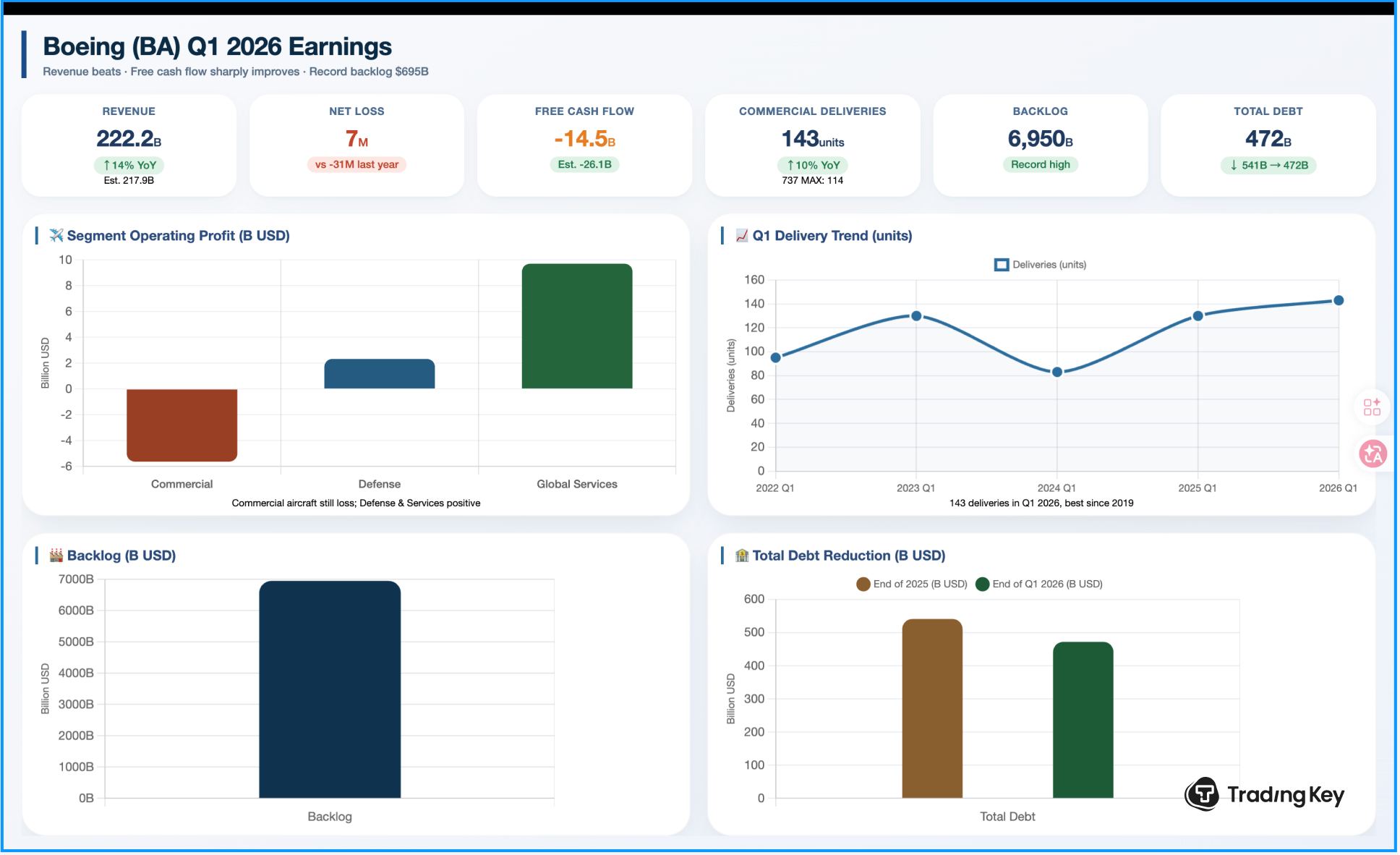
TradingKey - Boeing ( BA) reported first-quarter financial results on Wednesday, with revenue of $22.22 billion, up 14% year-over-year and exceeding market expectations of $21.79 billion. Net loss narrowed to $7 million, compared to a loss of $31 million in the same period last year. Adjusted free cash flow was -$1.45 billion, which was an improvement of approximately $1.16 billion over the market estimate of -$2.61 billion, a narrowing of more than 40%. Driven by multiple positive catalysts, the share price closed up 5.53% on the day, marking its largest single-day gain in nearly three months.
Rebound in deliveries drives cash inflows
The primary driver of the cash improvement was the rebound in aircraft deliveries, with Boeing delivering 143 commercial aircraft in the first quarter, a 10% increase year-over-year. However, the Commercial Airplanes unit is still recording losses, with quarterly revenue of $9.2 billion and an operating loss of $563 million; the company has delayed its target for achieving positive profit margins until 2027.
Another pillar for cash flow improvement came from the Defense and Global Services segments, both of which achieved positive profits and provided Boeing with a steady source of cash. The Defense unit's revenue was $7.599 billion, up 21% year-over-year, with an operating profit of $233 million, a 50% increase; the Global Services segment's revenue reached $5.370 billion, up 6% year-over-year, with an operating profit of $971 million, a 3% increase.
At the end of the first quarter, Boeing's total backlog reached a record high of $695 billion, covering over 6,100 commercial aircraft. This record backlog also provides visibility for future deliveries and cash flow conversion.
CEO Kelly Ortberg stated that the company had a strong start to the year, with growth across all business units and a record-breaking backlog, while also supporting customers through the Artemis II mission. The company continues to deliver commercial and defense products and services safely and with high quality.
Chinese Orders: Trump is Key
Boeing's potential upside is largely dependent on the Chinese market. Ortberg stated in an interview with Reuters on Wednesday that he is hoping the Trump administration can help unlock long-awaited major orders from China.
Industry sources revealed that negotiations could include 500 737 MAX aircraft and dozens of wide-body jets, which would mark China's first major order for Boeing since 2017. Boeing and Chinese airlines have reached a favorable solution regarding the supply of major spare parts.
Ortberg stated clearly: "Without government support, I don't think we will see any large orders from China in the short term." Trump plans to visit China in May, a trip previously postponed due to the war in Iran.
Jefferies analyst Sheila Kahyaoglu noted that the potential for 500 MAX orders from China is a key upside catalyst for Boeing, maintaining a $295 price target and a "Buy" rating.
However, whether the Chinese orders materialize depends on the outcome of bilateral trade negotiations during Trump's visit to China in May, and uncertainty persists.
Full-year free cash flow guidance
Boeing maintained its 2026 free cash flow guidance between $1 billion and $3 billion, implying that after the first-quarter cash burn, it will need to generate a total of approximately $2.5 billion to $4.5 billion in positive free cash flow over the subsequent three quarters to meet the target.
The company outlook stated: "The 737 program is currently producing at a rate of 42 aircraft per month, with plans to reach 47 this summer; the 787 program is steady at a production rate of 8 per month. Certification for the 737-7 and 737-10 is expected to be completed in 2026, with first deliveries projected for 2027. The 777X first delivery is also expected to be achieved in 2027."
JPMorgan analyst Seth Seifman noted that Boeing is transitioning from a "story stock" to a "cash counting" stock. The next major milestone is whether second-quarter free cash flow can approach break-even. If achieved, market confidence in full-year guidance will significantly strengthen. Conversely, there is a risk of a guidance downgrade. Investors should focus on Trump's visit to China in May and the progress of the 737 production ramp-up.
This content was translated using AI and reviewed for clarity. It is for informational purposes only.
Recommended Articles








Comments (0)
Click the $ button, enter the symbol, and select to link a stock, ETF, or other ticker.