


Amazon Talks to Acquire Globalstar: Can $9 Billion Deal Challenge SpaceX Starlink?



AI Podcast


Amazon is reportedly in talks to acquire Globalstar for $9 billion to accelerate its Project Kuiper satellite internet initiative and compete with SpaceX's Starlink. This potential deal is complicated by Apple's 20% stake in Globalstar, acquired in November 2024 for $1.5 billion, which provides crucial satellite SOS functionality for iPhones. Globalstar, which turned profitable in 2025 with $273 million in revenue, offers vital L-band spectrum licenses and existing infrastructure. Apple's decision regarding its stake will be pivotal, influencing regulatory scrutiny and the future competitive landscape of the LEO satellite market.
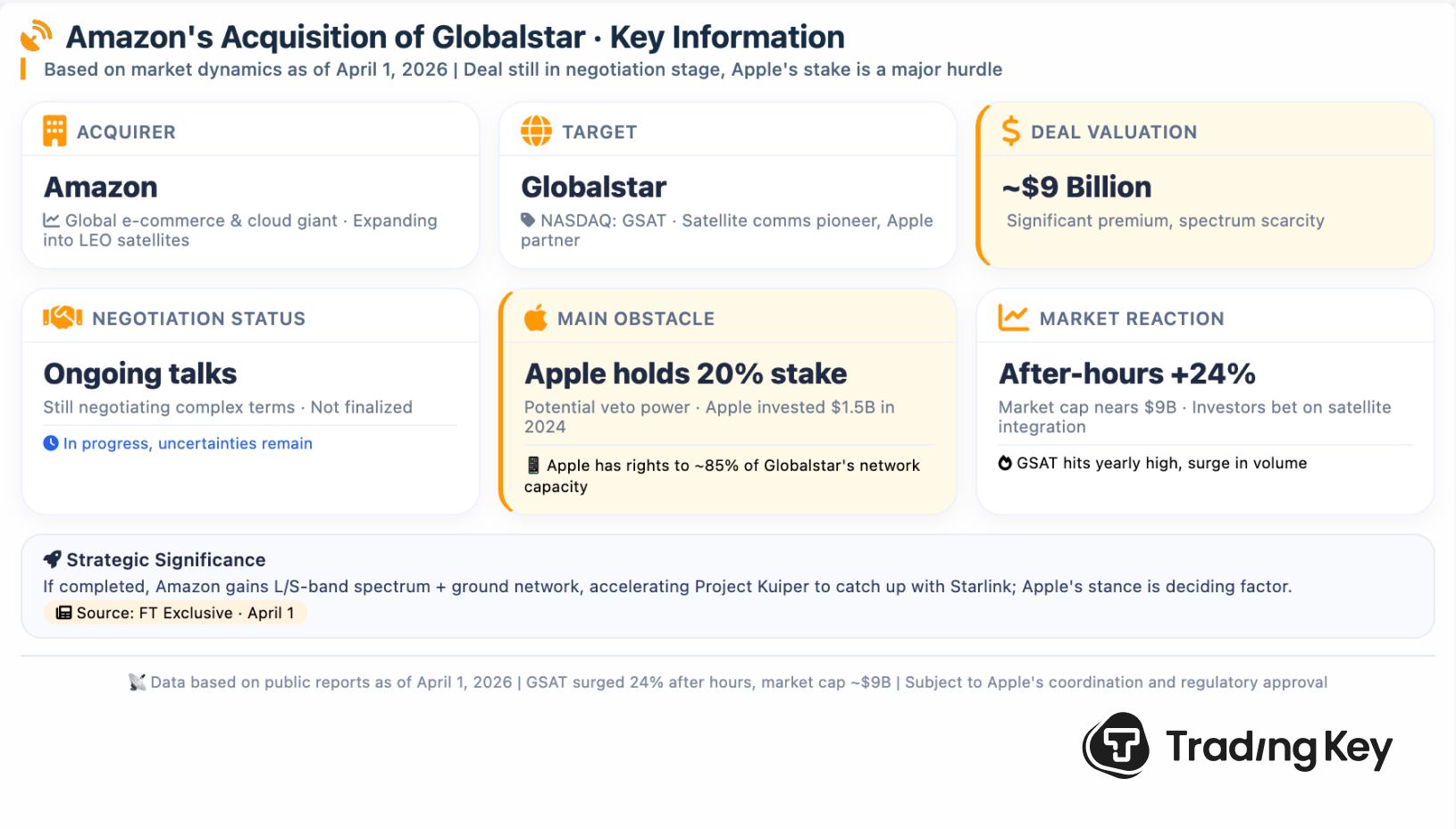
TradingKey - On April 1, 2026, during U.S. post-market trading, shares of satellite communications company Globalstar ( GSAT) surged 24%, with its market capitalization briefly nearing $9 billion. The source of the frenzy was an exclusive report from the Financial Times: e-commerce giant Amazon ( AMZN) is in talks to acquire Globalstar for $9 billion, aiming to compete head-on with Elon Musk's Starlink in the low-earth orbit satellite internet sector.
If this deal materializes, it will reshape the competitive landscape of the global satellite internet industry. However, the catch remains: Apple ( AAPL) holds a 20% stake in Globalstar, which could be the most difficult hurdle on Amazon's path to 'space internet.'
I. Can $9 Billion Catch Up With Spacex Starlink?
According to the Financial Times, citing people familiar with the matter, Amazon and Globalstar have been in long-term negotiations over a deal valued at approximately $9 billion. The parties are still working through complex issues, and the transaction has not yet been finalized and remains subject to change.
For Amazon, acquiring Globalstar is a critical step for its satellite internet initiative, 'Project Kuiper' (now known as Amazon Leo). Amazon's Leo project currently has roughly 200 satellites in orbit, far trailing the more than 10,000 satellites in SpaceX's Starlink constellation. A successful acquisition would grant Amazon direct access to existing L-band spectrum licenses, a gateway station network, and mature operational experience, significantly accelerating its efforts to close the gap with Starlink.
II. What Is Globalstar? From Struggling Operations To Apple’S "Guest Of Honor"
Founded in 1991, Globalstar is a low-earth orbit (LEO) satellite mobile communications company headquartered in Louisiana, USA. The company's history has been a rollercoaster: it filed for bankruptcy in 2002, resumed operations in 2004 following a private equity capital injection, and reached a turning point in 2017 when the FCC approved its 2.4 GHz band for terrestrial 5G communications.
Core Business: Globalstar provides mobile satellite voice and data services, offering connectivity solutions when cellular networks are unavailable. Key products include:
- Two-way voice and data satellite communication services and equipment
- SPOT series satellite devices (GPS trackers, one-touch SOS functionality)
- Commercial Internet of Things (IoT) solutions, supporting remote monitoring and asset tracking
- Wholesale capacity services providing Emergency SOS for Apple's iPhone
Financial Performance (2025) : In 2025, Globalstar generated $273 million in revenue, up 9% year-over-year, with operating profit reaching $7.4 million, achieving a turnaround to profitability.
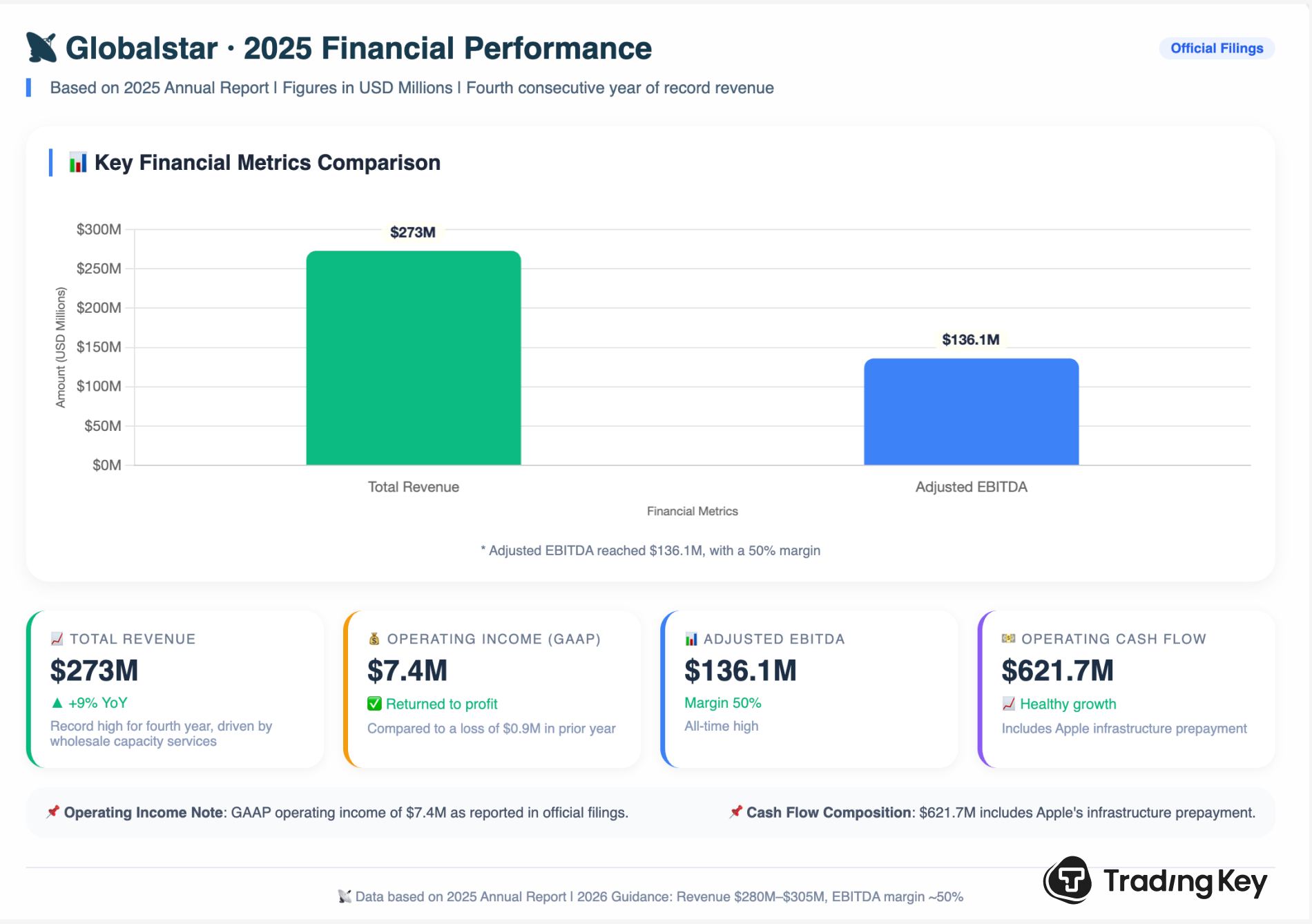
Strategic Alignment with Apple: In November 2024, Apple invested $1.5 billion in Globalstar to acquire a 20% stake, including a $400 million equity purchase and $1.1 billion in infrastructure prepayments. Apple will gain access to approximately 85% of Globalstar's satellite network capacity. This partnership has propelled Globalstar from a long-struggling legacy satellite firm into a key infrastructure provider for the Apple ecosystem.
As of April 1, 2026, Globalstar's market capitalization was approximately $8.81 billion, with its stock price rising over 200% in the past year and a 52-week range of $17.24-$74.88.
III. Apple’s 20% Stake: The Biggest Obstacle to Amazon’s Acquisition of Globalstar
Apple's investment logic is clear: to establish satellite communication as a differentiating feature for the iPhone and Apple Watch. Currently, the iPhone 14 and subsequent models, along with the Apple Watch Ultra, all support satellite SOS functionality, allowing users to send emergency messages in areas without cellular reception.
What does Apple's 20% stake represent?
According to corporate governance rules, a shareholder with a 20% stake typically possesses veto power over major corporate decisions. If Amazon seeks to fully acquire Globalstar, it must persuade Apple to either exit or become a passive shareholder. Apple's stance depends on two points:
- Whether Globalstar's service can continue to ensure the iPhone user experience.
- Whether the price for monetizing the equity is satisfactory.
When Apple initially invested, Globalstar's stock was around $1.50; it has now risen to approximately $68, representing more than 40 times in unrealized gains. While the financial returns are already quite significant, Apple may choose to hold firm—satellite services have become an important 'glue' for the iPhone ecosystem. If Amazon takes over and adjusts priorities, the experience for Apple users could be compromised.
IV. Market Reaction: Why Are Investors Betting?
Following the news, Globalstar shares surged 24% in after-hours trading, with its year-to-date gain exceeding 200%. This reaction underscores investors' optimistic outlook for the low Earth orbit (LEO) satellite sector.
Why are investors so focused on this?
- Scarce Spectrum Resources: Globalstar holds L-band and S-band spectrum licenses, which are scarce resources specifically designated by the ITU for mobile satellite services and possess significant strategic value.
- Mature Infrastructure: Featuring a network of over 20 global gateway stations, 24 second-generation satellites in orbit, and a third-generation constellation slated for launch, its infrastructure is ready for immediate use.
- Apple's Endorsement: A long-term service agreement with Apple has locked in a stable revenue stream for the coming years.
- Strategic Positioning: The LEO satellite market is moving from a "technical validation phase" to a "commercial consolidation phase," highlighting its acquisition value.
Notably, Globalstar had previously held sale discussions with SpaceX. This indicates at least one thing: in the competition among tech titans Elon Musk, Jeff Bezos, and Tim Cook, Globalstar's core assets have become a scarce commodity coveted by all parties.
V. Why does Amazon need Globalstar so urgently?
Why is Amazon so desperate for Globalstar? A set of comparative data reveals the answer:
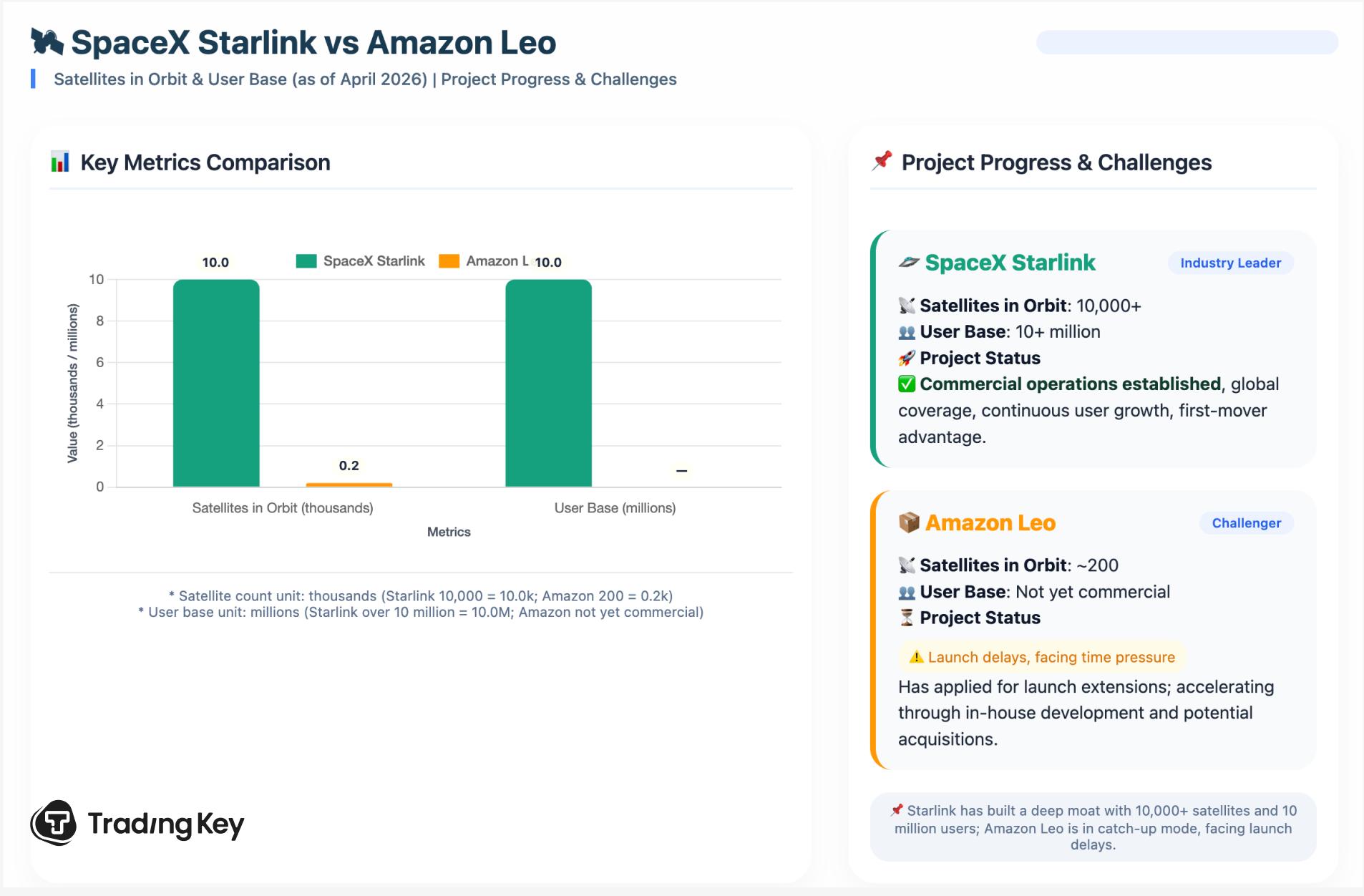
Amazon's LEO project applied to the FCC in February to extend the launch deadline for 1,600 satellites by two years. The company plans to place 700 satellites into orbit by mid-2026, but is currently hampered by insufficient launch capacity.
At the commercial level, Amazon has already signed agreements with JetBlue and Delta Air Lines to provide satellite internet services for their flights starting in 2027 and 2028, respectively. This means the time window for Amazon to build its satellite network is narrowing.
The value of acquiring Globalstar lies in "trading capital for time" : bypassing the lengthy cycles of spectrum applications and ground station construction to directly acquire mature operational capabilities. For Amazon, which is eager to catch up with Starlink, $9 billion buys time and, more importantly, a strategic foothold.
VI. IInvestor Perspective: How Will This Transaction End?
From an investment perspective, the eventual outcome of this transaction may unfold in several potential scenarios:
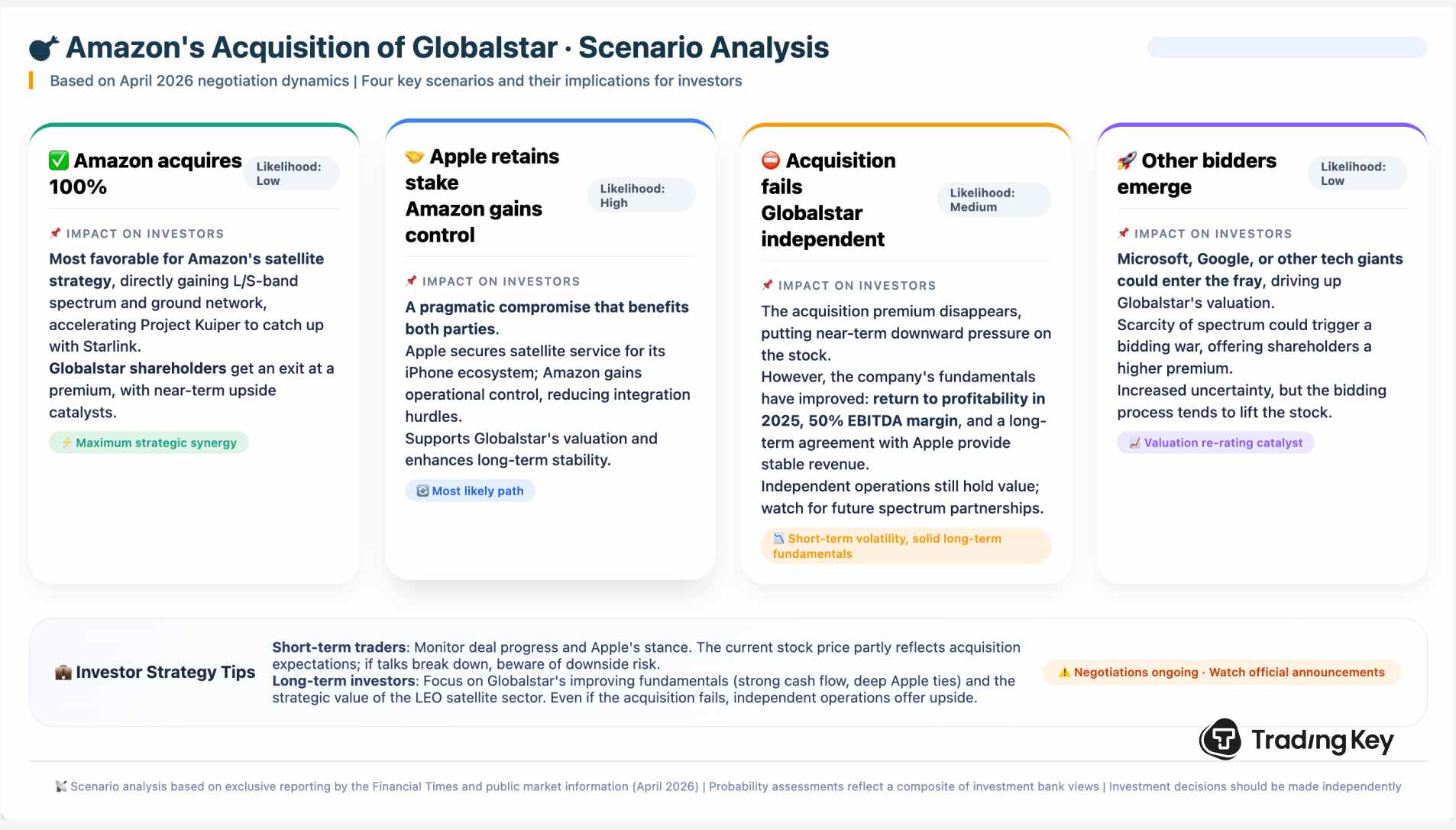
This potential acquisition is not only an escalation of the rivalry between Amazon and SpaceX, but also reflects an industrial inflection point as the low-earth orbit (LEO) satellite sector shifts from a "technical verification phase" to a "commercial consolidation phase."
For investors, the core focus should remain on:
- Apple's Stance: How the 20% stake is handled will determine whether the deal can proceed
- Regulatory Scrutiny: The $9 billion acquisition will face antitrust scrutiny
- Amazon's Contingency Plan: Whether the LEO project can independently close the gap with Starlink if the acquisition fails
What is certain is that regardless of how this acquisition concludes, the battle for LEO satellite resources will only intensify. Musk's Starlink has already established a first-mover advantage, Bezos is racing to catch up, and the 20% stake held by Cook could become the decisive leverage in this three-way space rivalry.
Recommended Articles








Comments (0)
Click the $ button, enter the symbol, and select to link a stock, ETF, or other ticker.