


Largest US IPO of 2026 Debuts, Cerebras Soars 68% on First Day, Is This AI Chip Upstart Worth Buying Now?



Cerebras Systems debuted on Nasdaq with a significant 68% gain, valuing the AI chipmaker at $95 billion. The company's unique Wafer-Scale Engine (WSE) architecture aims to outperform traditional GPUs by integrating an entire wafer into a single processor, reducing latency and increasing AI inference efficiency. Despite strong market reception and revenue growth, Cerebras faces challenges including high manufacturing costs, yield control, and a current lack of profitability, reflected in its high price-to-sales ratio. The successful IPO signals renewed investor appetite for AI-related companies and potentially revitalizes the U.S. tech IPO market.
TradingKey - On Thursday, May 14, Eastern Time, AI chipmaker Cerebras Systems, regarded by the market as a "Nvidia challenger," officially listed on the Nasdaq under the ticker "CBRS," with its first-day trading delivering a stunning performance.
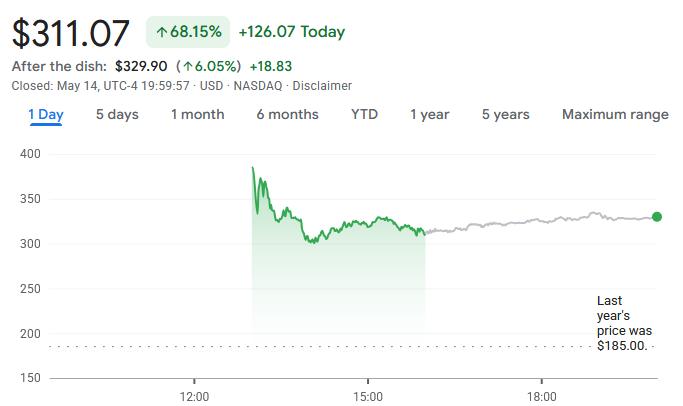
The stock opened at $385, a massive premium of approximately 108% over its $185 offering price, and surged as high as $386.34 during the session—a gain of nearly 109% that triggered a temporary trading halt; on a fully diluted basis, the company's valuation momentarily surpassed $100 billion. It eventually closed at $311.07, with its gain narrowing to 68%, corresponding to a market capitalization of approximately $95 billion, while the share price continued to climb in after-hours trading.
The offering consisted of 30 million Class A common shares, raising $5.55 billion; if underwriters fully exercise their over-allotment option for 4.5 million shares, total proceeds are expected to reach $6.38 billion, marking the largest IPO for a U.S. tech company since Uber's listing in 2019 and the most anticipated new listing in the U.S. market so far in 2026.
Notably, the final IPO price was set at $185 per share after several upward revisions from an initial guidance range of $115-$125 and a subsequent increase to $150-$160 due to robust market demand, reflecting high market confidence in its growth prospects.
Cerebras CEO Andrew Feldman stated after the stock began trading on Thursday: "We are very gratified that the market seems to have understood our business story and provided such positive feedback."
What are the technical advantages of the Cerebras Wafer-Scale Engine?
As a high-profile "Nvidia challenger" in the AI chip sector, Cerebras Systems is attempting to reshape the competitive landscape of the computing power market through a radically different technical path.
Founded in 2015 in Sunnyvale, California, the company's core barrier lies in its proprietary "Wafer Scale Engine" (WSE) architecture—abandoning the traditional GPU practice of relying on multi-chip stitching to directly integrate an entire 12-inch wafer into a single processor. This design significantly reduces inter-chip communication latency, allowing Cerebras' processing efficiency in AI inference scenarios to reach 10 to 20 times that of Nvidia's ( NVDA) GPU systems.
Interestingly, Cerebras' "bigger is better" technical route once shared intellectual resonance with Nvidia at the same historical juncture, yet ultimately diverged in completely different directions.
In 2019, Nvidia founder Jensen Huang asserted at CES in Las Vegas that "Moore's Law is dead"; around the same time, Cerebras also noted in its technical discourse that traditional transistor scaling laws might fail prematurely, constrained by economic costs rather than mere physical limits.
As explorers breaking out of old technical paradigms, their evolutionary logic differed significantly: Nvidia relied on GPU scalability, focusing on stacking multi-card clusters, while Cerebras concentrated on the physical boundaries of a single chip, pushing chip size to the extreme through its integrated supercomputing systems (CS series).
As global AI applications rapidly shift from model training to inference deployment, the forward-looking nature of this technical route has become increasingly prominent. Currently, the company's flagship CS-2 and CS-3 supercomputing systems are equipped with third-generation WSE-3 processors, offering customers flexible options for both on-premise deployment and cloud-based on-demand rental.
"Since we successfully achieved this breakthrough, other competitors have tried to follow suit, but all have ended in failure," Feldman stated. He continued, "Therefore, we have immense confidence in the technical moat we have built, believing it is both wide and deep."
However, this technical route also faces practical challenges: high manufacturing costs for wafer-scale chips, difficulty in yield control, and stringent heat dissipation requirements are all hurdles that must be cleared for mass production.
The inherent characteristics of silicon wafer manufacturing and photolithography dictate that a larger wafer area leads to a higher probability of random defects, which directly weighs on production yields—a risk Cerebras admitted when it launched the first-generation WSE. Furthermore, the massive size of the chip means it is slightly less flexible in task scheduling compared to miniaturized GPUs.
How does Cerebras' market capitalization compare to semiconductor giants?
Compared with other semiconductor giants, Cerebras's current market capitalization is still within the "emerging challenger" range, but its growth elasticity and valuation premium are significant. Based on the latest trading data, Cerebras's closing market cap is approximately $95 billion. When compared horizontally with leading global chipmakers, its scale gap and catch-up potential coexist.
Company | Market Cap (Approx.) | Comparison with Cerebras |
NVIDIA | $5.7 trillion | Approx. 60x; the absolute leader in the AI computing ecosystem |
TSMC ( TSM ) | $2.2 trillion | Approx. 23x; the core hub of global wafer foundry |
Broadcom ( AVGO ) | $2.1 trillion | Approx. 22x; a giant in networking chips and custom solutions |
Micron Technology ( MU ) | $900 billion | Approx. 9.5x; a representative of the memory chip cycle |
AMD ( AMD ) | $733.3 billion | Approx. 7.7x; a dual-track competitor in CPU+GPU |
In the future, if the company continues to deliver on its technological advantages and earnings growth, its market value is expected to achieve new breakthroughs; however, one must also remain cautious of risks posed by valuation bubbles and intensifying industry competition.
Is it still a good time to buy Cerebras stock?
In terms of financial performance, Cerebras' revenue for fiscal year 2025 grew by approximately 76% year-on-year to $510 million, demonstrating strong growth momentum. Regarding the revenue structure, hardware sales accounted for about 70%, while cloud services and other businesses surged 95% year-on-year, reflecting the initial success of the company's transition from an equipment supplier to a computing power service provider.
However, operating pressure during the high-investment phase remains significant, with an annual operating loss approaching $146 million and a gross margin of 39%, indicating that the company has yet to achieve large-scale profitability.
From a valuation perspective, more caution is needed. Based on trailing 12-month revenue, the stock's current price-to-sales (P/S) ratio is as high as 187x, far exceeding the valuation median of mature semiconductor industry peers. This premium reflects both the market's recognition of the scarcity of its "pure AI computing power" and high expectations for technological delivery and commercial implementation. Given that the stock price has already significantly reflected optimistic sentiment, the margin of safety for entering in the short term is relatively limited.
Furthermore, "lock-up period" clauses pose potential supply pressure. According to the IPO arrangements, shares held by most of the company's executives, directors, and pre-IPO shareholders are subject to a lock-up of several months before they can be released.
Historical experience indicates that as the lock-up expiration approaches, some early investors may choose to moderately reduce their holdings to realize returns, which could cause temporary volatility in secondary market liquidity.
Considering the current elevated valuation and the significant rise in stock price, investors may want to wait patiently for the company's next quarterly earnings report to verify revenue quality and the path to profitability, while observing shareholder behavior and stock performance following the lock-up expiration, before making allocation decisions based on their own risk tolerance.
Can the Cerebras IPO Revive the U.S. Tech IPO Market?
The IPO frenzy surrounding Cerebras is essentially a continuation of the AI bull market seen over the past two years. Since the wave of large language models swept the globe in 2023, capital has continuously poured into the computing power, semiconductor, and data center sectors.
As the core "pick-and-shovel seller" in the AI industry chain, NVIDIA's market capitalization surpassed $5.5 trillion this year. It not only solidified its position as the world's most valuable public company but even exceeded Germany's annual GDP and rivaled the total market capitalization of the Indian stock market, triggering a valuation re-rating across the entire semiconductor sector.
Driven by NVIDIA's wealth-creation effect, the capital markets have begun a frantic search for the "next NVIDIA." Beyond Cerebras, alternative paths such as custom AI ASICs, inference chips, and optical interconnect chips are also garnering significant attention.
Some institutions believe that as the AI industry shifts from the training phase to large-scale inference deployment, traditional GPUs are not the only solution. Academic research indicates that various AI acceleration architectures, such as Cerebras, TPU, Groq, and Gaudi, are challenging the dominance of GPUs in different task scenarios.
Wall Street is clearly willing to pay a high premium for this potential substitution. According to Investopedia data, prediction markets once bet that Cerebras' market capitalization would reach $70 billion to $80 billion on its first day of trading, far exceeding the average level for traditional IPOs.
Driven by the AI boom, Cerebras happened to catch the tailwind of the semiconductor sector's surging momentum. Since 2026, chip stocks such as Intel, AMD, and Micron have all recorded triple-digit gains, with the valuation floor of the entire sector continuously shifting upward. Furthermore, with the rapid rise of AI agents, demand for NVIDIA-dominated GPUs has continued to soar, which has also spurred demand growth for traditional CPUs.
As Wall Street's largest "pure-play AI" IPO to date, Cerebras has naturally become a focal point of capital pursuit.
Independent analyst Yakobovitch stated bluntly, "Cerebras is currently the only independent U.S. domestic company with scaling capabilities that can substantially benchmark against NVIDIA, and the market clearly undervalues it at present."
Filpo, co-founder of the private equity firm Fabrica, also revealed that the company has no plans to reduce its holdings during the IPO phase or after the six-month lock-up period, noting that its initial investment return has already exceeded sevenfold.
The successful listing of Cerebras is also seen as an important signal of a recovery in the U.S. IPO market. Over the past two years, affected by high interest rates, geopolitical risks, and concerns over economic slowdown, the U.S. tech IPO market was once in a slump, with many unicorns postponing their listing plans.
However, since 2026, AI has reactivated the risk appetite of capital markets. The scale of U.S. IPO fundraising has increased significantly year-over-year, with AI and defense technology companies serving as the core drivers.
Wall Street generally expects more mega-IPOs in the second half of the year, including star companies such as OpenAI, Anthropic, and Elon Musk's SpaceX, which has been integrated with xAI.
This content was translated using AI and reviewed for clarity. It is for informational purposes only.
Recommended Articles









Comments (0)
Click the $ button, enter the symbol, and select to link a stock, ETF, or other ticker.