


Nvidia’s Trillion-Dollar Market Value Stock Price Flash Crashes, Intraday Drop Exceeds 4.6%. What Are the Reasons?



NVIDIA's stock plunged over 4.6% on May 15, erasing $170 billion in market value after reports indicated limited H200 chip sales to China. This decline, exacerbated by escalating U.S.-Iran tensions, triggered a broad sell-off across tech stocks, index futures, cryptocurrencies, gold, and silver. China's push for AI chip localization, evidenced by the non-receipt of H200 chips despite permits, is projected to significantly reduce NVIDIA's market share in China. Despite potential strong earnings, market concerns about NVIDIA's valuation bubble persist.

TradingKey - Following its rally the previous day, Nvidia ( NVDA) shares suddenly plunged during intraday trading on May 15, dropping over 4.6% at one point and wiping out a significant amount of market value.
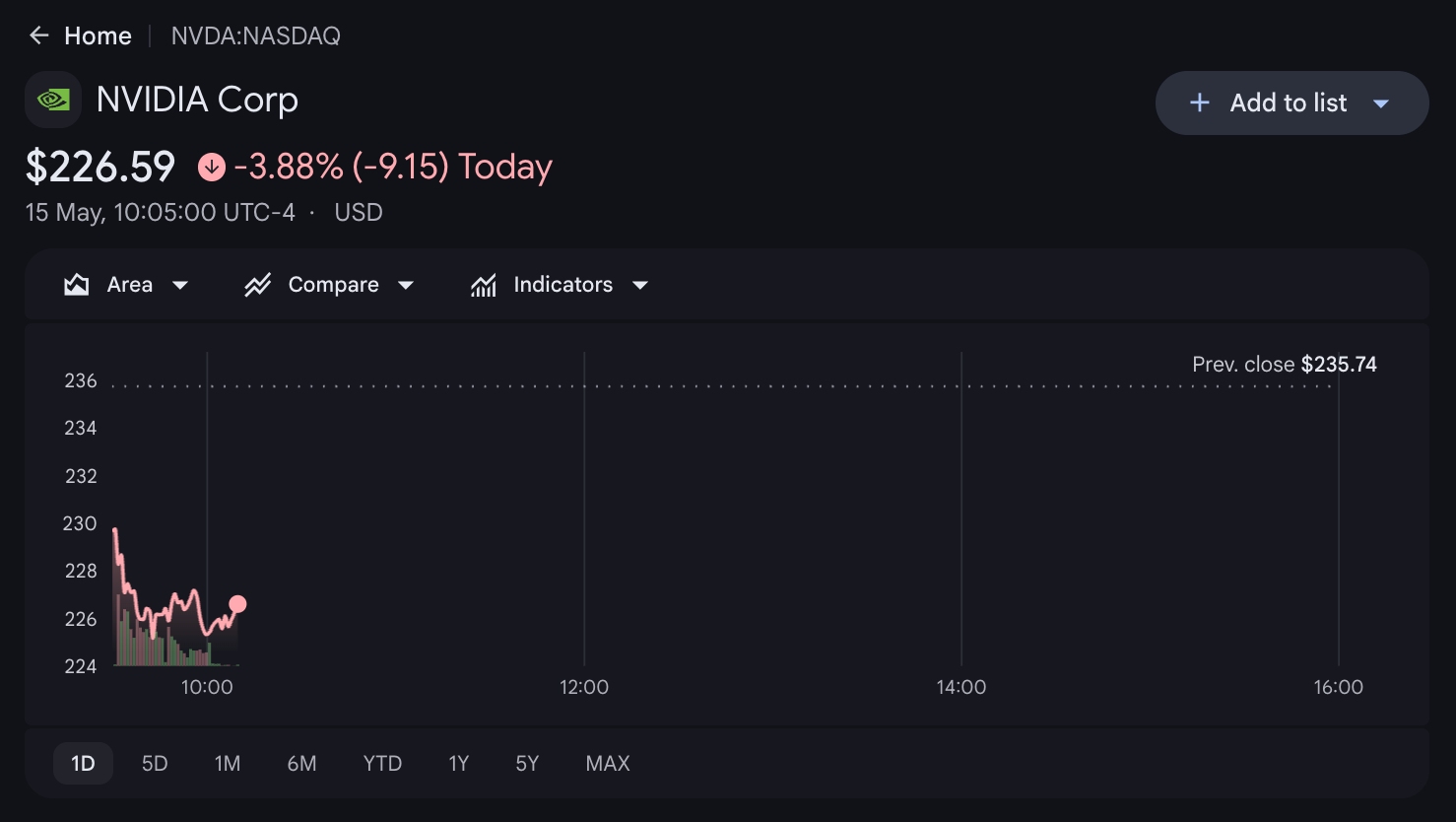
[Nvidia's stock price dropped sharply. Source: Google Finance]
During earlier pre-market trading, foreign media reported that a substantive breakthrough in the sales of Nvidia's H200 chips to China is unlikely in the short term. Nvidia's stock price subsequently fell to near $230, a decline of over 3%, erasing approximately $170 billion (about RMB 1.1 trillion) in market value.
Meanwhile, Nasdaq 100 futures extended losses to 1.78%, while S&P 500 futures fell 1.24%, as major tech stocks came under broad pressure. Intel fell over 5% pre-market, AMD dropped more than 4%, and Micron Technology declined 4.5%. TSMC, Qualcomm, and Tesla all fell between 2% and 3%.
Compounded by the re-escalation of tensions between the U.S. and Iran, panic spread to the cryptocurrency and Asia-Pacific index futures markets. Global assets experienced a synchronized sell-off, with popular cryptocurrencies like Bitcoin, Ethereum, and Solana all dropping over 3%. Spot gold fell more than 3%, while spot silver plunged over 9% at one point.
The catalyst for this sharp decline was the closely watched Nvidia chip trade incident.
On May 14 ET, the U.S. Department of Commerce had just approved about 10 Chinese companies, including Alibaba, Tencent, and ByteDance, to purchase Nvidia's H200 AI chips, news that initially boosted Nvidia's stock by more than 4%.
Meanwhile, on May 15 ET, U.S. President Trump, speaking to reporters aboard Air Force One after concluding his visit to China, confirmed that China had not approved the receipt of H200 chips, stating, 'They've chosen not to do that because they want to try and develop their own technology.'
U.S. Trade Representative Greer also stated clearly that chip export controls were not a primary topic of the bilateral talks between the U.S. and China, suggesting that a substantive breakthrough for Nvidia's H200 chip sales to China is unlikely in the short term.
Analysts believe that the collective 'zero orders' from Chinese companies despite holding procurement licenses reflects China's determination to accelerate the localization of AI chips. Estimates suggest that Nvidia's share of the Chinese AI chip market has plummeted from a peak of 95% to approximately 8%, while the market share of domestic AI chips surpassed 55% for the first time in the first quarter of 2026.
Although institutions like Citi expect Nvidia's fiscal first-quarter 2026 results, to be released next week, to beat expectations with revenue potentially reaching $80 billion, market concerns regarding a high-valuation bubble continue to intensify.
This content was translated using AI and reviewed for clarity. It is for informational purposes only.
Recommended Articles







Comments (0)
Click the $ button, enter the symbol, and select to link a stock, ETF, or other ticker.