


Why Elon Musk Decided to Restart Dojo 3? What Strategic Advantages Will This Move Bring to Tesla?



AI Podcast


Tesla has restarted its Dojo 3 supercomputer project, aiming to build large-scale AI capabilities for autonomous driving and robotics. This move signifies a clearer roadmap for AI development, potentially enhancing Tesla's competitiveness by enabling self-sufficient, faster AI model training and reducing reliance on external suppliers. Dojo is designed to significantly accelerate the training of Full Self-Driving (FSD) and Optimus robot models, enabling more frequent FSD updates and earlier robot commercialization. The company anticipates Dojo will offer cost and energy efficiency advantages over traditional GPUs, potentially leading to cloud service offerings and improved profit margins. While its short-term stock impact is uncertain, Dojo's success is expected to support Tesla's valuation and drive future share price upside if validated by financial reports.
TradingKey - Following hesitation and strategic adjustments, Tesla has once again restarted the Dojo 3 project. This move indicates that the company now possesses a clearer roadmap for building large-scale AI capabilities—a critical foundation for supporting its long-term goals in autonomous driving, robotics, and other fields.
From a long-term perspective, the current restart of Dojo 3 will have a lasting impact on Tesla's stock price. If future financial reports validate the value it brings, there remains further room for upside in the share price.
What is Dojo?
Dojo is a supercomputer purpose-built by Tesla to train its "Full Self-Driving" (FSD) neural networks. On August 19, 2021, Tesla officially unveiled the Dojo supercomputer during its inaugural AI Day event.
The development of Dojo is closely tied to Tesla's objectives for FSD and the robotaxis the company intends to sell. As Tesla's advanced driver-assistance system, while FSD has been installed in hundreds of thousands of Tesla vehicles and can perform certain autonomous functions, it still requires the driver to maintain visual attention.
However, Tesla believes that with more data, greater computing power, and deeper training, FSD can cross the threshold from "near-autonomous" to "fully autonomous," and that is where the value of Dojo lies.
Why is Elon Musk restarting Dojo 3?
Tracing back to August 10, 2025, Musk believed Dojo had hit a "dead end," as the computing power of older generation chips (D1, D2) reached its limit, restricting the training speed and scale of Dojo 2. Musk decided to focus efforts on the production of AI5 and AI6 chips, effectively shutting down the Dojo project progress.
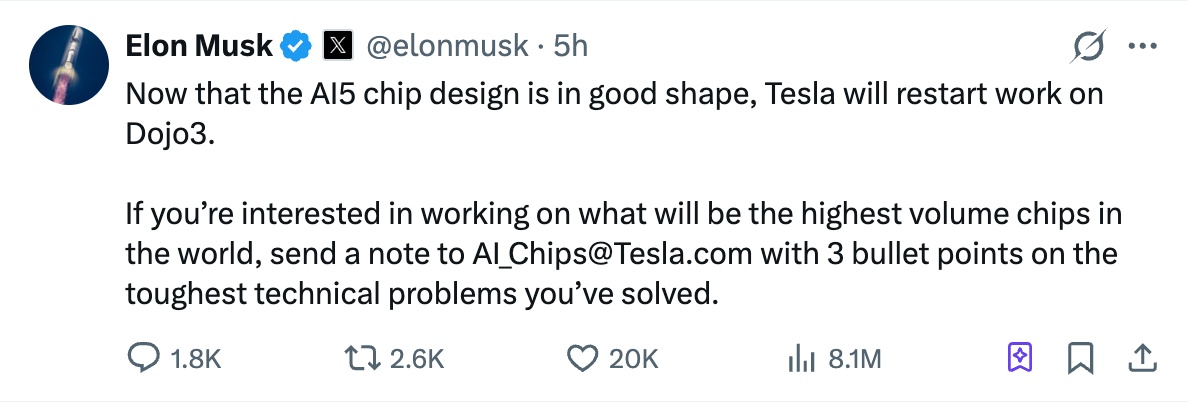
The timing for restarting Dojo 3 coincides with the near-completion of Tesla's AI5 chip and the commencement of R&D for the AI6 chip.
First, the restart of Dojo holds significant strategic importance for Tesla. From its business trajectory, the training of Tesla's EV FSD and Tesla robots requires massive scale computing power. In the long run, Dojo 3 accelerates AI model training speeds, which can substantially enhance Tesla's competitiveness in its business sectors.
Furthermore, Tesla's demand for computing power has consistently been constrained by external suppliers (such as NVIDIA general-purpose GPUs ), which creates timing misalignments for real-time AI training and leaves the company with no pricing power over computing costs. Building Dojo 3 is equivalent to mastering "underlying core capabilities," making the pace of AI development entirely self-sufficient.
In the increasingly fierce AI competition, the upward spiral of time and production costs will be a major future issue. Even if R&D investment is massive in the short term, from the perspective of long-term cost control and efficiency gains, this is undoubtedly a key move for Tesla to stand out.
Amidst the competitive AI landscape, restarting Dojo 3 also sends a signal to the market, investors, and competitors—Tesla is truly transforming from what the market perceived as a "carmaking" company into an "AI strategy" company.
What will Dojo bring to Tesla?
Looking at Tesla's operations, the primary starting point for Dojo is Tesla FSD. Through massive training, Dojo drastically shortens the evolution cycles for both FSD and Optimus.
Unlike general-purpose GPUs (such as NVIDIA A100/H100) , Dojo's primary task is to train on and process vast amounts of video data. It can shorten model training that would originally take months down to weeks or even days. This means FSD version iterations will be more frequent, and the algorithm's ability to handle complex road conditions will grow exponentially.
In other words, Tesla will be able to catalog and process hazardous scenarios faster, successfully navigating through dangerous road conditions and unpredictable risks, providing consumers with compelling reasons to purchase a Tesla. We believe that after FSD optimization, the growth in Tesla's sales figures will be reflected in future financial reports.
The same vision training capabilities can be directly ported to Optimus robots. Dojo provides a "digital brain" for robots to undergo simulation training in various environments, enabling earlier commercialization.
Additionally, Tesla has claimed that Dojo can provide several times the performance of traditional GPUs at the same cost, with lower energy consumption. As scale increases, the cost advantages brought by this vertical integration will significantly expand the company's profit margins.
Institutions like Morgan Stanley have pointed out that Dojo has the potential to allow Tesla to launch a cloud service business similar to Amazon AWS, such as AI computing power rentals and an FSD licensing foundation.
Tesla could lease Dojo computing power to other companies requiring large-scale vision, robotics, or autonomous driving training. If Tesla licenses FSD technology to other automakers in the future, Dojo will serve as the backend "data processing center" supporting the entire ecosystem's operations.
Regarding the energy storage business, Dojo may lead to the continuous optimization of battery life, improved conversion efficiency of energy storage over time, and reduced maintenance costs through AI training. For the sustained high growth of energy storage, this is undoubtedly a hidden catalyst.
Will Tesla's stock price be affected by Dojo?
From a long-term perspective, the restart of Dojo will have a lasting impact on Tesla's stock price. If future financial reports validate the value it brings, there is further room for upside in the share price. In the short term, however, the restart of Dojo is not a major immediate positive event, as its advantages cannot be quantified yet, and the market may lack sensitivity to this move.
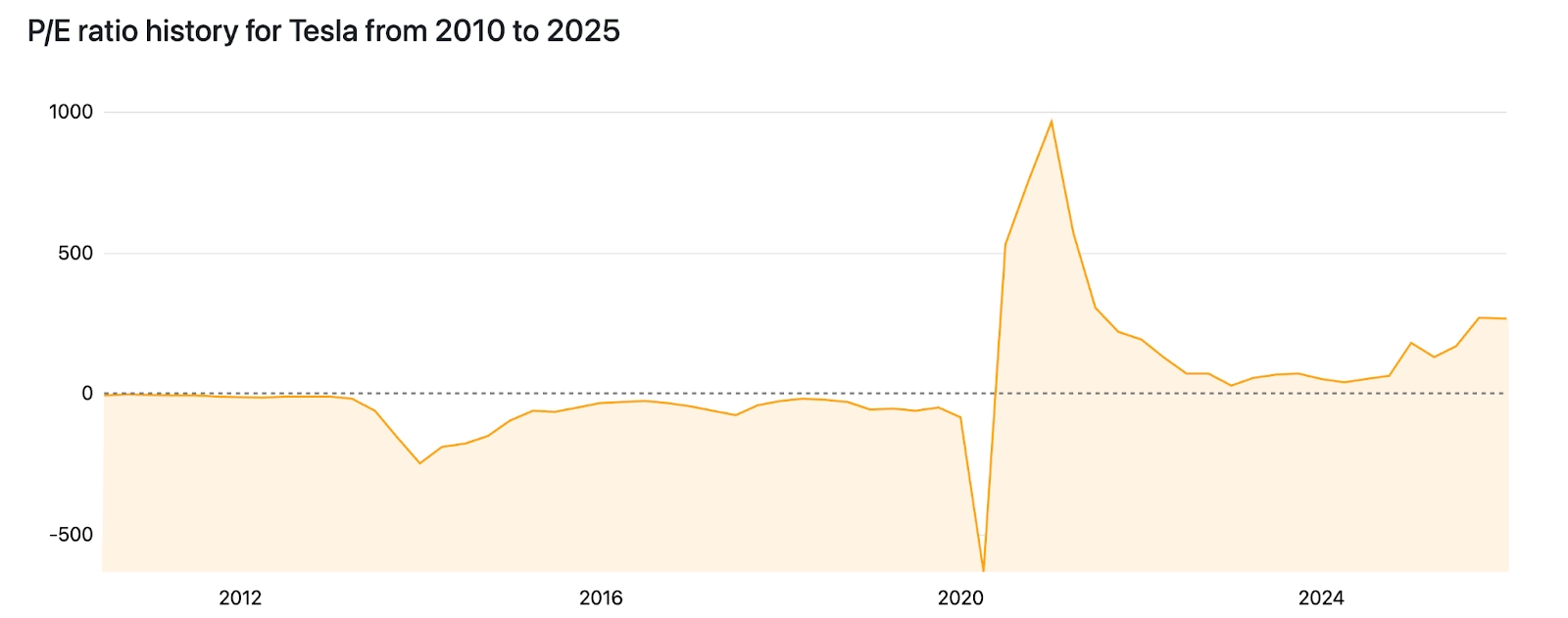
[Tesla P/E Ratio Overview 2010-2025, Source: companiesmarketcap.com]
The restart of Dojo also makes Tesla's long-questioned valuation premium more credible. In the medium to long term, we believe Tesla's stock price will reflect the value of Dojo in future financial reports.
This content was translated using AI and reviewed for clarity. It is for informational purposes only.
Recommended Articles








Comments (0)
Click the $ button, enter the symbol, and select to link a stock, ETF, or other ticker.