


Behind Intel's 2026 Stock Rally: Panther Lake Chip Debuts At CES, A Launch That Cannot Fail



AI Podcast


Intel's Panther Lake chip launch in January 2026 significantly boosted its stock, signaling renewed investor interest. The new architecture, optimized for AI and efficiency, addresses market demands and was showcased with strong partner support. While this marks a restoration of expectations, analysts caution it's not yet a fundamental reversal. Challenges remain in production, yield, and competition from AMD and Apple. The stock surge reflects a "worst is over" sentiment rather than guaranteed future earnings. Investors should monitor shipment schedules, OEM adoption, and gross margins for concrete fundamental improvements.

TradingKey - In January 2026 at the CES exhibition , Intel officially unveiled its new generation Panther Lake chip, prompting a swift and direct market reaction. Fueled by the new product's debut, Intel's stock price (INTC) demonstrated significant strength that day, at one point substantially outperforming the broader market, with trading volume simultaneously expanding, signaling a renewed inflow of capital into the once-perceived “lagging” chip giant .
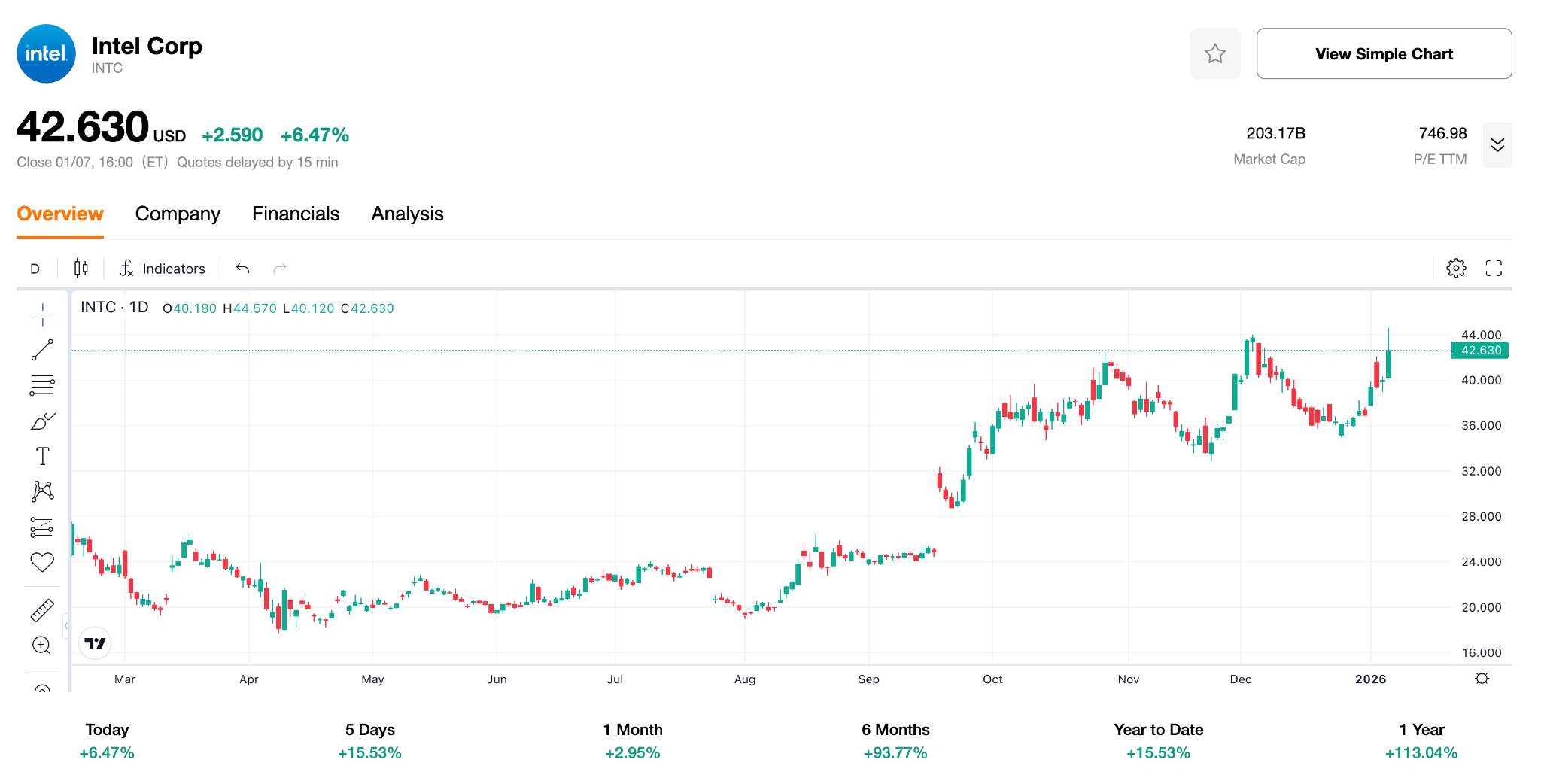
[ Intel Stock Price (INTC) Performance, Source: TradingKey]
This launch event was widely regarded by the market as a pivotal moment for Intel. Over the past few years, due to setbacks in process advancement and repeated product rollout delays, , Intel has continuously ceded high-end market share in its competition with AMD , Apple 's self-developed chips. Whether in the PC segment or the data center sector, investor confidence in its technological roadmap and execution has repeatedly wavered.
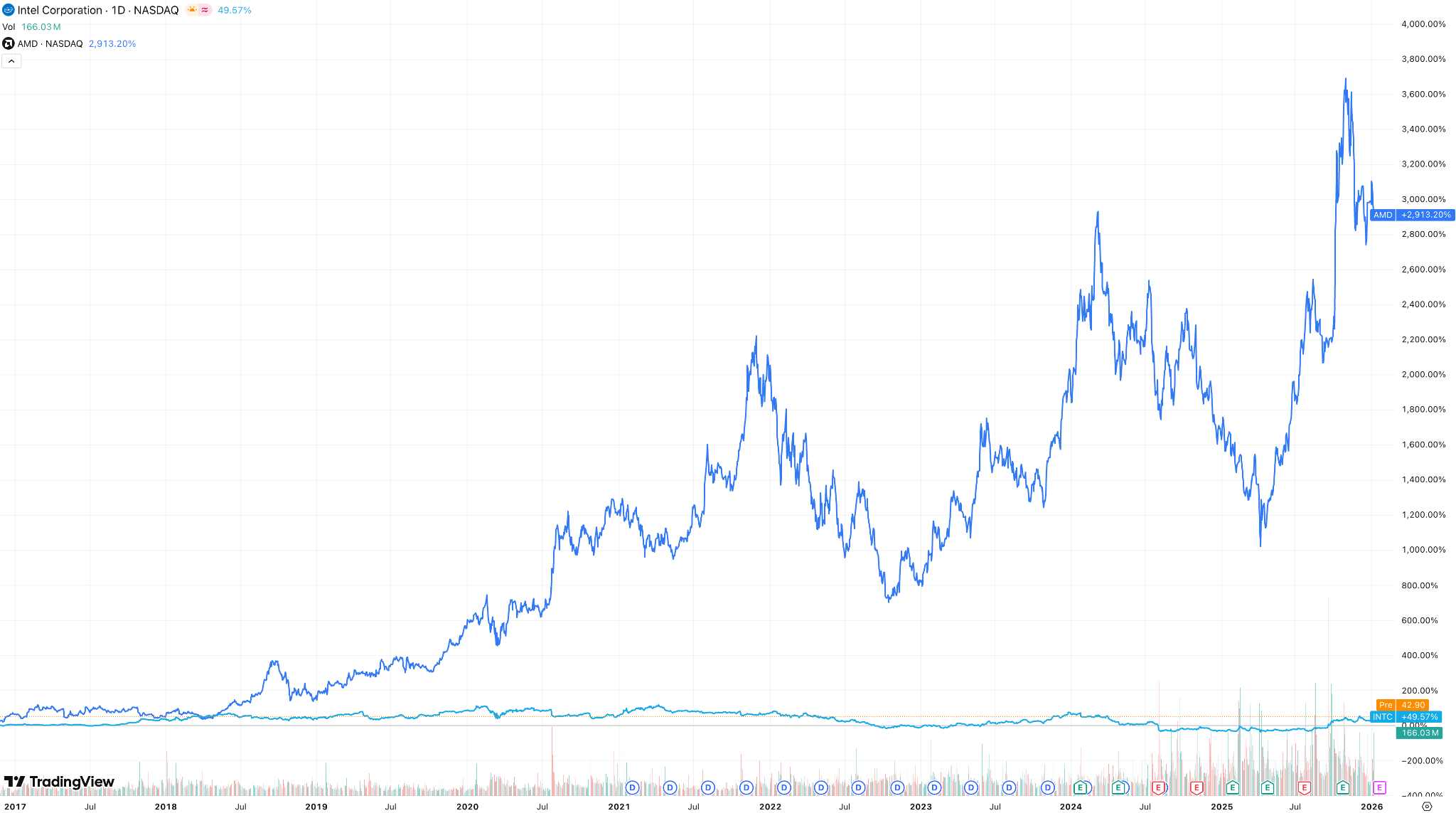
[ Intel and AMD Stock Prices Comparison Chart, Source: TradingView]
At CES, Intel underscored that the new architecture achieved a significant leap in performance and energy efficiency, while also being specifically optimized for AI workloads, multi-tasking, and mobile power consumption. These improvements precisely address the current market's core demands for computing power and energy efficiency .
Beyond technical specifications, Intel also showcased a vast lineup of partners at the event, including numerous PC manufacturers and platform ecosystem partners. This signal holds considerable market significance, as Intel's past challenges were never solely about "whether it could be developed," but rather "whether it could be brought to market on time, in sufficient quantity, and at an appropriate cost."
The surge in stock price fundamentally reflects the market's optimistic valuation that “Intel might genuinely be emerging from its slump” .
However, market analysis suggests that Panther Lake's introduction still primarily represents a restoration of expectations, rather than a confirmed fundamental reversal. The performance demonstrations at the chip launch event are still separated from genuine market sales performance by multiple challenges, including production capacity, yield rates, cost, and end-user demand.
From a competitive landscape perspective, Intel continues to face immense pressure. AMD is steadily encroaching in the high-performance computing sector, Apple's self-developed chip strategy has established a robust ecosystem in the laptop market, and the entire industry is rapidly shifting towards AI computing power. The success of a single product can no longer build a long-term competitive moat.
This is why the market generally characterizes Panther Lake as “a generation that cannot afford to fail.” Should this product generation again encounter issues in its mass production schedule or market performance, Intel's strategic credibility will suffer a new round of setbacks .
From a valuation standpoint, Intel's stock price had long traded within a "skepticism-priced" range. This current rebound is more indicative of a re-evaluation by the capital market that "the worst may be behind us," rather than a uniformly optimistic outlook on future earnings.
In other words, the Panther Lake chip has brought about a restoration of confidence in valuations, not an endorsement of future prospects.
Investors should closely monitor upcoming earnings reports to see if the new chips can improve shipment schedules, if adoption rates by original equipment manufacturers (OEMs) can increase, and if gross margins can show structural improvements. Only with significant fundamental improvements visible in subsequent financial reports can the market fully acknowledge Intel's standing in the semiconductor industry .
Overall, the strengthening of Intel's stock price in early 2026 merely reflects the market's willingness to give the company another chance.
This content was translated using AI and reviewed for clarity. It is for informational purposes only.
Recommended Articles








Comments (0)
Click the $ button, enter the symbol, and select to link a stock, ETF, or other ticker.