


Intel Stock Rally Explained: What’s Driving INTC Higher and Should You Buy It Now?



AI Podcast


Intel's stock has surged due to government support, tech giant investments, and market trust in its new CEO. The company, a unique integrated device manufacturer, faces challenges but offers long-term structural opportunities alongside short-term volatility risks. The US government's significant equity stake, coupled with a $5 billion investment from Nvidia for AI infrastructure collaboration, has boosted confidence. Despite a high P/E ratio, investors are betting on a turnaround, with potential for further upside driven by AI PC expansion and foundry business growth. A prudent approach involves a long-term horizon and staggered buying strategies.

TradingKey - Intel (NASDAQ: INTC) shares have surged strongly from multi-year lows, prompting significant investor attention: What's driving this rare rally—fundamentals or market sentiment? Is there further upside, and is now the optimal time to invest?
First, our perspective: We believe Intel's future direction is clearer than ever, backed by government support, investments from major tech giants, and market trust in its new CEO. In other words, even with the headwinds of a high valuation, we see a sufficiently clear investment thesis at this stage: Intel offers long-term structural opportunities alongside short-term industry volatility risks. A prudent approach involves leveraging its strategic value, adopting a longer-term investment horizon, and optimizing the risk-reward ratio through staggered buying and risk-hedging strategies.
What Kind of Company is Intel?
Intel Corporation (INTC.US) engages in semiconductor design and manufacturing. It is also one of the few companies globally with both chip design and wafer fabrication (IDM) capabilities. It operates through three segments: Intel Products, Intel Foundry, and All Other. The Intel Products segment includes the Client Computing Group (CCG), Data Center and AI (DCAI), and Network and Edge (NEX).
Segment | Key Responsibilities / Business Scope |
|---|---|
CCG (Client Computing Group) | Focuses on enabling long-term operating systems, system architectures, hardware, and application integration for PC experiences. |
DCAI (Data Center and AI Group) | Provides workload-optimized solutions for cloud service providers and enterprise customers; supplies silicon equipment to communication service providers. |
NEX (Network and Edge Group) | Helps network and edge computing systems transition from fixed-function hardware to cloud-native software running on programmable hardware; provides general-purpose computing, acceleration, and networking equipment. |
Intel Foundry (Intel Foundry) | Comprises foundry technology development, foundry manufacturing and supply chain, and the foundry services organization. |
All Other | Includes Altera, Mobileye, and other businesses. |
How Has Intel Historically Performed?
Intel went public in 1996. In the following years, as Intel capitalized on the internet boom, its stock price and market capitalization climbed steadily, reaching its peak in 2000.
The 2000 peak was driven by several factors: the explosion of the internet and PC markets boosted demand for Intel CPUs, and the company held immense pricing power and market influence at the time. Simultaneously, investor optimism towards tech stocks pushed valuations to irrational heights. The subsequent dot-com bubble burst led to a significant retracement between August 2000 and 2002, with the stock price halving multiple times.
After the bubble cleared, Intel's performance in the US stock market was overshadowed, and its share price did not see another surge for over a decade.
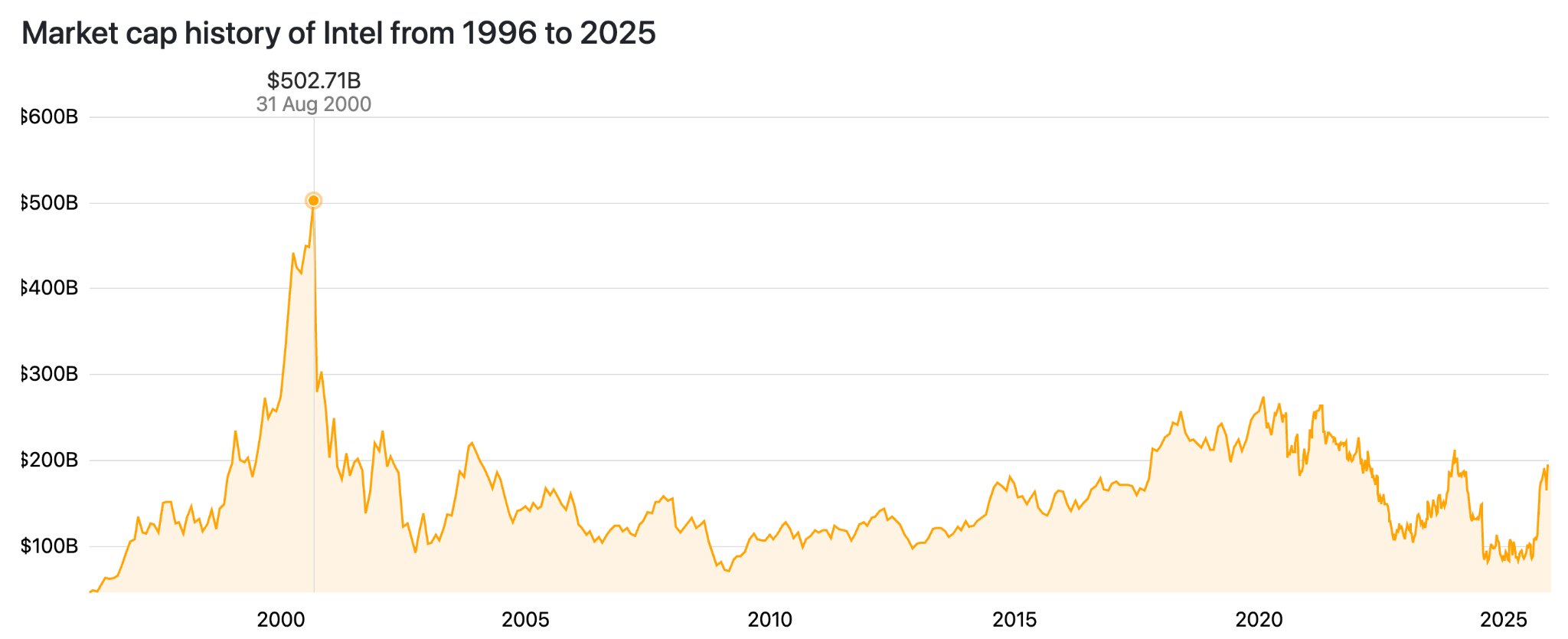
【Intel Historical Market Cap Overview, Source: Companiesmarketcap.com】
It wasn't until 2015-2020 that its stock price experienced a second, albeit temporary, surge.
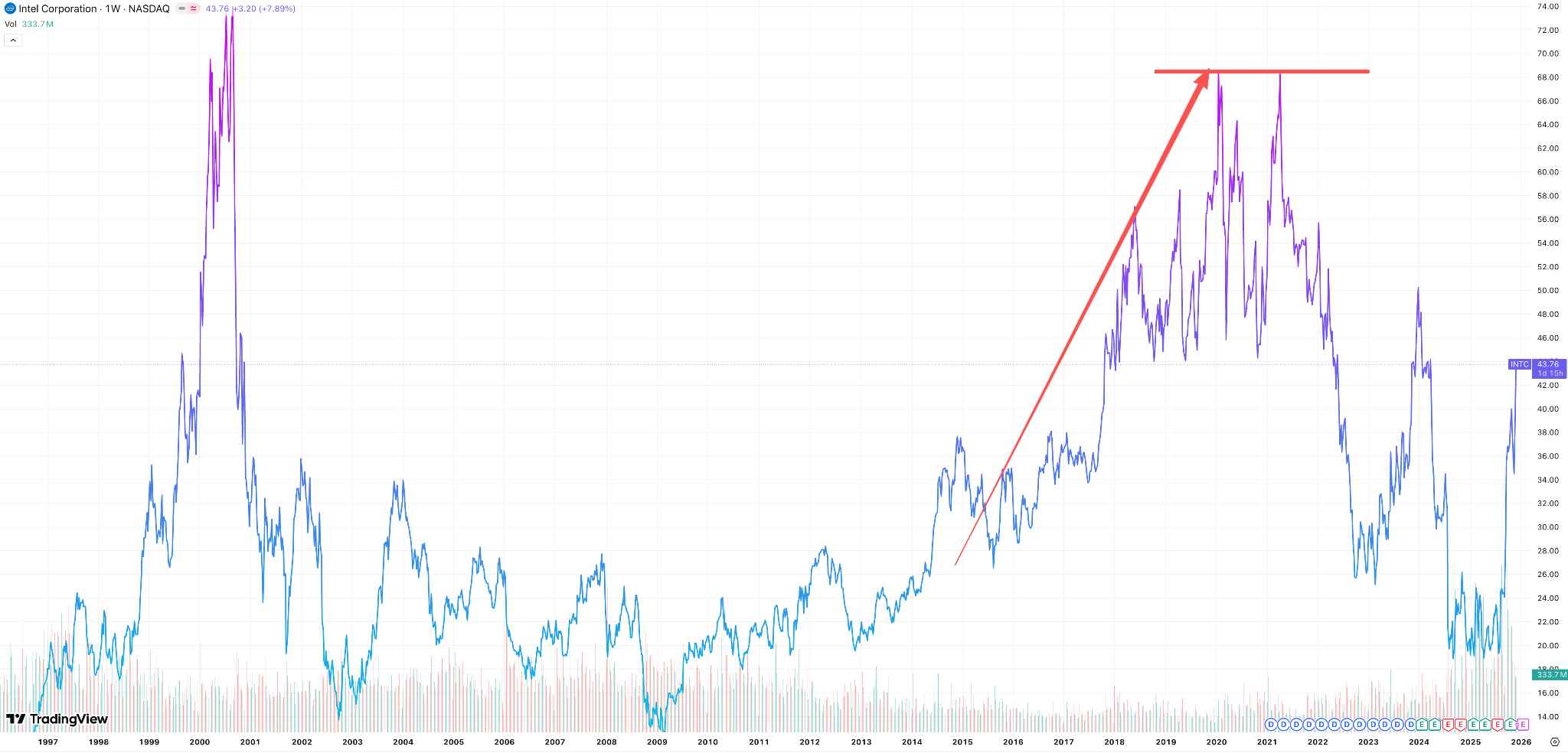
【Intel Stock Price Historical Weekly Chart, Source: TradingView】
During this period, Intel's data center and enterprise cloud server demand grew significantly, providing a powerful driving force. As the waves of cloud computing, big data, and enterprise IT infrastructure upgrades emerged, Intel's Xeon server processors virtually monopolized the market. Analysts noted that between 2015 and 2020, this "transition from PC to data center and cloud enterprise services" shifted Intel's business structure towards higher-profit, high-growth areas.
Secondly, during this time, Intel enriched its product portfolio and market coverage through mergers, acquisitions, and business expansion. In 2015, it acquired FPGA (Field-Programmable Gate Array) maker Altera, and subsequently integrated multiple technologies and teams related to AI, IoT, and other areas, transforming into a semiconductor company with broader business scope.
In terms of financial performance, Intel's revenue and profits generally maintained relatively stable growth during these years, particularly with advancements in its data center business and diversified operations, which helped the company maintain profitability and cash flow.
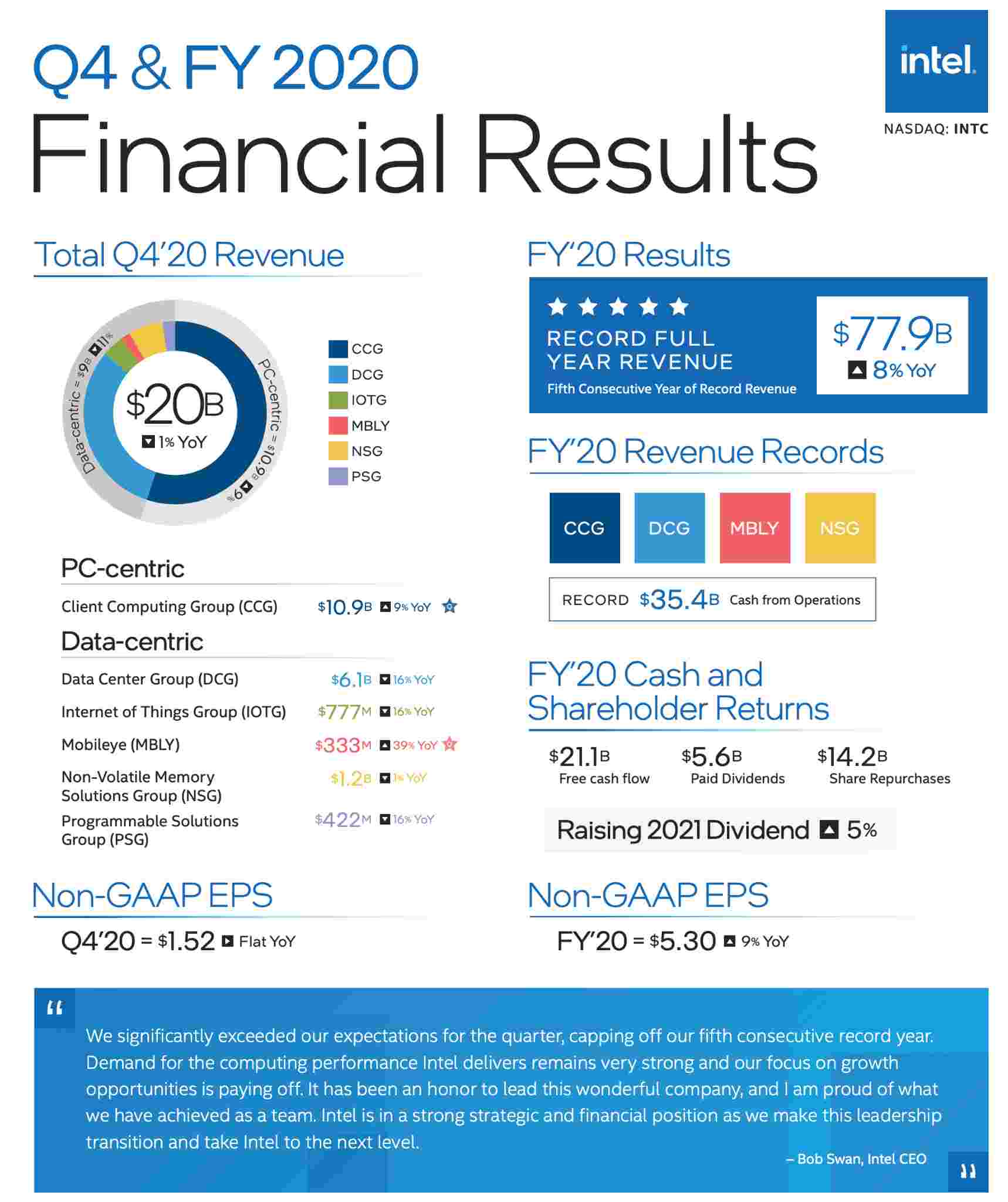
【Intel Q4 2020 Infographic, Source: Intel】
This earnings stability was highly attractive to institutional and long-term value investors.
Furthermore, from a market and industry trend perspective, this period was also the golden age of cloud computing, big data, enterprise digitalization, and network infrastructure upgrades. As a traditional CPU and data center chip giant, Intel was at the epicenter, reaping industry dividends – leading many to view it as a hybrid winner in "traditional semiconductors and emerging data centers."
However, even as everything appeared to be thriving, the market began to realize that Intel was too focused on consuming existing resources without effectively developing new growth areas, causing it to fall behind in semiconductor competition.
Between 2015 and 2020, Intel failed to achieve new process breakthroughs on schedule, experiencing continuous delays in 10nm and 7nm process development. By 2019, it was surpassed by competitors like TSMC and Samsung, completely losing its dominant position.
From 2020 onwards, with the advent of the AI wave, Intel again missed significant opportunities, further exacerbating its market share and revenue challenges.
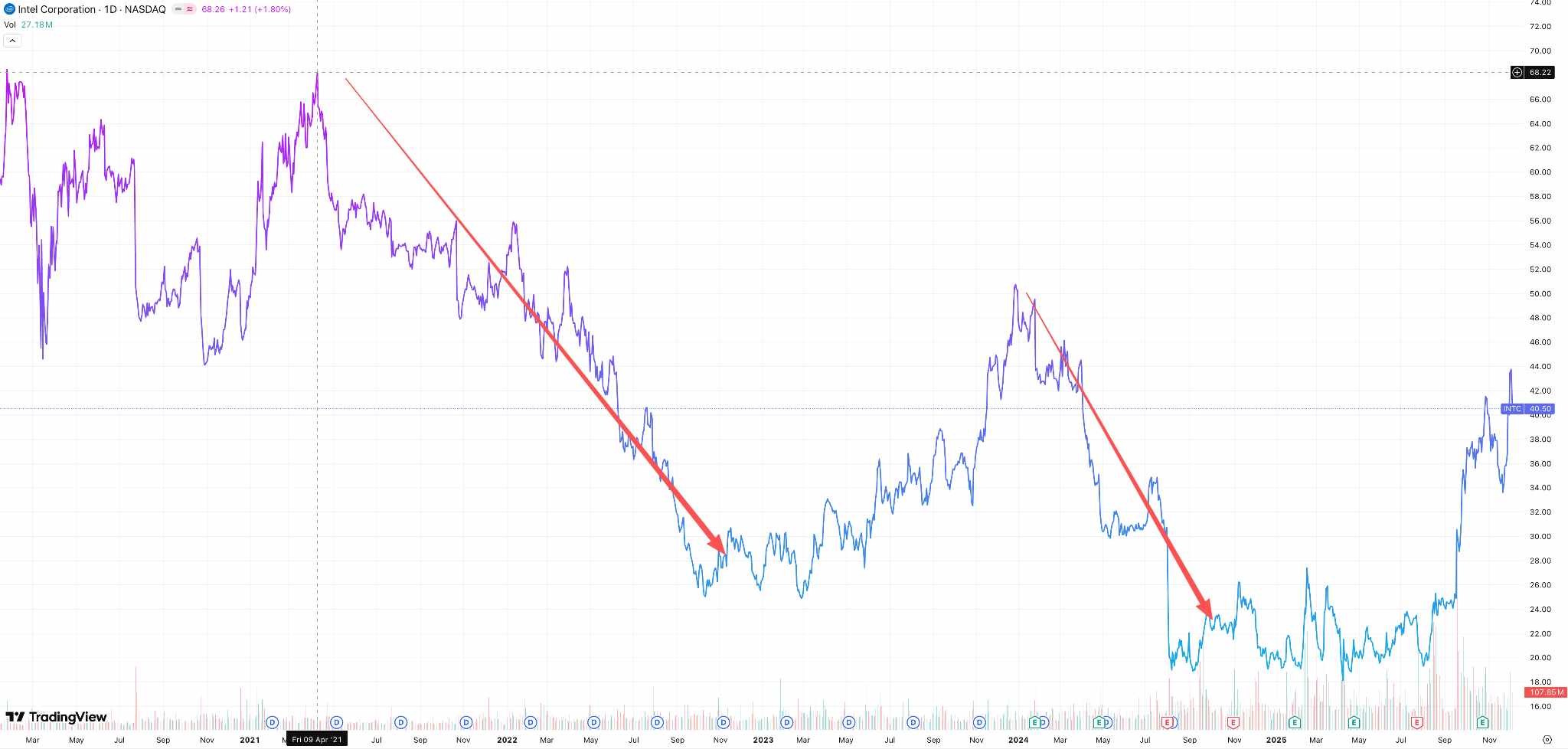
【Intel Stock Price Trend 2021-2025, Source: TradingKey】
Although Intel has been led by Pat Gelsinger since 2021, and a revitalization plan was launched to regain process leadership, alongside securing $7.86 billion in US government subsidies under the CHIPS Act to boost domestic capacity, the company's overall market performance has not significantly improved, and the business downturn has persisted.
In 2024, sharp internal conflicts erupted at Intel, leading to CEO Pat Gelsinger's "forced" retirement in November 2024, followed by a three-month CEO vacancy period.
On March 13, 2025, the board voted to appoint semiconductor executive Chen Liwu to revive the company. Following this news, the stock surged 14.6% that day, marking its largest single-day gain in years as of that date.
Upon taking office, Chen Liwu initiated cost-cutting measures and formulated a strategy to refocus on artificial intelligence. However, controversy quickly arose when Trump demanded his resignation over Chen Liwu's investments in Chinese semiconductor companies. This led to negotiations between both parties, ultimately culminating in the US government taking an equity stake.
Why Has Intel Stock Recently Surged?
After Intel's stock price plummeted to historic lows, Intel Corporation made multiple attempts to recover. In August 2025, influenced by Chen Liwu's decision to invest in Chinese semiconductor companies, Trump called for his resignation.
On August 11, local time, Intel CEO Chen Liwu met with Trump at the White House. On August 14, media reported that the Trump administration was negotiating with Intel Corporation about the US government taking an equity stake in the company. On August 18, SoftBank Group and Intel Corporation signed a $2 billion investment agreement. Subsequently, on August 22, the US government invested $8.9 billion in Intel Corporation, becoming its largest single shareholder.
Despite the US government's endorsement, market investors remained concerned about potential government influence on company decisions and the political implications in its trade relations with various countries, which introduced significant uncertainty for the market.
On September 18, local time, Intel announced that Nvidia and Intel would jointly develop AI infrastructure and personal computing products. Nvidia further committed to investing $5 billion to purchase Intel common stock. Following this news, Intel's stock surged over 22% that day and has continued to attract strong buying interest from investors.
On November 28, local time, market rumors suggested Intel might reach an agreement with Apple (NASDAQ: AAPL) by 2027 to co-produce certain Mac chips. The stock rose over 10% in a single day.
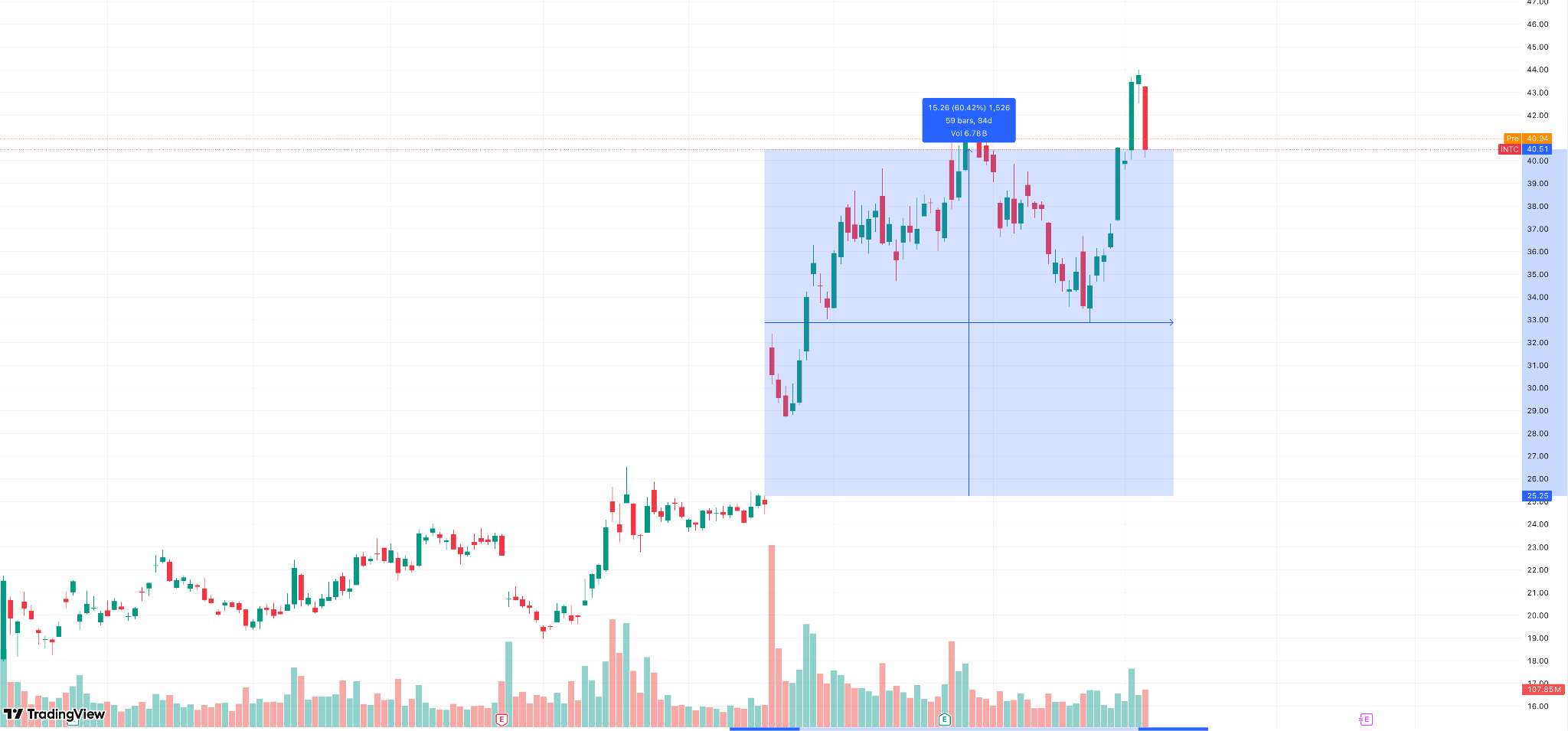
【Intel Stock Price Trend, Source: TradingView】
As of the publication date, Intel's stock price has surged over 60%. The government's backing and support from multiple tech giants have instilled confidence in Intel's investors and provided a clear direction for market capital.
Does the Stock Still Have Upside Potential?
We believe that the US government's semiconductor investment plan is becoming a core variable in Intel's future valuation re-rating. For the market, this not only signifies massive capital subsidies for Intel but also represents its progressively strengthened position in the US national strategy.
The US semiconductor industry urgently needs a "secure anchor" with domestic advanced process and packaging capabilities, and Intel is precisely seen as the company most capable of fulfilling this role. As such, Intel is viewed as a "core stock" or even a "favored son" of the US chip industry. Other semiconductor companies seeking to maintain policy benefits in the US will inevitably need to collaborate or share ecosystems with Intel to some extent in the future.
Amid the accelerating expansion of AI infrastructure and the entry of PC terminals into an AI-driven cycle, the structural growth in market demand for computing power, packaging, and foundry services further reinforces the transformation potential of Intel Foundry (IFS).
Multiple large clients (e.g., Apple, AMD) have confirmed collaborations, while technology transfer or M&A opportunities with small and medium-sized enterprises could also become new growth drivers. This implies that even if Intel's current performance isn't stellar, its stock price might not necessarily suffer because market pricing more significantly reflects expectations for its future strategic value and policy backing.
From an investment perspective, Intel's current stock price already reflects some growth aspirations. On one hand, if new catalysts emerge—such as securing more strategic clients, scaling up the foundry business, or further validation of advanced process nodes like 18A—the stock could command further premium. On the other hand, major investment banks may raise their price targets once a clear growth path is established, providing a secondary impetus. Therefore, in a strong market, positioning at current elevated levels isn't overly aggressive, but investors should set an investment horizon of over one year, rather than focusing solely on six-month fluctuations.
Considering Intel's valuation recovery cycle and industry capital flows, despite its significant stock price surge this year, there remains "catch-up upside" compared to the doubling performance of other AI-themed stocks. Based on current prices, a sustained upward trend is not overly optimistic if the triple tailwinds of policy support, foundry business expansion, and AI PC continue to advance.
Is Now the Right Time to Invest in Intel Stock?
First, we state our view: even if Intel's stock is currently highly valued, with a staggering P/E ratio of 690x compared to TSMC's mere 30x, this precisely demonstrates the market's strong bet on Intel's future turnaround.
We believe that with government backing and investments from various tech giants, coupled with market trust in its new CEO, Intel's future development has more defined direction than before. In other words, even facing the resistance of a high valuation, we still believe it possesses further investment value. However, investors should be mindful of short-term valuation pullback risks.
The investment thesis at this stage is clear enough: Intel offers both long-term structural opportunities and short-term industry volatility risks. A prudent approach involves leveraging its strategic value while adopting a longer-term investment horizon, optimizing the risk-reward ratio through staggered buying and risk-hedging strategies.
This content was translated using AI and reviewed for clarity. It is for informational purposes only.
Recommended Articles







Comments (0)
Click the $ button, enter the symbol, and select to link a stock, ETF, or other ticker.