


Japan and South Korea Markets Crash at Open: Nikkei and Kospi Face Sequential Stampede, Samsung and SK Hynix Plunge, Kioxia Buck Trend to Rise



AI Podcast


During the Asian session on July 8, Japanese and South Korean equities experienced significant declines amid a second wave of panic selling. The KOSPI plunged 3.34%, while the Nikkei 225 fell 1.34%. Semiconductor heavyweights, including Samsung Electronics and SK Hynix, led the retreat, pressured by a sharp overnight drop in U.S. tech stocks and the Philadelphia Semiconductor Index. Furthermore, escalating geopolitical tensions following U.S. strikes against Iran and the revocation of oil sanction waivers triggered a 6% surge in oil prices, exacerbating market volatility and deepening the sell-off across regional indices.

TradingKey - Japan and South Korea stocks dive at the open; Kospi and Nikkei 225 hit by a second wave of panic selling, with Samsung Electronics and SK Hynix both down about 4%, while Kioxia bucks the trend.
During the early Asian trading session on July 8, Japanese and South Korean stock markets continued to open lower today. Among them, South Korea's KOSPI index plunged 3.34% to 7,400.24 points, hitting its lowest level since May 26; the Nikkei 225 index fell 1.34% to 67,341.86 points, touching its June 15 low.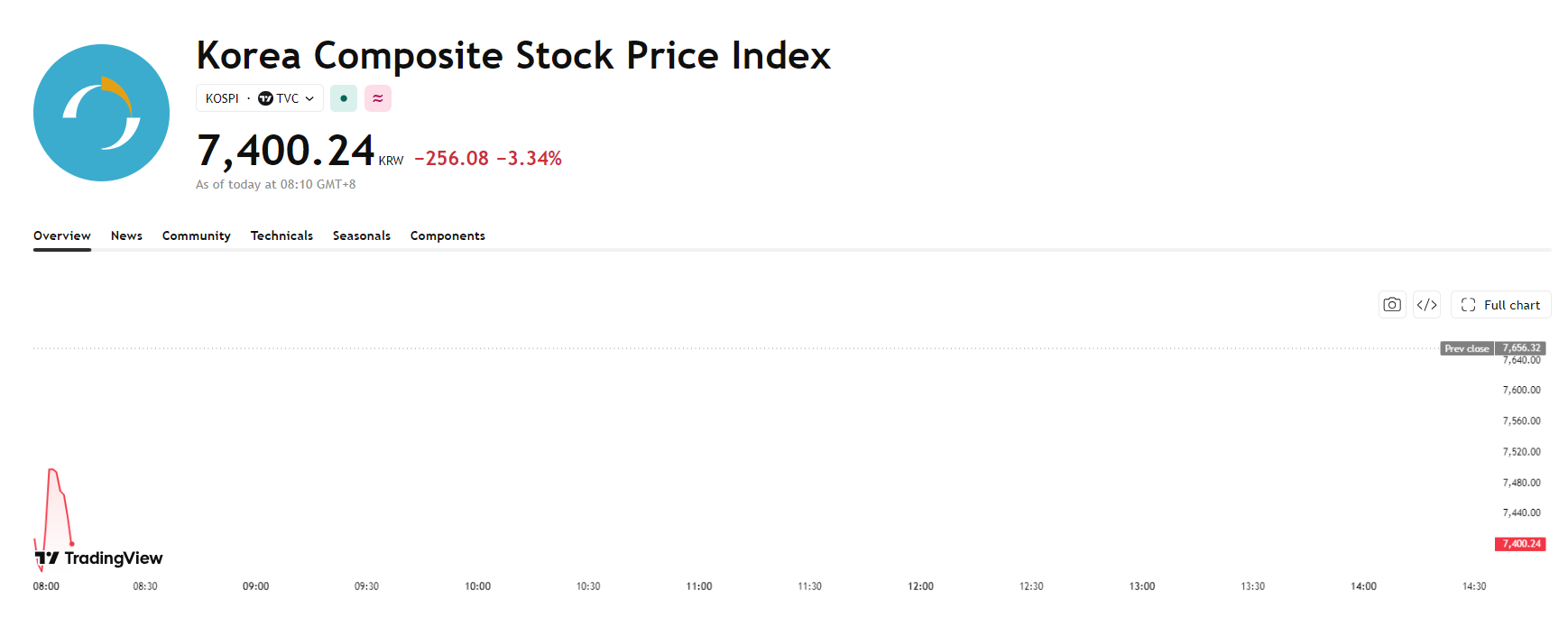 KOSPI Index Chart, Source: TradingView
In terms of individual stocks, heavyweights in the Japanese and South Korean markets fell collectively, with the exception of Kioxia. Among them, Samsung Electronics dived at the open, falling 4.32% to 283,500 KRW; SK Hynix fell 4.77%, nearing the 2 million KRW threshold at 2,096,000 KRW; SoftBank fell 1.18% to 5,703 JPY; only Kioxia rose 1.16% at the open to 73,240 JPY.
Following yesterday's (July 7) "sell the news" sell-off in Samsung Electronics, which triggered a historic circuit breaker in South Korean stocks, Asia-Pacific stock markets weakened again in early trading today. The Japanese and South Korean markets suffered a second wave of panic selling, opening with gaps down across the board. This was driven not only by the unfinished profit-taking pressure on chip stocks, but also by the collective plunge in U.S. tech stocks and a sudden worsening of geopolitics.
Overnight, the Philadelphia Semiconductor Index fell sharply again, and the Nasdaq dropped 1.8%. In addition, the U.S. military launched a new round of strikes against Iran while revoking Iran's oil sanction waivers, causing oil prices to surge 6%. These two major macroeconomic blows directly battered the fragile Japanese and South Korean stock markets right at the opening bell.
This content was translated using AI and reviewed for clarity. It is for informational purposes only.
Recommended Articles









Comments (0)
Click the $ button, enter the symbol, and select to link a stock, ETF, or other ticker.