


AI Storage Leader SK Hynix to List ADRs in US, UBS Recommends Arbitrage Strategy: Buy ADRs and Sell Korean Shares



AI Podcast


SK Hynix has launched an ADR offering for 17.79 million common shares, aiming to boost valuation and capital investment. UBS suggests an arbitrage strategy by longing ADRs and shorting local shares, citing potential premiums driven by superior liquidity and anticipated Nasdaq 100 inclusion. Despite a strong HBM market position and 77% profit margins, risks persist, including potential supply gluts, cyclical volatility, and the challenge of meeting aggressive growth expectations. Investors must weigh the benefits of reduced accessibility discounts against systemic pressures and the high valuation priced into the current AI-driven bull market.
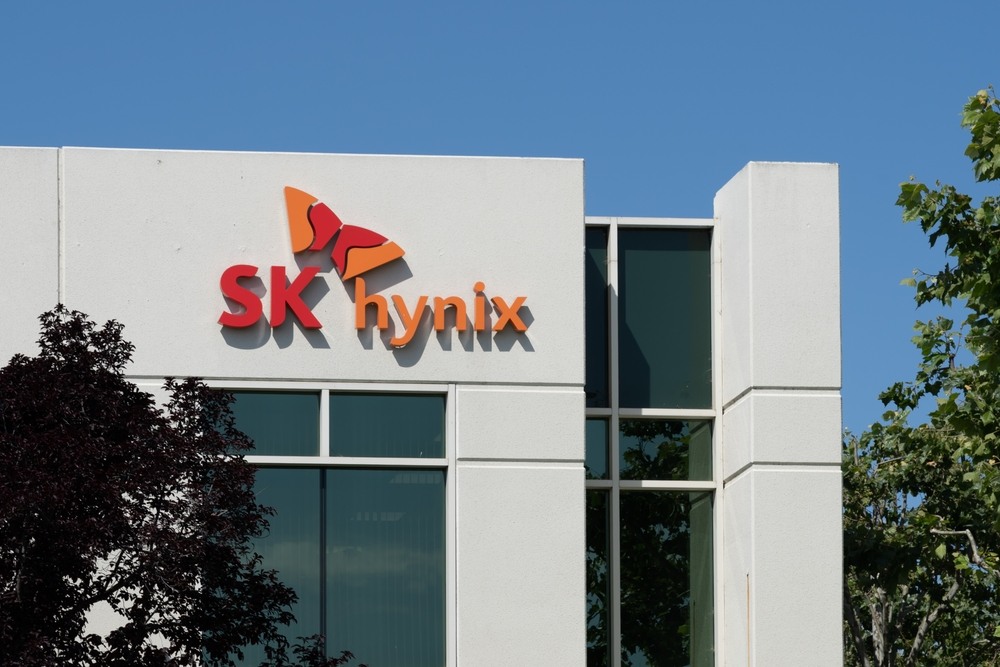
TradingKey - SK Hynix officially launched its global roadshow for American Depositary Receipts (ADRs) this Monday, planning to issue ADRs representing approximately 17.79 million common shares. Based on last Friday's closing price in Seoul, the size of this fundraising is approximately $28 billion.
The South Korean memory chip giant's stock price has surged more than 230% cumulative this year, with its market value surpassing $1 trillion. Its debut on Nasdaq is viewed as a landmark event in the capitalization process of the global chip industry amid the AI wave.
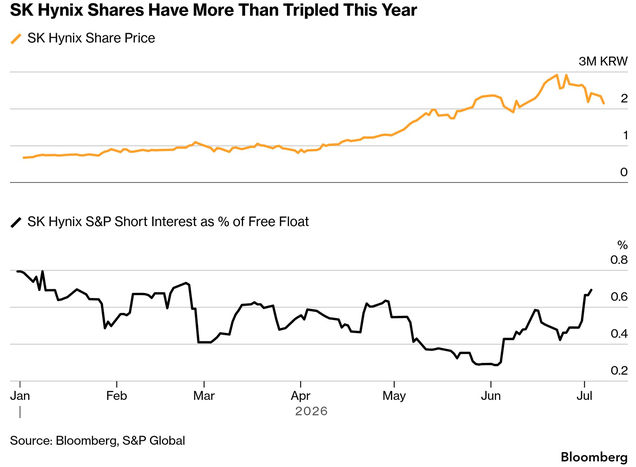
Source: Bloomberg, S&P Global
UBS Group ( UBS) proposed a highly attractive arbitrage strategy in its latest client report: go long on SK Hynix ADRs while shorting its shares listed domestically in South Korea, suggesting this trade carries extremely low risk and significant scale.
The Premium Logic of SK Hynix ADRs
UBS's strategy is built on the expectation that the ADRs will trade at a premium to the local Korean shares. The report points out that institutional investors, such as hedge funds, will prefer holding ADRs due to their higher operational efficiency and lower holding costs, particularly showing clear advantages in settlement, taxation, and liquidity management.
More importantly, global retail investors have an extremely low ownership of SK Hynix's Korean shares, and the launch of the ADRs will significantly improve access for this investor segment. Although some US brokerages have recently opened trading channels for Korean stocks to overseas retail investors, UBS believes this change is too recent, and global retail ownership of SK Hynix remains low, making ADRs the preferred way for them to participate in this AI memory leader.
Uncertainty in the share conversion mechanism further reinforces the premium expectations. According to US Securities and Exchange Commission (SEC) filings, ADR holders can cancel them and exchange them for local Korean shares, but the reverse conversion may require approval from Korean regulators and is not guaranteed to be seamless.
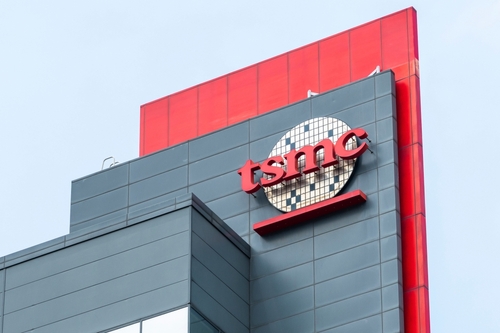
UBS pointed out that without the flexibility of two-way conversion, inefficient conversion channels could lead to ADRs trading at a significant premium over the long term. The fact that TSMC's ADR traded at an average premium of about 16% to its local Taiwan shares this month provides a real-world reference for this premium structure.
The dual dividend of valuation recovery and passive capital inflows
SK Hynix's primary objectives for this listing are valuation recovery and capacity expansion. Leveraging its global leadership in the High Bandwidth Memory (HBM) sector, the company holds approximately a 58% market share. Its revenue exceeded 97 trillion KRW in 2025, and its net profit for the first quarter of 2026 surged by 406% year-over-year, with a net profit margin reaching as high as 77%.
The funds raised will be allocated to domestic semiconductor capacity construction, including an investment of 100 trillion KRW (approximately $64.38 billion) to build new chip factories, as well as the procurement of Extreme Ultraviolet (EUV) lithography machines from ASML in the Netherlands. Simultaneously, the South Korean government has launched a large-scale industry support initiative, with President Lee Jae-myung directing an acceleration of the approval process to facilitate the implementation of a $576 billion chip project in the southwestern region.
Currently, SK Hynix's forward 12-month price-to-earnings (P/E) ratio stands at 6.2x, lower than Micron Technology's 7x; its forward price-to-sales (P/S) ratio is 3.6x, which is also below Micron's 4.6x.
Following its Nasdaq listing, SK Hynix is expected to be included in the Nasdaq 100 Index, triggering systematic buying by passive funds. The Invesco QQQ Trust, which solely tracks this index, manages assets as high as $482 billion; its inclusion will therefore generate substantial passive capital inflows.
An analysis by HSBC suggests that the offering price is attractive to U.S. investors, with an expected upside of approximately 20% for the stock price post-listing.
The CEO of Roundhill Investments pointed out that SK Hynix has been one of the world's most important companies that U.S. institutions have found difficult to hold directly, and this listing eliminates the "accessibility discount." A chief portfolio manager at investment firm Synovus Trust also believes that listing in the world's largest capital market will help address the undervaluation of SK Hynix.
Hidden Concerns Behind High Growth
Despite the market's high anticipation for SK Hynix's listing, risks cannot be ignored; with recent selling pressure hitting U.S. chip stocks, SK Hynix's performance in its U.S. listing is seen as a key bellwether for the direction of the AI bull market.
As Samsung Electronics also pushes forward with large-scale capacity expansion, market concerns over future oversupply are intensifying.
The CEO of asset management firm Riverwealth Advisors pointed out that investors are taking on the risk of a potential speculative bubble. Furthermore, while SK Hynix's net profit is projected to surge in 2026, it also means the market has priced extremely high growth expectations into the stock, and any performance falling short of expectations could trigger a sharp correction in the stock price.
As a global leader in the AI memory chip sector, the semiconductor industry's inherent cyclical fluctuations, potential oversupply risks, and the sustainability of the AI investment boom remain issues that the market needs to watch closely.
While UBS's arbitrage strategy appears attractive, investors still need to carefully assess the risks and rewards involved.
This content was translated using AI and reviewed for clarity. It is for informational purposes only.
Recommended Articles





Comments (0)
Click the $ button, enter the symbol, and select to link a stock, ETF, or other ticker.