


Memory Chips Drive Samsung Earnings Surge, But Stock Price Opens High and Closes Lower: Why?



AI Podcast


Samsung Electronics reported strong Q1 guidance driven by memory chips, with operating profit projected to surge eightfold. Despite this, its stock opened higher and trended lower, indicating a profit-taking phase as investors assess sustainability. Memory chips, particularly DRAM and HBM, are Samsung's key strength, with HBM4 shipments commencing. However, smartphone, display, and foundry divisions are weaker. The market is repricing Samsung as a chip-driven stock, and while future growth is possible, it hinges on sustained earnings and the longevity of the AI memory supercycle, alongside geopolitical and cost uncertainties.
TradingKey - Samsung Electronics' Q1 earnings guidance was exceptionally strong, yet its share price followed a pattern of opening higher and trending lower. While the market acknowledges the strength of the results, investors remain cautious regarding their future sustainability.
As of April 7, Samsung Electronics released its first-quarter guidance, projecting operating profit to reach 57.2 trillion KRW, a more than eightfold increase from 6.69 trillion KRW in the same period last year. Revenue is also expected to grow 68% year-over-year to 133 trillion KRW.
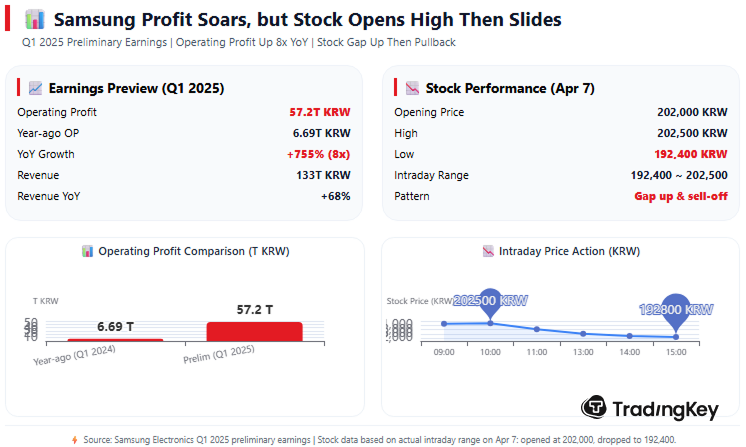
Following the announcement, Samsung's stock price gapped higher at the open to 202,000 KRW but subsequently retreated to a low of approximately 192,400 KRW. With an intraday range of 192,400 to 202,500 KRW, the shares exhibited a classic pattern of opening high and trending lower.

Why was Samsung’s Q1 performance so strong?
Samsung's latest profit surge was driven not by smartphones or televisions, but by memory chips.
Reuters noted that Samsung's chip division is expected to contribute approximately 95% of total profit, as memory shortages triggered by AI data centers pushed up prices for DRAM and related components; furthermore, DRAM contract prices are projected to rise by more than 50% this quarter.
Simultaneously, a weak Korean won inflated the won-denominated value of overseas revenue; combined, these factors propelled Samsung's first-quarter earnings to record highs.
More importantly, this is not a sporadic profit spike, but the result of the sustained expansion of AI capital expenditure.
Global tech firms are scrambling for memory supplies to build AI data centers, driving an uptick in both pricing and shipment volumes for traditional chips. Samsung now appears positioned at the heart of this "memory supercycle," rather than being a mere beneficiary of the cycle's tail end.
Positive Earnings: Why Did the Stock Price Retreat After a Higher Open?
The stock price reaction is actually quite telling.
Samsung announced the cancellation of treasury shares worth approximately $9.55 billion on March 31, and its stock price fell 5.16% that day; today, although earnings guidance exceeded expectations again, the market gapped up to 202,000 KRW at the open but quickly returned to around 192,400 KRW.
The price action indicates that the positive catalysts have not disappeared; rather, capital is moving more quickly to take profits.
The underlying reason is not that the market doubts Samsung's profitability, but that it has begun to worry whether the expectations have already been fully priced in.
In terms of the overall trend, Samsung's stock has retraced about 13% since late February, yet its year-to-date gain remains around 61%.
This rally suggests that the AI memory narrative has long been heavily priced in; today's high-open, low-close pattern seems like investors are seeking confirmation—while these results are strong, whether they are enough to support a higher valuation depends on their sustainability over the next two quarters.
Which of Samsung's business divisions is currently the strongest, and which is the weakest?
From a business structure perspective, Samsung's greatest strength remains memory chips, particularly DRAM and HBM.
Data shows that Samsung has begun shipping HBM4 to Nvidia, suggesting that in its pursuit of SK Hynix, it is no longer just in the "narrowing the gap" phase but has moved toward substantive product implementation.
Meanwhile, Samsung management expects memory chip demand to remain strong throughout this year and potentially extend into next year.
By contrast, Samsung's other business segments have not been as stellar. The performance of its smartphone, display, and foundry divisions has been relatively weak; while the mobile business was able to sustain profits in the first quarter supported by low-cost inventory, rising memory and component costs will squeeze smartphone margins starting in the second quarter. The foundry business remains unprofitable, having only seen a modest boost from its partnership with Nvidia.
Compared to SK Hynix and Micron, Samsung’s strengths and weaknesses are clearly defined.
When comparing Samsung with its semiconductor peers, its most direct competitors remain SK Hynix and Micron ( MU ).
SK Hynix currently maintains a first-mover advantage in HBM, holding approximately 57% of the market. Its revenue is expected to double by 2026, and its profit margins could be significantly higher than those of its peers. Furthermore, it previously stated that strong memory demand is expected to persist through 2027.
While Samsung has begun shipping HBM4 and significantly accelerated its catch-up pace, it is not yet the absolute leader in the HBM segment. Samsung's strength lies in its manufacturing scale and integrated capabilities, whereas its weakness is that its first-mover advantage in HBM lags behind SK Hynix.
Micron's situation illustrates the discrepancy between 'strong earnings' and 'strong stock performance.' While Micron's recent earnings were robust, its stock price pulled back following the report due to a sharp increase in capital expenditure, as the market concerns that capacity expansion will normalize current supply shortages.
This case serves as a reminder for Samsung: while AI demand is real, capital markets will not unconditionally grant every memory company the same high premium. Only those who can consistently deliver profits will sustain high valuations.
Will Samsung Electronics continue to rise in 2026?
In the short term, Samsung's stock price opening higher and closing lower today indicates that the market has entered the "profit-taking" phase following the realization of positive news.
While this earnings guidance was strong, capital will not focus solely on single-quarter profits; the market's next focus points are how long the AI memory supercycle can last, whether HBM4 can continue to ramp up, when the foundry business will turn a profit, and whether geopolitical and energy costs will slow down future growth rates.
From a medium-term perspective, Samsung's price action today actually shows that the market has redefined it as a "chip-driven" stock rather than just a consumer electronics company.
As long as memory prices and AI capital expenditures continue to trend upward, Samsung's fundamentals will remain strong; however, if capital begins to worry that this supercycle is overheating, the stock price is prone to behaving as it did today—surging initially before giving back gains.
Looking ahead, Samsung still has room to grow in 2026, but the trajectory will not be a straight line and will show clear divergence. Supporting its continued strength are rising memory prices, the scaling of HBM4, and the view held by many institutions that DRAM contract prices will rise further in the second quarter.
However, the factors restricting a further surge in Samsung's stock price are also clear.
First, Samsung's stock has already risen significantly this year, and despite a correction at the end of March, it is still up about 61% year-to-date; second, geopolitical conflicts and energy costs continue to add uncertainty; third, the mobile and foundry businesses have not improved in tandem.
Overall, Samsung may still rise in 2026, but the market will no longer chase the single logic of "AI memory" as it did in previous months. It behaves more like a semiconductor stock that has entered a high-level verification period; whether it can continue to rise depends on whether earnings can maintain their strength for several consecutive quarters.
Recommended Articles






Comments (0)
Click the $ button, enter the symbol, and select to link a stock, ETF, or other ticker.