


Anthropic Revenue Surpasses OpenAI for First Time, IPO as Early as October



AI Podcast


Anthropic's annualized revenue has surpassed $30 billion, exceeding OpenAI, driven by enterprise adoption and strong performance in AI programming tools. The company secured 3.5 GW of compute capacity through agreements with Broadcom and Google, ensuring future operational stability. Anthropic is evaluating an IPO in October 2026, potentially valuing the company at $380 billion. Despite revenue growth, high computing costs and legal challenges present profitability concerns. Its success hinges on attracting significant enterprise clients and managing substantial operational expenses, with the IPO serving as a critical test for its valuation in the public market.
On April 7, 2026, Anthropic released two major pieces of news:

Explosive Performance: Annualized revenue has surpassed $30 billion, overtaking OpenAI's $25 billion to become the world's highest-earning AI unicorn.
Computing Power Secured: New agreements with Broadcom and Google will secure 3.5 gigawatts of TPU capacity starting in 2027 for training and running Claude.
Following the news, the market immediately linked these developments to an IPO. According to media reports, Anthropic is evaluating an initial public offering as early as October 2026, which could raise over $60 billion, with its valuation reaching $380 billion.
I. How Can Anthropic Annualized Revenue Surpass OpenAI?
The answer is simple: enterprise customers are willing to spend big.
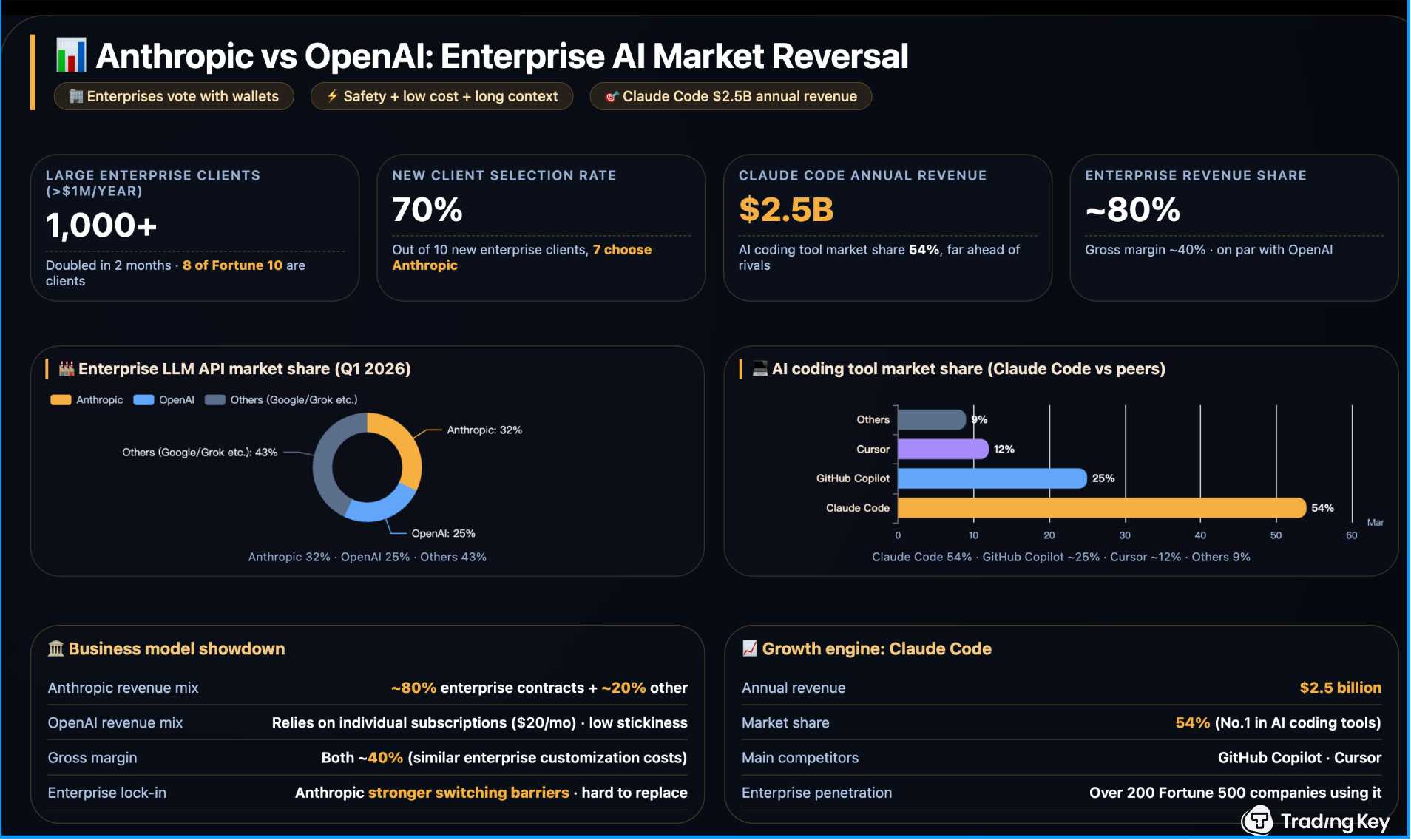
- 1,000+ major customers: The number of enterprise customers spending over $1 million annually on Anthropic doubled in just two months. Eight of the Fortune 10 are its clients.
- Market share reversal: In the enterprise LLM API market, Anthropic accounts for 32%, compared to OpenAI's 25%. Seven out of every ten new customers choose Anthropic.
- Flagship product Claude Code: It holds a 54% market share in the AI programming tool segment, with annual revenue surpassing $2.5 billion—far exceeding GitHub Copilot and Cursor.
Why do enterprises favor Anthropic? Because its models are more secure, lead the industry in long-context reliability, offer lower inference costs, and provide corporate customization. Once enterprises adopt them, they are difficult to replace.
In contrast, OpenAI is more dependent on individual subscriptions ($20/month). Approximately 80% of Anthropic's revenue comes from enterprises, with gross margins of around 40%, which is essentially on par with OpenAI.
II. What Does 3.5GW of Compute Capacity Mean for Anthropic?
What AI companies lack most is not algorithms, but electricity and chips. For Anthropic, 3.5GW is more than just a figure; it is a critical move in a computing power arms race that concerns the future.
Anthropic's demand for computing power is skyrocketing. Broadcom CEO Hock Tan revealed during last month's earnings call that Anthropic's TPU computing demand will be approximately 1GW in 2026 and will surge to over 3GW in 2027. Securing 3.5GW in advance is equivalent to purchasing "computing power insurance" for the next two years all at once.
More importantly, Anthropic is not putting all its eggs in one basket. It utilizes three separate streams of computing power:
- AWS Trainium
- Google TPUs (supplied via Broadcom)
- NVIDIA GPUs
Anthropic stated clearly in its statement: "We train and run Claude across various hardware types including AWS Trainium, Google TPUs, and NVIDIA GPUs, which means we can match workloads with the most appropriate chips to offer better performance and resilience to our customers." This "multi-platform strategy" protects it from price hikes or supply disruptions from any single provider—and it is the world's only company capable of providing frontier AI models across the three major platforms: Amazon ( AMZN) Bedrock, Google ( GOOGL) Cloud Vertex AI, Microsoft ( MSFT) Azure Foundry simultaneously. For enterprise customers relying on Claude to handle core business operations, this translates to superior performance and enhanced system stability.
In contrast, OpenAI is not nearly as flexible. According to financial documents obtained by The Wall Street Journal, OpenAI's computing expenditure will reach as high as $121 billion by 2028, with a projected loss of $85 billion that year; it is not expected to break even until 2030. Even more troubling is that ChatGPT has approximately 900 million weekly active users, with free users accounting for about 95%—meaning massive inference costs cannot be covered by revenue.
While Anthropic is also burning cash, the 3.5GW secured in advance provides it with more breathing room. However, Broadcom explicitly added a key note in its SEC filing: the scale of computing expansion depends on Anthropic's "continued commercial success." In other words, 3.5GW acts more like a conditional "computing power option"—the faster Anthropic's revenue grows, the more computing capacity it can realize.
III. IPO Countdown: Anthropic Could Go Public as Early as October 2026
Anthropic's IPO has shifted from a question of "if" to "when".
Key Timeline: Expected to list in the U.S. as early as October 2026, with an estimated fundraising scale exceeding $60 billion.
Valuation Trends:
- September 2025: $183 billion
- February 2026 (Series G): $380 billion
- Pre-IPO Expectations: $400 billion to $500 billion
Underwriter Lineup: Top Wall Street investment banks such as Goldman Sachs, JPMorgan, and Morgan Stanley are all vying for underwriting roles.
Market forecasts indicate that, given its current growth trajectory, Anthropic is highly likely to become the world's most valuable AI startup by the end of 2026.
IV. Anthropic Profitability Predicament
High revenue does not equate to profitability. The shadows hanging over Anthropic are also clear:
- Exorbitant computing costs: AI inference costs are high, and with free users making up 95% of the user base, compute-intensive products have become a profit black hole. Data shows that while Anthropic's gross margin improved significantly from -94% in 2024, it is expected to be around 40% in 2025—still 10 percentage points below previous targets.
- Legal battles with the government: Refusing the Pentagon's request to modify safety restrictions led to being labeled a "supply chain risk." Although the court temporarily ruled the government exceeded its authority, the trouble is far from over.
Compared to OpenAI, Anthropic's cash burn is slower and it has fewer internal conflicts, but both face the same core problem: Revenue is surging, but so are losses. Raising capital through an IPO is not just for expansion, but for survival.
V. Changing of the Guard: The Secondary Market Is the Ultimate Test
Anthropic’s annualized revenue surpassing OpenAI’s is not a simple numbers game, but a victory for its business model— the enterprise-grade, high-stickiness route that is proving more potent in the early stages of AI commercialization. With 3.5GW of computing power locked in, its growth foundation is more robust than that of most competitors.
However, the profitability dilemma has not vanished. How much is a company with $30 billion in annual revenue and potential annual losses in the tens of billions truly worth in the public market? The answer will be revealed as early as October 2026.
At that time, the ringing of Anthropic’s IPO bell will not only seal its own fate but also set a new valuation benchmark for the entire AI industry.
Recommended Articles








Comments (0)
Click the $ button, enter the symbol, and select to link a stock, ETF, or other ticker.