


Tesla Officially Advances Terafab, Can New AI Chip Narrative Reverse Stock Price Pressure?



AI Podcast


Tesla's Terafab project signals a strategic shift towards an AI computing and robotics platform, aiming for 1 TW/year output and enhanced control over computing power segments. This move, including designing the AI5 chip, pushes Tesla beyond EVs towards vertical integration in AI hardware, offering potential cost optimization and supply control. However, the capital-intensive nature, execution challenges, and long ramp-up times are significant drawbacks. Despite the long-term narrative potential, Tesla's stock remains pressured by delivery concerns, rising capital expenditures, and negative cash flow outlooks, exacerbated by a challenging market environment for growth stocks.

TradingKey - Tesla ( TSLA) The Terafab project is officially moving forward, drawing market attention back to its AI chip and robotics narrative. However, while future possibilities are being amplified, Tesla's delivery pressures, capital expenditures, and cash flow issues continue to weigh on its stock price.
Yesterday (March 30), Tesla officially launched the Terafab project, which is expected to achieve a computing power output of over 1 TW per year.
Tesla's launch of Terafab sends a clear signal. Elon Musk is no longer satisfied with defining Tesla solely as an electric vehicle company; he is pushing it further toward becoming an integrated platform for 'AI computing power, autonomous driving, and robotics.'
What is the core of Terafab?
The true significance of Terafab lies not just in whether Tesla produces its own chips, but in its desire to control key computing power segments.
According to Reuters, Tesla is designing its fifth-generation AI chip, AI5, which will primarily serve scenarios such as autonomous driving, FSD, Optimus, and Robotaxi.
Previously, Musk stated on March 22 that Tesla and SpaceX plan to build advanced chip factories in Austin. One will produce chips for Tesla vehicles and Optimus robots, while the other will cater to AI satellites and space data centers.
In response, Musk claimed that even accounting for the full capacity of existing suppliers, it remains insufficient; Tesla may eventually need to build larger-scale wafer production lines to meet future demand.
From an industrial logic perspective, this move appears to push the 'EV manufacturer' a step further toward becoming a 'vertically integrated AI hardware company.'
The benefits are clear: chip supply becomes more controllable, and the cost structures for autonomous driving and robotics businesses are easier to optimize. However, the drawbacks are equally direct; such projects are extremely capital-intensive, and construction cycles, yield ramps, and supply chain coordination are all challenging. Musk himself admitted that no matter how much suppliers expand production, it will be difficult to fully keep up with Tesla's future needs.
Why didn't the market immediately buy into this news?
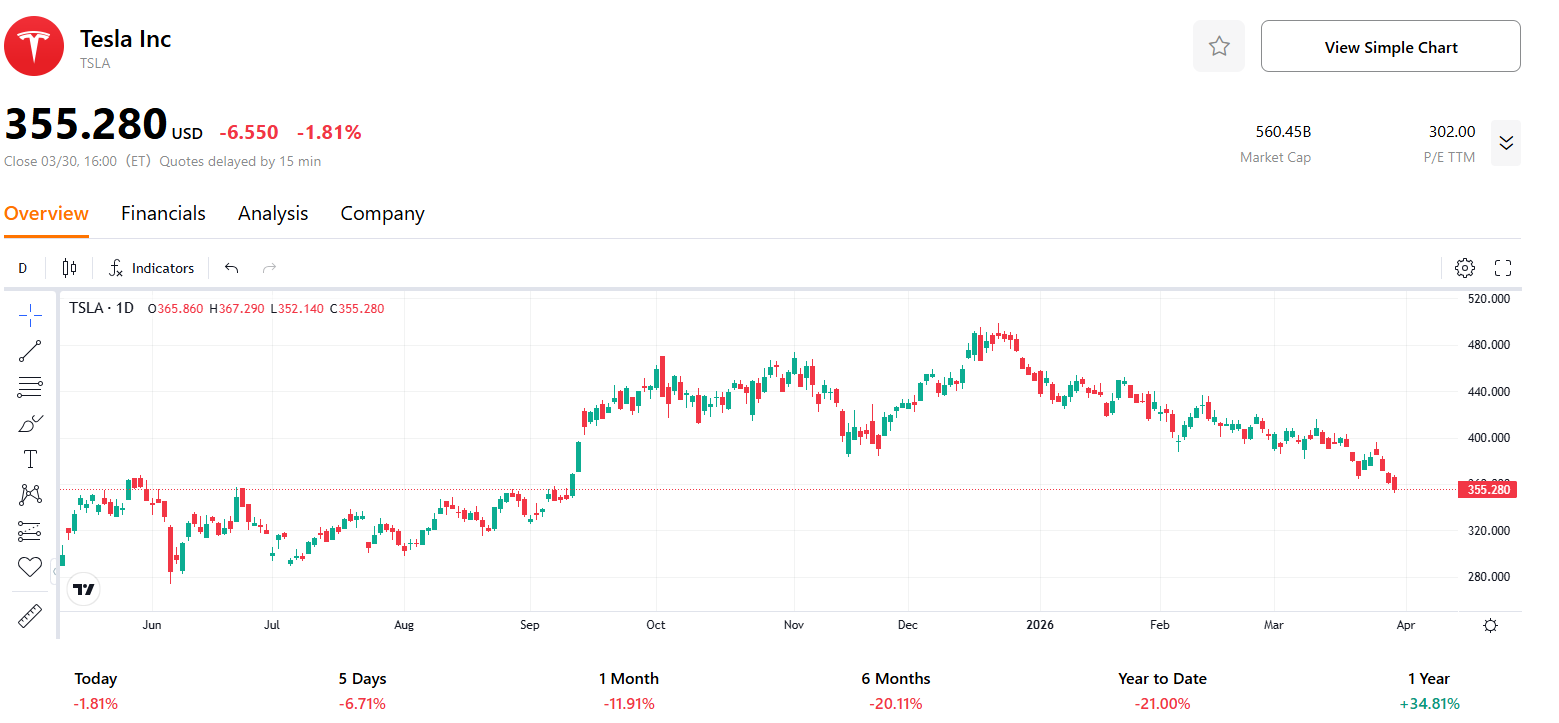
Based on the theme alone, Terafab is clearly a narrative with longevity, yet the stock price did not surge as a result. Tesla's share price is currently around $355.28, with a recent market capitalization of approximately $1.33 trillion and a P/E ratio still as high as 336x.
This indicates that the market's pricing of the company has long extended beyond automobiles, with a significant portion of its future value staked on autonomous driving, robotics, and AI chips.
Precisely because the valuation is so high, any sign of the 'narrative taking too long to materialize' is amplified by the market.
More troublingly, Tesla's own operational pace has not been easy recently.
According to Reuters, analysts are increasingly concerned that Tesla may see a third consecutive year of delivery declines in 2026, citing weak demand in the U.S. and Europe, reduced tax incentives, and the limited appeal of lower-priced, simplified models.
Meanwhile, Tesla plans to double its capital expenditures to over $20 billion by 2026, which could lead to its first negative cash flow in seven years.
Why has the stock price been weak lately?
Judging by recent trends, Tesla's decline is not due to the Terafab news itself, but rather being dragged down by the broader market environment.
Market data shows that Tesla rose 1.11% on March 16 following the Terafab launch news, but was subsequently pushed back down by Middle East tensions, a tech stock correction, and delivery concerns. On March 27, Tesla's stock broke support to fall to $361.83, a daily decline of 2.76%, and dropped a further 1.8% by March 30.
This is also related to the overall environment of the U.S. stock market. All three major U.S. indices have posted five consecutive weeks of losses, with tech stocks and the semiconductor sector under broad pressure.
At the same time, soaring oil prices, rebounding inflation, and cooling expectations for Fed rate cuts are once again compressing the valuation space for growth stocks.
Tesla is inherently a high-duration asset; once interest rate expectations tighten, its valuation is among the first to be affected.
What is the market focusing on regarding Tesla right now?
The market is currently focused on two aspects of Tesla: the very practical automotive business on one hand, and the long-term narrative of AI, robotics, and in-house chips on the other.
The problem is that the automotive business line has not been stellar recently, with mounting pressure on deliveries and cash flow. While the AI line offers immense room for imagination, projects like Terafab, AI5, Robotaxi, and Optimus are still in the investment phase and far from large-scale monetization.
Therefore, the significance of Terafab for Tesla's stock price is more about strengthening the long-term narrative rather than immediately improving financial reports.
If the project proceeds smoothly, it will reinforce Tesla's vertical integration capabilities in the era of autonomous driving and robotics; however, in the short term, the market is more concerned with whether deliveries can stabilize, whether cash flow will continue to weaken, and whether the high valuation can still be supported.
Overall, Terafab is positive for the long-term logic, but in the current market environment, it feels more like adding a larger story to Tesla while also raising the bar for execution.
Recommended Articles









Comments (0)
Click the $ button, enter the symbol, and select to link a stock, ETF, or other ticker.