


Hormuz 'De Facto Blockade' Spikes Oil: WTI Crude Rebounds to $90 as Mine Risks Stall Reopening



AI Podcast


WTI crude rebounded above $90 per barrel after Iran's de facto blockade of the Strait of Hormuz halted oil price declines. This reversal follows a sharp drop caused by earlier ceasefire talks. Iran cited ongoing Israeli airstrikes on Lebanon, deeming the current ceasefire fragile and further negotiations unreasonable. An Iranian military spokesperson indicated readiness for a long-term war if talks fail. The US maintains a strong military presence, awaiting compliance with any agreement. High tensions and uncertainty surrounding negotiations, particularly concerning sanctions and strait access, contribute to volatile crude oil prices, with potential for triple-digit prices if talks falter.

TradingKey - Sudden turn of events in U.S.-Iran ceasefire talks; oil prices rebound as WTI breaks above the $90 mark.
On April 9, Iran implemented a de facto blockade of the Strait of Hormuz, halting further declines in crude oil prices. WTI crude ( USOIL) rebounded nearly 1%, returning above $90 per barrel. Yesterday, the U.S.-Iran ceasefire agreement caused WTI crude to plunge over 17%, hitting a two-week low near $87 per barrel.
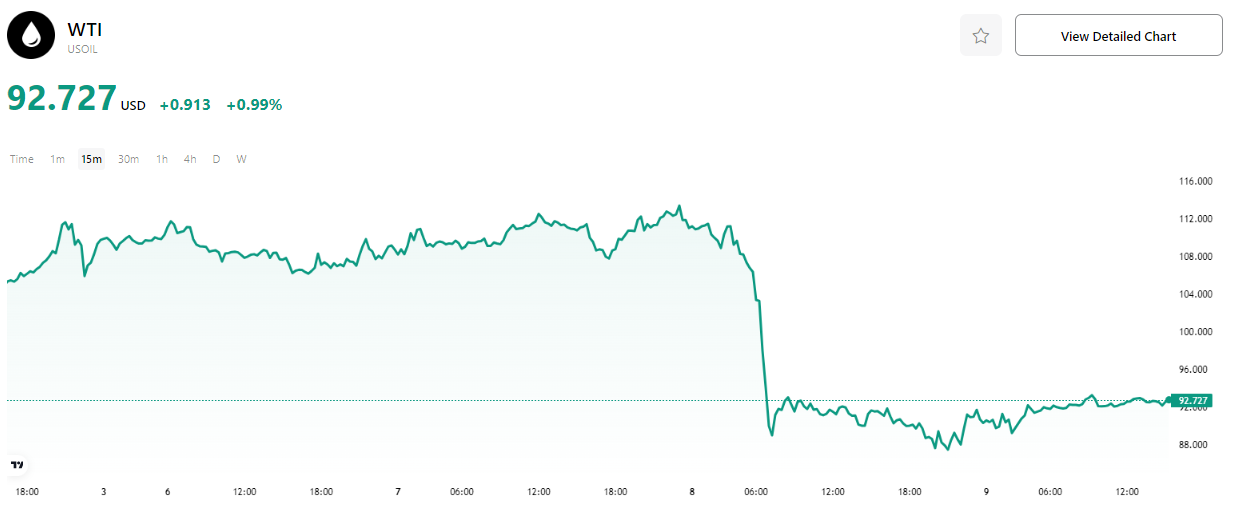 WTI Crude Oil Price Chart, Source: TradingView
Today, Iran once again asserted control over the Strait of Hormuz. The Iranian Revolutionary Guard Corps issued a maritime notice claiming significant risks from naval mines in main shipping channels, requiring all commercial vessels to navigate via designated "alternative routes."
The Iranian Ambassador to Pakistan stated that because Israel has not ceased its airstrikes on Lebanon, Iran views the current ceasefire agreement as extremely fragile, even calling further negotiations "unreasonable." Furthermore, an Iranian military spokesperson stated regarding the talks, "We hope to reach an agreement, but if negotiations fail, we are prepared for a long-term war."
Meanwhile, the United States remains on high alert. President Trump stated, "All U.S. ships, aircraft, and military personnel, along with additional ammunition, weapons, and any other appropriate and necessary supplies, will remain stationed in and around Iran until a genuine agreement is fully complied with."
Tensions between the U.S. and Iran are palpable, with hostilities potentially resuming at any moment. However, as neither side has officially withdrawn before formal negotiations, uncertainty remains high, leading to volatile crude oil prices. Investors should closely monitor the progress of the Islamabad negotiations on April 10. If Iran insists on "no lifting of sanctions, no opening of the strait," crude oil prices will return to the era of "triple-digit prices."
This content was translated using AI and reviewed for clarity. It is for informational purposes only.
Recommended Articles








Comments (0)
Click the $ button, enter the symbol, and select to link a stock, ETF, or other ticker.