


Is SanDisk (SNDK) Stock a Buy at $1,542 After Its Massive Earnings Boom?



AI Podcast


SanDisk (SNDK) experienced a surge, closing at $1,542.24, supported by strong fundamentals and technicals. The company, recently re-established as an independent entity, benefits from a global memory trade boom, with prices increasing over 130% quarter-over-quarter. Strong ROE (47.01%) and ROIC (42.08%), coupled with ample liquidity, underscore its financial strength. A successful retest of its ascending channel support at $1,463-$1,500, along with positive oscillator divergence, indicates potential for further upside towards $1,677 and beyond. Institutional accumulation suggests a favorable risk/reward profile for growth investors.

TradingKey - On May 21, SanDisk Corporation (SNDK) surged 10.75% to close at $1,542.24, pausing just under its fresh records after what appears to be a significant transformation cycle. The 2-hour chart shows a bullish hammer formation, confirming that a retest of the lower end of its sharp ascending channel, now hovering between $1,463 to $1,500, was successful. This support is tested while fundamentals are also at a new high, with the independent chipmaker noting a more than 130% increase in prices compared to the previous quarter amid a global memory trade boom.
SNDK still has a few major dynamic moving average supports holding beneath it, while the oscillator at the base of the price action sits in neutral territory but with strong positive divergence on the pullback so far. The current pause seems to be a good one. The challenge, of course, is determining if this flag-type setup is a good entry point for the next stage toward $1,677.
First-half 2026 results, the memory trade supercycle, explain why SNDK has rocketed
SanDisk's numbers through the first half of 2026 illustrate a major transformation in the organization. After being part of Western Digital since 2016, SanDisk was carved out as an independent, public company in 2026, now joining the ranks of the top five providers of NAND flash memory semiconductor devices worldwide. The vertically integrated chipmaker, operating within a powerful manufacturing joint venture with Kioxia in Japan, is well positioned to meet the rising tide of enterprise demand for flash chips converted into higher-density solid-state drives (SSDs) for cloud computing, artificial intelligence (AI) and other consumer technologies.
The fundamental story behind this repositioning is incredibly strong. As the company noted in its latest earnings report, SanDisk turned in what Wall Street analysts dubbed a “blowout” quarter. A combination of tight global supply and new cloud architectures saw product pricing surge more than 130% compared to the prior quarter, while year over year, the figure accelerated more than 200%. Such pricing dynamics have turned SanDisk into a highly profitable entity, with a normalized 47.01% return on equity (ROE) and 42.08% operating return on invested capital (ROIC). With a current quick ratio of 3.41 and current ratio of 4.78, it has ample balance sheet strength to grow its capacity at will.
2-Hour Chart: Parallel Ascending Channel Maintains the Pattern
The 2-hour chart depicts a nicely defined uptrend. Unlike some more volatile risk assets, which have fallen from parallel ascending channels amid a broad economic slowdown, SNDK has formed a classic higher-high and higher-low structure within its current channel. The retracement from last week’s high at $1,562 found immediate support off the confluence of a blue channel line on the lower end and a black ascending trendline off the lows seen in early May.
A group of dynamic moving average supports sits just above these levels. The short-term, red moving average offers dynamic support between $1,371 to $1,400, while the longer-term, blue moving average lags at a deeper level, between $1,188 to $1,247. Meanwhile, the bottom oscillator sits in neutral range between 53 and 68, which was confirmed during the intraday retracement by the presence of clear positive divergence.
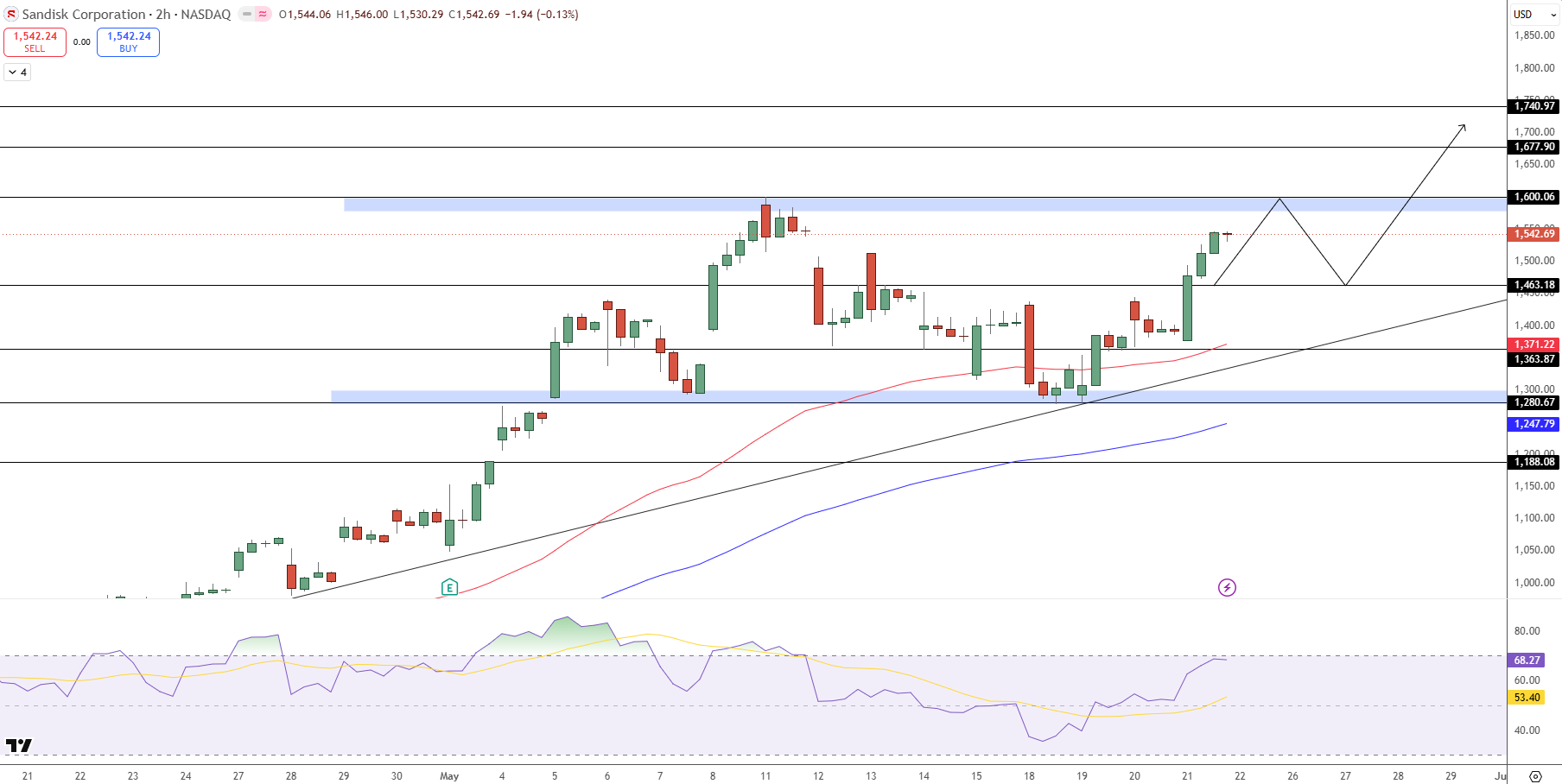
SanDisk (SNDK) Price Chart - Source: Tradingview
Such divergence suggests that the downside is exhausted, meaning there are many more opportunities for an upside continuation well before SNDK enters the overbought zone. Resistance is next expected near $1,600 to $1,677, followed by $1,740 to $1,850.
● Long: Buy above $1,550, the lower end of the channel holds
● Target: $1,677, recent highs, with a further extension expected next
● Extension: $1,740 to $1,850, upper parallel channel trend line
● Stop: Beneath $1,463, breakdown of trend structure and channel loss
Why did SanDisk shares hold up near $1,542 on May 22?
At $1,542.69, the stock fell 0.13% as institutional buyers stepped in to protect the bottom of SanDisk's sharp, bullish trend channel after an initial period of selling profit. It's still very much in play with positive long-term momentum given that its separation into an independent enterprise was recently realized and the global demand surge in the chip industry that increased its sequential pricing by more than 130%.
Where is SanDisk's long term growth coming from?
Its integration with Japan's Kioxia and position in the top-five memory NAND manufacturers globally as the largest AI cloud and data centers have led to explosive growth in demand for its enterprise-class SSD products. Its ability to charge higher prices has resulted in year-over-year revenue growth that was more than 200%.
Should you buy SNDK at $1,542 after its successful test of support?
This technical set up has all the makings of a high-probability setup. The $1,463-$1,500 support zone, in which SanDisk successfully tested its support cluster inside an ascending channel, has no signs of a bearish reversal candle that would indicate a breakdown in the trend. The oscillator is neutral and has positive divergence, combined with outstanding financials such as ROE of 47.01% and blowout earnings momentum that make it an excellent risk/reward proposition for growth funds seeking a semiconductor exposure.
Summary
SanDisk's modest 0.13% pullback following a new ATH suggests that institutional buyers are accumulating rather than distributing. In addition, the stock has successfully separated into an independent enterprise at an opportune time to benefit from the cyclical upturn in the memory chip industry with pricing that has grown YoY over 200%, combined with its high margins.
The 2-hour chart shows a very clean, flat-based consolidation that has held strong in the lower blue channel support zone. Buying the stock with a trigger above $1,550 provides a well-defined strategy with clear profit targets at $1,677, $1,740. In a volatile, high-beta sector, SanDisk is well positioned for its cash flow generation and core market share advantage in memory chips and data storage, and it provides some of the best fundamental characteristics associated with the current hardware cycle.
Recommended Articles











Comments (0)
Click the $ button, enter the symbol, and select to link a stock, ETF, or other ticker.