


TSMC February Revenue NT$317.66 Billion, Taiwan Stocks Rally as Market Value Recovers NT$3 Trillion



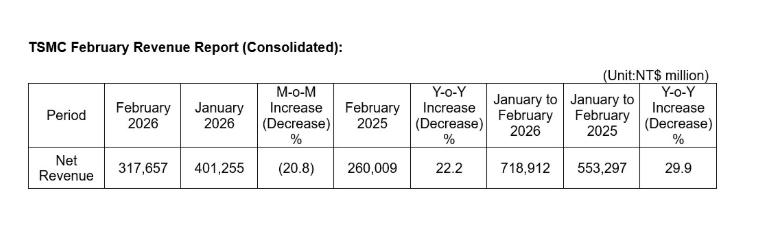
TradingKey - On Tuesday, March 10, leading foundry TSMC ( TSM) disclosed its latest revenue data: Monthly consolidated revenue for February reached NT$317.66 billion, representing a 20.8% decline month-over-month, but still achieving a solid 22.2% increase year-over-year. Cumulative revenue for January and February reached approximately NT$718.91 billion, a significant 29.9% increase compared to the same period last year.
On the same day, the broader Taiwan stock market staged a powerful rally, with intraday gains exceeding 1,000 points. TSMC (2330) emerged as the market leader, with its share price surging to NT$1,890, a single-day jump of NT$80. This marked the third-largest intraday gain in history, restoring over NT$3 trillion in market value in a single day.
In the overnight U.S. market, TSMC ADRs also closed up 2.89%.
Industry analysts pointed out that this rally was driven, on one hand, by the easing of geopolitical tensions between the U.S. and Iran, which significantly boosted market risk appetite. On the other hand, with Nvidia's GTC developer conference scheduled for next week, interest in the AI supply chain continues to heat up, and hot money that had been on the sidelines is accelerating back into leading blue-chip stocks.
TSMC has been highly active in advanced process technologies recently. Capacity for its N2 (2nm) process over the next two years has already been fully locked in by top-tier customers, with orders scheduled through the second quarter of 2027. Construction of the dedicated 2nm fab in the Tainan Science Park is also set to begin in the second quarter of 2026, accelerating the deployment of advanced nodes.
As a 'barometer' for the global technology industry, TSMC's earnings performance has long been regarded as a core leading indicator for tracking capital expenditures in the global tech and AI sectors.
The timing of this data disclosure is particularly notable, occurring as the U.S. and Israel launched military strikes against Iran. With geopolitical tensions in the Middle East escalating sharply, the market experienced temporary doubts regarding the long-term investment prospects for AI infrastructure—with core concerns focused on whether geopolitical conflict would slow the pace of data center expansion by tech giants, thereby impacting demand for high-end chips.
This content was translated using AI and reviewed for clarity. It is for informational purposes only.
Recommended Articles








Comments (0)
Click the $ button, enter the symbol, and select to link a stock, ETF, or other ticker.