


PNC Financial Services Group Inc Stock (PNC) Moved Down by 3.20% on Mar 6: Facts Behind the Movement



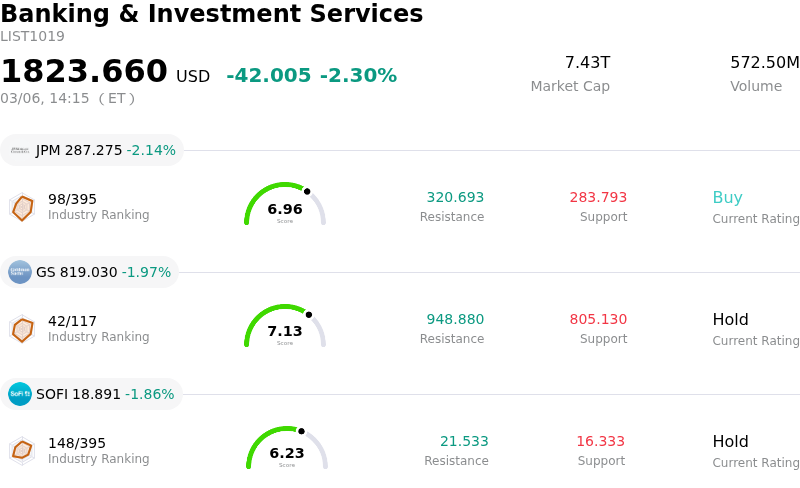
PNC Financial Services Group Inc (PNC) moved down by 3.20%. The Banking & Investment Services sector is down by 2.30%. The company underperformed the industry. Top 3 stocks by trading volume in the sector: JPMorgan Chase & Co (JPM) down 2.14%; Goldman Sachs Group Inc (GS) down 1.97%; SoFi Technologies Inc (SOFI) down 1.86%.
What is driving PNC Financial Services Group Inc (PNC)’s stock price down today?
The significant intraday volatility observed in PNC's stock, particularly its downward movement, appears to be influenced by a combination of evolving macroeconomic expectations, shifts in market sentiment towards the banking sector, and some company-specific activity.
A primary factor contributing to the negative sentiment is the reduced expectation for Federal Reserve interest rate cuts in 2026. Recent forecasts, as of early March, suggest the market is increasingly anticipating that the Fed will either implement fewer rate cuts or hold rates steady for a longer period than previously thought. This shift is driven by persistent inflation concerns, which have been exacerbated by a surge in oil prices stemming from geopolitical conflicts. A "higher for longer" interest rate environment can negatively impact bank profitability, particularly net interest income, as it may compress margins and potentially slow loan growth.
Furthermore, the broader market experienced a decline on the day, with major indices showing negative movements due to these escalating inflation fears and geopolitical risks. This indicates a general risk-off sentiment that tends to affect financial stocks. The banking sector, in particular, is navigating a transition phase from a period of higher rates to one of normalization, which could pressure net interest income for some institutions. There is also a discernible investor rotation away from banks with significant exposure to consumer credit card portfolios, partly due to potential regulatory actions.
The February employment report, released on the same day, showed a decline in jobs and an uptick in the unemployment rate. This data suggests a cooling labor market, which, while potentially easing some inflationary pressures, could also signal an economic slowdown that might impact loan demand and credit quality for banks.
While there have been positive developments such as a recent analyst upgrade from JPMorgan, increasing PNC's price target, and substantial institutional investment activity with firms boosting their stake, these appear to be overshadowed by the broader economic and sector-wide concerns. However, it is also notable that certain company insiders, including the CEO and an Executive Vice President, conducted significant share sales in February, which can sometimes be interpreted by the market as a cautious signal. The upcoming first-quarter earnings call in April for PNC could also be contributing to anticipatory market movements as investors await concrete financial performance data amidst these changing macroeconomic conditions.
Technical Analysis of PNC Financial Services Group Inc (PNC)
Technically, PNC Financial Services Group Inc (PNC) shows a MACD (12,26,9) value of [-0.58], indicating a sell signal. The RSI at 37.89 suggests neutral condition and the Williams %R at -77.97 suggests oversold condition. Please monitor closely.
Fundamental Analysis of PNC Financial Services Group Inc (PNC)
PNC Financial Services Group Inc (PNC) is in the Banking & Investment Services industry. Its latest annual revenue is $22.33B, ranking 24 in the industry. The net profit is $6.58B, ranking 18 in the industry. Company Profile
Over the past month, multiple analysts have rated the company as Buy, with an average price target of $248.03, a high of $284.00, and a low of $182.00.
More details about PNC Financial Services Group Inc (PNC)
Company Specific Risks:
- Wolfe Research downgraded PNC Financial from Outperform to Peerperform on Thursday, citing valuation concerns and a perception that the company offers comparatively less upside torque than other banks in its coverage universe.
- Recent significant insider selling, including by the CEO and an EVP, with over $14.8 million in shares sold over the last 90 days, potentially signals a lack of confidence from key management.
- The stock has experienced a 4.6% decline over the last 30 days, indicating negative market momentum and weakness despite recent news of strategic branch expansion.
This article may include AI-generated content that is human-reviewed, which is for reference and general information purposes only and does not constitute investment advice.
Recommended Articles




Comments (0)
Click the $ button, enter the symbol, and select to link a stock, ETF, or other ticker.